
A nervous Audrey Hepburn arrives on location in Spain to be greeted by Sean Connery in costume; director Richard Lester looks on.
I only ever saw one Audrey Hepburn picture in a theater—Robin and Marian, in 1976. I remember the big fuss made by her return to the marquee back then. I remember she had a bigger-than-life screen presence that began for me the moment she shed her nun’s habit and fluffed a poofy 1970s hairdo courtesy of Sergio of Rome. I understood then: This is a movie star I should respect. Unfortunately, I found the goings-on around her to be a mixed bag, most of it disappointing, as the screenwriter (James Goldman) and director (Richard Lester) set out to turn legendary characters into simple aging mortals with psychological problems. Give me Errol Flynn in sequins over balding Sean Connery in grime any old day.
I love Richard Lester. His The Three Musketeers is the film that changed my life. Robin and Marian did not change my life, except to prove that Lester was every bit as human as his Robin Hood and Maid Marian; it also revealed that Lester has at least one psychological screw loose that made him need to myth-bust beloved heroes of legend.
We could argue all day about Robin and Marian, because I’m sure some of you out there like or love it, but I have the battle scars of first run that include ownership to this day of the souvenir program, not to mention some emotional residue from a picture about heroes that ends with (spoiler alert) a murder-suicide.
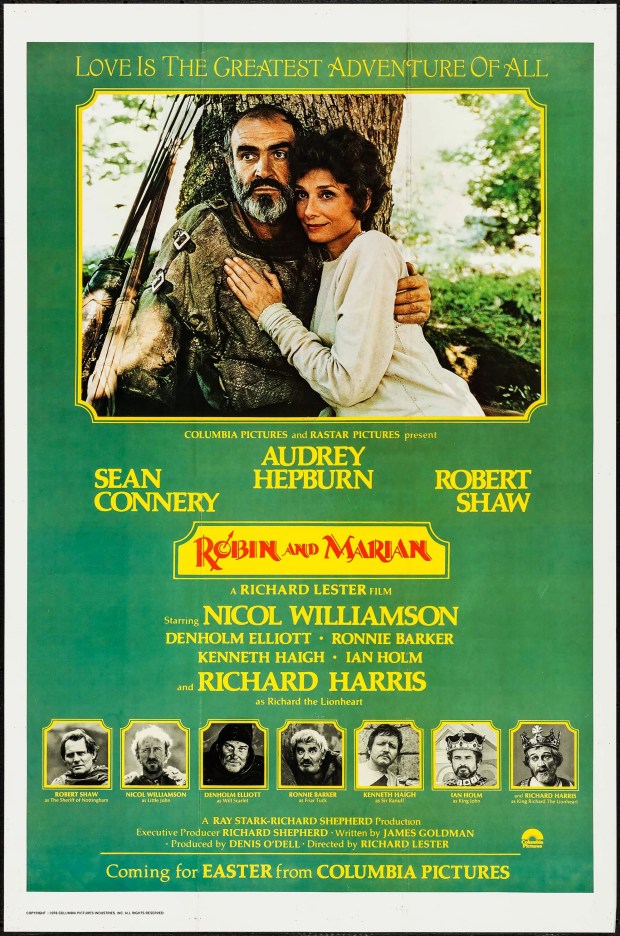
The advance once sheet with a hackwork tag line.
I’m here to talk about something mentioned in Dutch Girl: Audrey Hepburn and World War II (Buy your copy today!), and that’s Audrey’s experience actually making this thing in the heat of Spain after eight full years away from turning cameras. She had last worked on Wait Until Dark at Warner Bros. of Burbank during Jack L. Warner’s final coherent days ruling the last, most productive old-style Hollywood studio. Because Audrey was a pro who always showed up on time and knew her lines, she would have been a darling to J.L. She was spun gold back then and treated as such. Total star turn, including the best dressing room available—maybe even Bette Davis’s old second-story suite.
Flash forward to 1975 when Audrey met avant-garde Lester, veteran of heady successes like the Beatles’ A Hard Day’s Night and Help! in addition to A Funny Thing Happened on the Way to the Forum and his latest hits, The Three Musketeers and The Four Musketeers. Actually Lester was just past a total bomb of a picture called Royal Flash, the umpteenth spin on The Prisoner of Zenda and a career-killer for Malcolm McDowell and Alan Bates. Royal Flash hadn’t yet exploded in Lester’s face as he began principal photography of Robin and Marian; his ego rode as high as that of 007 Sean Connery when they initially greeted former Dutch girl-turned-Academy-Award-and-Tony-Award-winner Audrey Hepburn.
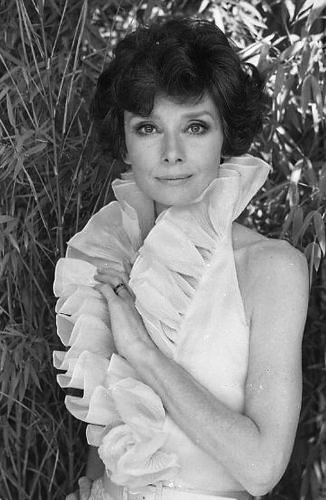
Audrey is photographed in Rome the same month as the Robin and Marian Radio City Music Hall premiere.
According to the Old School from which Audrey had graduated, a star was picked up in a car and delivered to an air-cooled dressing room. Food was anything requested; wardrobe by Givenchy crisp and tailored within a millimeter of its life; hair and makeup took as long as it took and she’d sit there and mark up her script and diligently go over her lines; all the while, the director patiently set up shots with the camera, conferring with his director of photography or DP. Gaffers ran cables; lighting men fussed with 8Ks and peppers. Retakes were the norm, as many as it took until the director and the stars thought: Yes! That’s the one!
For Audrey, Old School filmmaking felt like Europe, like her roots with her family in the last vestiges of a fading Dutch aristocracy. Manners, curtsies, head coverings and white gloves.
Then came Dick Lester. Lester considered the script to be a filming aid rather than a bible. The fact that he liked to work fast had attracted Audrey because her sons, Sean and Luca, could be towed along for a quick, starring shoot lasting six or eight weeks during the boys’ summer vacation from school. But she should have been careful what she wished for, because Lester achieved his rapid work style by rolling multiple cameras to capture the master shot and over-overs all at once. This was fine by Connery, who didn’t like to rehearse anyway; Audrey had been groomed in the classic studio system by the old masters—William Wyler, Billy Wilder, Fred Zinnemann, etc.—and simply didn’t know where to focus her energy and spent the entire Lester production off-balance.
Lester shot most of Robin and Marian out-of-doors in natural light supplemented by Thomas Edison whenever possible, and it wasn’t always possible. Audrey Hepburn hadn’t benefitted from a lot of formal education in her life, but she knew the laws of gravity as they applied to her 46-year-old face. Sure, she would tell you she never liked her looks and mean every word of it, and yet she was as vain as the next girl about the face that had made the career. As a result she had developed a growing reliance as years passed on the DP of each of her pictures to shoot her with optimized lighting in the best, most attractive angles for the contours of that face. It was always better to charm the DP at the first opportunity, Audrey knew, because even in a bad picture you’d look good as a result.
Well, the only scene in which she was guaranteed not to look bad in Robin and Marian was a dusk exchange with Nicol Williamson’s Little John when DP David Watkin misjudged the fading available light and Audrey disappeared into the dark forest undergrowth of a scene that even in the theater as a kid I knew was a problem. “I can’t see them. I can’t see anything.”

How could you do this to Audrey Hepburn?
As early as the costume fitting, Audrey sensed trouble. There was just one costume: a potato sack of a nun’s robe and undergarments. There was no Givenchy in sight because Lester’s usual costumer, Yvonne Blake, had, according to Lester, “been at pains to give it [the robe] a medieval look, rather than a couture finish, by sewing it together with bone needles. I watched Audrey slip it on and stand in front of the mirror and then, with hope that it could be improved, ever so slightly, into something that a 12th-century Givenchy might have blessed with his scissors, she twitched and tugged and tucked it this way and that. She finally resigned herself to the unyielding form.”
This was just one of many indignities for Audrey on the production. Lester and Goldman had blown up the charming script that had nudged her out of retirement in the first place, and now it was time for Lester to encourage the ad lib. Oh sure, he would allow of Hepburn, “She really was a good sport,” which she was. But this flippant attitude, treating Audrey Hepburn like any old plow horse instead of the thoroughbred she’d become, earning four Best Actress Academy Award nominations to supplement her win, shows Lester’s arrogance and lack of empathy.
“After all,” he said blindly, “she had been away from the screen for eight years. Filmmaking had changed a lot in that time.” And yet he continued to horse-whip her through the Spanish fields and forests that doubled as Nottinghamshire.
The rushes became another issue. On past pictures, the director and stars would look at the rushes to gauge performances and tweak as needed. Lester didn’t work that way. The exposed film went straight from the cameras to the edit suite of Lester’s cutter, John Victor Smith, who was putting the picture together on the fly.
A mere nine months later, in March 1976, Robin and Marian premiered at Radio City Music Hall in New York City. The occasion as attended by Audrey must have felt like any other, but even though the calendar said spring was in the air, for Audrey it was autumn. If you look at Audrey Hepburn’s filmography, this was her last viable dramatic role. She knew now, looking at herself as captured by Richard Lester and David Watkin, that her career as a leading lady was over, that filmmaking had indeed passed her by.


 Robert Matzen