Author: rmatzen

Award-winning author of the international bestseller "Dutch Girl: Audrey Hepburn and World War II" as well as "Mission: Jimmy Stewart and the Fight for Europe" in 2016, "Fireball: Carole Lombard and the Mystery of Flight 3" in 2014, "Errol & Olivia" in 2011, "Errol Flynn Slept Here" with Michael Mazzone in 2009, and three other books.

Fear of Flying

I didn’t expect to be writing another column about Mary Johnson Savoie, the girl who lived, but she passed on Thursday night, two weeks shy of her 95th birthday. To refresh your memory, Mary is a survivor of TWA Flight 3, the DC-3 that crashed on January 16, 1942 killing 22 people, including Carole Lombard. No, Mary didn’t walk away from the crash. She was bumped from the flight during a refueling stop and a serviceman with priority status took her seat. The serviceman died; Mary did not.

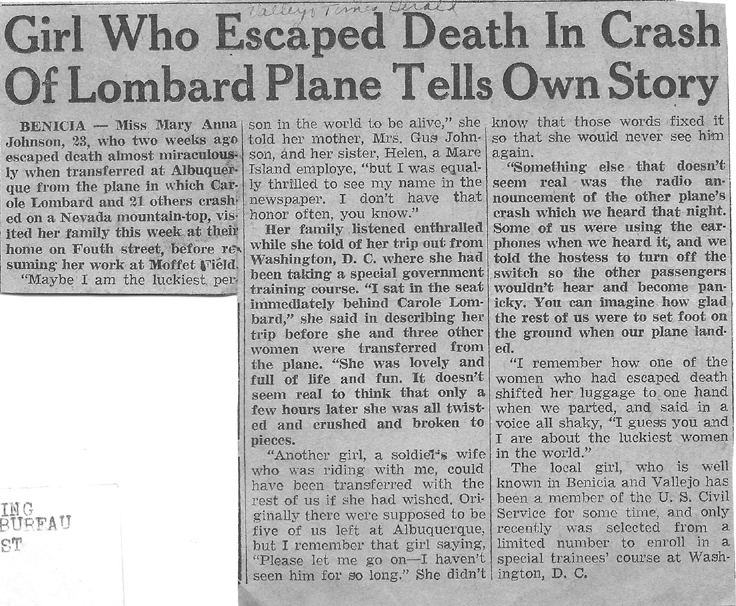
A local California newspaper reporter wrote on January 17, 1942, “Today, Carole Lombard, idol of millions, is dead, and little Mary Anna Johnson of Benicia, whom millions do not know, is still alive. In a little New Mexico city called Albuquerque, Fate held out its hand—and then waved back Mary Johnson.”

Mary-clipping

How Mary Johnson did live. Survivor’s guilt? She felt sorry for those who perished, but chose to look on the bright side, summing up decades later, “I’ve always been lucky.”

Fear of Flying? That would be natural after such a close brush with death. Not Mary. She loved to fly before the crash and loved to fly after it. “I took a plane to San Francisco the next day,” she said with a shrug. “No problem.” Then she added, “Some people might have taken the train, but trains have crashes too.”

In an era where women aspired to find a good man and settle down, Mary graduated from college and became a working girl. After the war, she told me, grudgingly it seemed, she “met a Cajun” and that was it for her career. Lee Savoie snagged the girl who lived, and they were married for a while and had a son. But the marriage didn’t take and they divorced—and remained close friends for the remainder of Mary’s life. Mary had a lot of friends and a wonderful family, and they represent the finest group of people I have ever met.

Mary’s friend Pamela Weir said of her back in December: “Mary has a spirit of adventure. She finds adventure in everyday life, always. It could be going to lunch, but there’s always adventure. She creates it or she finds it.” In fact, Mary loved the experience of helping with Fireball, and being a part of the narrative, and holding a copy in her hands. She found working with me to be yet another adventure.

Marie Earp is the one who connected me with Mary’s family, allowing her story to be included in Fireball. Said Marie, “Mary is and always was lovely, daring, exciting, and chock full of life. I think she did it all at one time or another. Carole Lombard was ‘another Mary’ in my book.”

Marie makes a great point: Mary and Carole were peas of a pod and shared many traits. Both were attractive, energetic, humorous, met life head-on, took each day as it came, loved hard, and surrounded themselves with people of high quality. I can’t say whether Mary lived life recklessly like Carole did because I only met Mary near the end of her life. Then again, if you get to almost 95, it means you made a great number of right decisions and no fatal ones.

Savoie-6

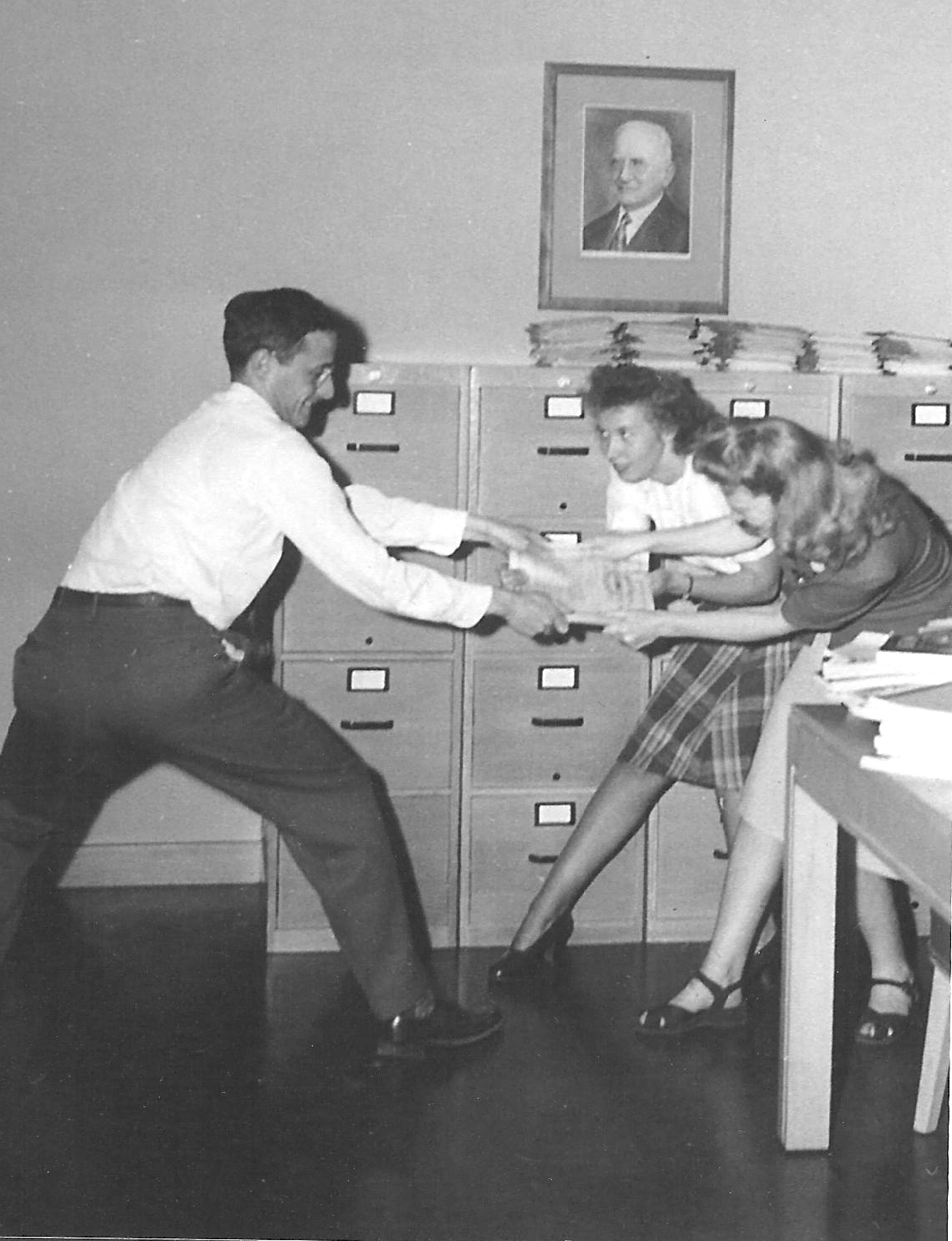
In the photo above, Mary (in plaid skirt) clowns in Lombard fashion with an aeronautics researcher reluctant to return a research document he had borrowed from the NACA library at Moffett Field, California.

For this column I tracked down Mary’s own encapsulation of a long, successful life as related to me. “I can sum it up in a sentence,” said Mary. “I rode a camel to the pyramids of Egypt; I rode an elephant in India; I rode the Bullet Train in Japan; and I walked the Great Wall of China.”

Mary’s story reveals what was lost with the crash of Flight 3. Of the 22 people killed, 20 were under 40 years of age and most were in their 20s, as was Mary. These people were highly accomplished and on their way to destinations far beyond Burbank, where the DC-3 was scheduled to land. But, as Carole herself said on a number of occasions, “When your number’s up, your number’s up.” Twenty-two died on that remote mountaintop, while Fate granted Mary another 72 years and 1 month.

I’m not going to say that the world is a poorer place because Mary Johnson Savoie has left it. In fact, the world is a far better place for Mary having been here. Mary’s story lives on in Fireball and her spirit lives on in those fortunate enough to call her “Mom” or “Grandma” or “friend.” Boy, am I lucky to have been a friend, even if only for a little while.

Benecia-girl

The Girl Who Lived

I have done a lot of public speaking in support of Fireball, most recently this past Sunday at Way Public Library in Perrysburg, Ohio, just south of Toledo. I looked out on a large and enthusiastic crowd, especially for a snowy Sunday afternoon in the middle of the worst winter anyone can remember.

In case you don’t know, Fireball is the irresistible story of Carole Lombard’s hurly-burly life and the circumstances that led to her last fatal trip aboard TWA Flight 3 along with 21 other souls, which ended in catastrophe just west of Las Vegas on January 16, 1942. Reviewers are calling Fireball a thriller, a page turner, a heartbreaker, and a book that’ll make you cry. It really is. I didn’t realize it myself until I reviewed the audiobook and heard the story performed by national voice talent Tavia Gilbert.

But there are some smiles in Fireball too. On Sunday in Perrysburg I told the crowd that I had found a survivor of Flight 3, a woman who had flown cross-country with Carole Lombard on January 16 and lived to tell the tale. You should have seen their faces. Mouths hung open. There were even some gasps. I always liken this survivor to hundred-year-old Rose Dawson whose memories form the basis for the plot of Titanic. Mary Johnson is my Rose Dawson, and at age 94 the unknown survivor of a catastrophe.

Mary was, of all things, a young aviation researcher working for the feds and NACA (the precursor to NASA) at Moffett Airfield, California. She had been on assignment in Washington, DC, and was heading for home that fateful day. To show you what a small world we live in, I worked in the same wind tunnel (the 7×11 wind tunnel) at Moffett Field in 2007 and 2008 during my NASA years that Mary had worked in during World War II.

Mary Anna Johnson Savoie 4
Mary was in her seat on Flight 3 when Carole Lombard, Elizabeth Peters (Carole’s mom), and Otto Winkler (Clark Gable’s publicist) boarded in Indianapolis. Mary then flew all the way to Albuquerque sitting two rows behind Carole, enduring stops in St. Louis, Kansas City, Wichita, and Amarillo. These weren’t fun stops either. There were weather and cargo delays for the plane and Miss Carole Lombard was anything but happy.

In Albuquerque a big clot of Army Air Corps personnel needed to fly west and all seven civilians on Flight 3 were ordered off the plane to make room for these priority passengers. Mary Johnson and three others gave up their seats; Carole Lombard refused to surrender her three tickets, so she stayed on the plane, and Mary Johnson’s dream of seeing Clark Gable up ahead in Burbank ended in what was the worst moment of her young life. Then the unthinkable happened and, said Mary Johnson, “Suddenly Clark Gable didn’t seem that important.”

I caught up with Mary Johnson Savoie near the end of the Fireball project. She’s right up there with the most interesting people I’ve ever met—smart, funny, and possessing vivid memories of that winter’s day. Just a couple of weeks prior to seeing Carole, Mary had been at the White House where she laid eyes on FDR and Winston Churchill, and after living through the crash of Flight 3 she went on to a rich full live with a husband and kids and became a world traveler. Hers is one of the central storylines in Fireball and yet another of a hundred layers of irony in its pages.

For me it was the biggest kick in the world to hand deliver a copy of the book to Mary this past December, and it was clear to me by the wonderful people surrounding her that Mary is a wonderful person herself and glows with an attitude that embraces life. She has been known to say, “I’ve always been lucky,” but isn’t luck really about the decisions a person makes that sets the stage for magic to happen?RM-MJS

Right now, in Lake Charles, Louisiana, Mary is having some health challenges, and I hope you will take a moment to send some positive energy her way. The world needs Mary Johnson Savoie to be up and around and setting an example for all of us to follow, keeping it positive, showing us how to set the stage for good things to happen, and in general making the most of every single day because we just don’t know how many there’ll be.

Fireball’s Companion Piece

high-mighty-1a

Please tell me I’m not the only one who loves The High and the Mighty, John Wayne’s 1954 aviation picture made by his independent production company, Wayne-Fellows, and released and distributed by Warner Bros. I find The High and the Mighty to be an irresistible experience specifically because of writing Fireball and becoming immersed in mid-century aviation. Not much had changed between 1942 when TWA Flight 3 went down and the world of commercial aviation of 1954 as seen in the picture, when a flight departs Hawaii heading for San Francisco and all hell breaks loose.

By 1954 the quad-engined Douglas DC-4 had replaced the twin-engined DC-3, but both NC 1946, the DC-3 in Fireball, and the DC-4 seen in The High and the Mighty rolled off the Douglas Corp. assembly line in Santa Monica and first flew from Clover Field, also in Santa Monica. However, the DC-3 cockpit crew had been augmented by 1954; in addition to a pilot and co-pilot, the crew now included a navigator.

We get some nice exteriors of the Glendale Grand Central Terminal filling in for Hawaii and lots of shots inside an airport terminal of 1954, with its desk and station man and the stewardess on hand to get to know the passengers as they check in. It is a glamorous world of flight depicted here, with men in suits and ties and women in dresses and heels for their ocean-hopping commute. The pilots chain-smoke in the cockpit, and when a passenger pulls out a cigarette, the stewardess is there instantly with a light.
high-mighty-5

The High and the Mighty has some interesting parallels to Flight 3, which carried 22 people to their deaths. The DC-4 seated 44 passengers but the flight depicted in the picture carried 5 crew members (including an alternate pilot for the long flight) and 16 passengers for a total of 21. There was one stewardess on board, and she reminds me very much of Alice Getz of Flight 3. Co-pilot “Whistling Dan” Roman, portrayed by John Wayne, is described as an old barnstormer and airmail pilot who turned to commercial aviation. It’s a description that fits Flight 3 Captain Wayne Williams to a T.  A backstory in The High and the Mighty (one of many) has Roman surviving the catastrophic loss of a DC-3 he had piloted, a crash not dissimilar to that of Flight 3. As a result, Roman is busted back to co-pilot, and nobody quite trusts him. But at the critical point in the picture, it’s Roman who doesn’t crack because he’s been there before, and his experience pays off.

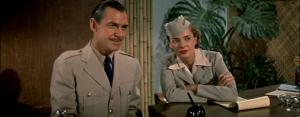
The flight crew mesmerizes me: Doe Avedon as stewardess Miss Spalding; William Campbell as the brash young 20-something alternate pilot; Wally Brown as the nervous burnout navigator; Wayne as the too-old co-pilot; and my old pal Robert Stack as the captain who’s highly skilled but just a little too willing to fold when dealt a bad hand.
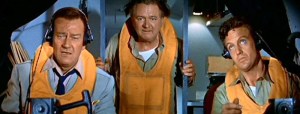
high-mighty

In a nutshell, TOPAC Flight 420 is flying east toward San Francisco from Hawaii and past the point of no return when an engine flames out, spilling fuel into the Pacific. It’s clear that the crew will have to ditch their plane hundreds of miles short of land and hope for rescue, and yet there’s a chance to reach the coast on remaining fuel if they can lighten the load and if tailwinds become favorable.

William Wellman directed an ensemble cast that included many heavy- and middle-weight motion picture actors of the golden age, headlined by Claire Trevor as a blonde show business star in furs not unlike you-know-who. Much of the goings-on don’t fit two-fisted Wellman, like the long, syrupy exchanges of dialogue revealing character backstories, with overdone reaction shots straight out of the days of silent cinema. Sure this becomes tedious in places and, yes, inspired some scenes in the 1980 masterpiece spoof, Airplane. But the screenplay’s got a lot of heart and before long we care about these souls who may soon be tossed into the sea. Up ahead at TOPAC headquarters in San Francisco, operations manager Regis Toomey waits. In real life both my parents knew Regis Toomey, who hailed from their Pittsburgh stomping grounds and went to Pitt some years prior to my dad’s arrival there. Talk had it that one of my mom’s friends dated Regis Toomey and so I always see him as a part of the family, and never was he better than here portraying the cranky, cigar-chomping airline official waiting to see if crisis-control will be necessary because his plane has gone into the drink.

CinemaScope adds a lot to the proceedings, as when the giant beast of a plane growls right at and then over camera on takeoff, filling the screen wingtip to wingtip. When you see magnificent shots of this big airliner lost in wide angles of blue skies and cloud tops, you understand where James Cameron may have gotten his shot of tiny Titanic from high in the sky and far off, lights blazing, against a big, ebony canvas of ocean.

I can’t get Dimitri Tiomkin’s musical score out of my head. It’s full of big, bold, blockbuster themes, one of which spawned several runaway hit records upon the film’s release.

I spent a lot of time in Fireball putting Flight 3’s last transcontinental trip in context: 15 years after Lindy crossed the Atlantic; 12 years after the first instrument landing; 11 years after the crash that killed Knute Rockne; 4 years after the disappearance of Amelia Earhart. Think about what you were doing 15 years ago, and 12, and 11, and 4. It’s a compressed timeframe for the evolution of something as important as aviation, with our corporeal selves suddenly high up in the air and vulnerable to going splat at any moment.

Flight 3 went splat at a time when the government and airlines were still figuring out how planes flew in the first place and what rules and regulations would assure that they stayed up and didn’t come down all-of-a-sudden-like. As a result, and as demonstrated in The High and the Mighty, flight crews received training on every contingency, including the loss of an engine and fuel dump on a long-distance flight, and how to ditch to save as many passengers as possible. By now, they had also figured out that a pilot and co-pilot had plenty to do without also navigating, and so airlines added a third man to the DC-4 crew whose job was to calculate head and tail winds, load, fuel consumption, course, and position, and feed this information constantly to the men in command of the ship. Everything just listed became a factor in the crash of Flight 3 when pilot and co-pilot had their hands full trying to get their over-packed ship with the movie star and Army fliers efficiently west toward a final destination. There they were, powering up to cruising altitude on a moonless night when disaster struck—disaster that would have been averted with a navigator on board to tend to little details like terrain and compass heading.

Ernest K. Gann, author of the novel The High and the Mighty, had been flying DC-2s and DC-3s for American Airlines at the time Flight 3 was lost, and the aero details in the picture are fantastic. The crew flying into San Francisco knows the altitude of the hills and radio towers on final approach because it’s their job to know, so this deepens the mystery of Flight 3 because those pilots knew the altitude of the terrain around Vegas. It was their job to know. When we see Stack, Wayne, and Campbell at the controls, it feels absolutely authentic because a pilot wrote the words and described the actions.

The crash of Flight 3 was a game changer in commercial aviation and well-known background for Gann since he was flying DC-3s and would have been briefed on the findings of the investigation. At one point in The High and the Mighty, Campbell and Avedon are talking about a DC-4 trying to ditch in the Pacific and fatalist Campbell says of a water landing, “You might as well crash into a mountain.” When John Wayne proposes that they not ditch and instead try to make it to SFO, Campbell reminds him, “This isn’t seat-of-your-pants flying days,” and that Wayne should “go back to your helmet and goggles.” It’s classic conflict: youth not respecting the experience of one who had flown way back in the era of the biplane and is therefore of no value flying modern ships in modern times. But it had been Wayne who first noticed vibrations signaling engine trouble; vibrations that meant nothing to Campbell.
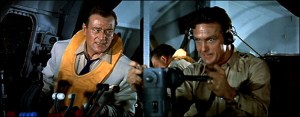
high-mighty-3

I intended Fireball as an ode to the 22 companions on that TWA DC-3. As with the characters in The High and the Mighty, every passenger and crew member on Flight 3 gets (at the very least) one moment to shine in the book because I wanted to honor them all. I feel that John Wayne’s movie can also be viewed as a salute to Flight 3 in glorious CinemaScope and WarnerColor as the determined pilots of a doomed airliner overcome grim odds and bring their ship home safely. It doesn’t take much imagination to see Capt. Williams and First Officer Gillette walking down the steps to look up at the belly of their DC-3 after a safe landing in Burbank like Stack and crew do at the end of The High and the Mighty. In my alternate universe, TWA Flight 3’s “ancient pelican” of a skipper gets to whistle safely off into the darkness as the music swells, his mission accomplished and his passengers all delivered safe. It’s a nice alternate ending for a real-life heartbreaker of a story, and so I guess my imagination helps to make the last scene of The High and the Mighty such a spectacular, smile-worthy, spine-tingling payoff.
high-mighty-4

Titan of the Twentieth Century

I had prepared another column to kick off my new blog, but learned that Shirley Temple had passed on last evening. The news hit me hard because every second I’ve been on the planet, I’ve been sharing it with Shirley Temple. Shirley Temple was a given, and now she’s not.

For anyone around my age (whatever that may be), Shirley Temple is half moppet and half cliché. My generation knows what an icon she was during the Depression. The generation behind mine is vaguely aware that once there was a child star named Shirley Temple. The generation after that hasn’t a clue what power the letters S-H-I-R-L-E-Y T-E-M-P-L-E wielded on a theater marquee from 1934 through 1938. This knee-high kid, around three-feet tall at her most popular, made tens of millions for 20th Century Fox and became the first personality, real or imagined, to have her likeness and adorable little self spun off into all manner of product, from the highly profitable Shirley Temple Doll to paper dolls to coloring books, magazines, writing tablets, record albums, and more. Whatever Shirley Temple was selling, people lined up to buy.

Then came this unwelcome thing called adolescence. As Shirley neared it, she started to grow and the cute factor reduced from a million to about, well, zero. I guess audiences experienced letdown that she dared be biological, and then betrayal that Fox continued to wardrobe this suddenly gangly 11 year old in little-girl dresses and force her to affect the time-tested pout and delivery. Boy, it must have been awkward for the masses, for Fox, and for Shirley and her mother, to spend years beating back the fame monster—and then to be dismissed by Fox and on the outside, hearing nothing but crickets.

Unexpectedly, puberty was kind to Shirley. Very kind. She re-emerged working for Selznick in 1944, and then made pictures here and there through the 1940s and became a hottie, which produced a new paradox: Wouldn’t any guy be a dirty old man for thinking the recent-moppet sexy?

With nothing left to prove in pictures and caught as she was in that purgatory of grown-up child star, she walked away from Hollywood at 21 and aspired to matrimony and motherhood. What a life she went on to live! In 1972 she experienced breast cancer and moved right past it, saying, “I have much more to accomplish before I am through.” She justified that pronouncement by becoming U.S. Ambassador to Ghana and then U.S. Chief of Protocol. She wrote her autobiography, Child Star, in 1988 and earned a SAG Life Achievement Award in 2006.

My own brush with Shirley Temple came in 1989 when I requested an autograph by mail. She was at that time akin to the Soup Nazi of autographs. If you followed certain protocol and sent a still photo and return envelope, you stood a reasonable chance to get something back. I did, and I did, a bold signature on a still of tiny moppet Shirley riding the shoulders of Carole Lombard. Shirley Temple Black read the signature, along with the year. When I first held it in my hands I could feel the weight of history, of greatness, but then I went back to taking Shirley Temple for granted, secure I guess in the knowledge she would always be around. After all, wasn’t she just a child star, so really, how old could she be? Well, old enough, I guess, because now she’s moved on, and we are left to reflect on a titan of the Twentieth Century. In fact, the littlest titan of all.

ST-autograph