Season of the Gods

Taking it to a higher plane

A good friend and colleague of mine picked up a sign on the WGA picket line in Hollywood the other day. That sign read on one side: AI WILL NEVER GIVE YOU and on the other side: CASABLANCA. He sent me a video showing the two sides of the poster because he knows how much I’ve been into Casablanca lately due to my new novel, Season of the Gods—which he had read in draft form months ago, offering key feedback for improvement.

Only through a historical novel could I get as close as I needed to get to the story of how Casablanca came to be. I wanted to understand its writers, Julie and Phil Epstein—that’s where this project started. Who were these guys who have already been lost to history except for a few well-worn anecdotes that have been spun into implausibility over the decades? Once, the Epsteins—“the boys” as everyone on the Warner Bros. lot knew them—were young, vital, ambitious, and living by their own code—and I needed to travel back there and walk around Hollywood with these guys to grasp the evolution of a masterpiece day by day.

Read the September 23 article in Air Mail.

Why can’t AI ever give you Casablanca? You’ll find all the reasons in Season of the Gods. A high school teacher named Murray Burnett wrote the stage play on which the film was based. On Broadway it didn’t need to contend with Hollywood’s morality code, and Warner Bros. story editor Irene Lee, nicknamed “Renie,” looked past the code when she purchased the play, figuring her writers would simply adapt key parts of the story and junk the rest.

Cue the hand-wringing.

Two veteran studio writers were assigned to the project and hit a brick wall because of the illicit sex that formed the foundation of the story. But the Epstein brothers, twins then age 32 and ready to conquer the world, all but begged production boss Hal Wallis for the assignment when the first two writers failed. Wallis granted the Epsteins’ wish and then they too got stuck. A third writer, political idealist Howard Koch, came aboard for new angles, and then a fourth writer, studio Cadillac Casey Robinson, stepped in and offered critique on the work of the other three. And still these four highly skilled craftsmen couldn’t figure it out.

Julius and Philip Epstein, who appear in Season of the Gods, a novel about Casablanca by Robert Matzen
Julius Epstein (left) and his twin brother, Phil, ready to take on the world.

Cue the ticking time bomb.

Irene Lee had sold Hal Wallis on the timeliness of a story set in North Africa, where Montgomery was battling Rommel. Wallis wedged the property he had retitled Casablanca into an already crammed production schedule. He couldn’t find actors—they were already booked on the other productions. He couldn’t build much in the way of sets or use real airplanes—wartime restrictions. All he knew was he had to make a movie and get it cut and release it, and the goddamn writers were holding him up! He gritted his teeth and started shooting a movie based on a partial script and kept a gun to the backs of his writers to figure out the ending!

Irene Lee, who appears in Season of the Gods, a novel about Casablanca by Robert Matzen
Warner Bros. Story Editor Irene Lee, who championed development of Casablanca.

Imagine you’re a fly on the wall of those story conferences, particularly the last one when Renie and her four writers had literally reached the end of the runway and would shoot something in the morning to represent the end of the story. They had filmed everything but the airport climax, and it had to make sense for the German to die, the freedom fighter to escape, the freedom fighter’s wife to leave the hero, and the hero to walk away free and clear.

As my WGA screenwriter friend said yesterday, “One of the things I find so interesting about your book is that it really is a celebration of the writing process—Casablanca, with its myriad contributors, seems like an early, unintentional example of the value of the writers’ room that is so much at issue.”

Could AI have reasoned out the ending to Casablanca? Could AI have written all the great lines the Epsteins created, lines that everyday people around the world have repeated on the job or at the dinner table for 80 years and counting? These zingers charm your pants off because you can’t see them coming. They’re human, revealing, self-deprecating, and ironic.

Season of the Gods, a novel about Casablanca by Robert Matzen
Ludwig Stössel, Ilka Grüning, and S.Z. Sakall, three famous European actors who had been driven to America by the Nazi regime. All were taken into the production at the urging of director Michael Curtiz.

Season of the Gods takes you inside studio walls, inside the writers’ room, inside the soundstage. You will meet the Epsteins, Renie, Wallis, Koch, Robinson, Bogart, Bergman, Lorre, and a dozen others who made this masterpiece come together despite the odds. You’ll walk a mile in the shoes of Dooley Wilson, watch refugees from Europe join the cast and weigh it down with loss and sadness, and learn how the Epsteins’ secretary saved the day at the very last moment. You will relive fateful months at the beginning of World War II, and you will understand for the first time exactly why we all love Casablanca so much—because of those who rose to a higher plane and brought it to the world.

Season of the Gods: A Novel, from GoodKnight Books.

Almost Ilsa

Have I mentioned that I’ve written a historical novel? Season of the Gods follows real people and actual events from 1941 and ’42, taking you inside the heads of key players at Warner Bros. studio during the golden age of Hollywood. The rough draft hit around 180,000 words and about 40,000 words got cut along the way, meaning entire story threads were lost. One of those storylines involved Michèle Morgan, an actress who gained a reputation in France working with international sensation Jean Gabin; Morgan came to the United States in 1941, after the Nazi occupation of France and before U.S. entry in WWII.

You probably have no idea how close Casablanca came to seeing Michèle Morgan as Ilsa Lund, with the only hang-up her asking price—RKO, which owned her contract, demanded $55,000 and wouldn’t budge; Ingrid Bergman, under contract to David O. Selznick, would cost only $25,000. Casablanca producer Hal Wallis had seen Morgan and Paul Henreid in the RKO wartime drama Joan of Paris during a screening at the Warner studio, where he was taken with both leading players. Morgan was a petite 21-year-old with topaz blue eyes who played well beyond her chronological age. In fact, when Paul Henreid first heard he would be working with Morgan in Joan of Paris, his mouth watered just thinking of the French sexpot. But meeting her in person he thought, My God, she’s just a young girl!

Morgan’s story fascinates me. RKO, the studio that had teamed Astaire and Rogers, imported Michèle because of her uniqueness, and then, once she arrived in Hollywood, her handlers worked tirelessly to obliterate that uniqueness. Change how you talk, how you walk, how you think, to become the French-girl stereotype that Americans expect. And she went through it alone, completely alone, a stranger in a strange land.

I believe Michéle Morgan would have been a dynamite Ilsa, whether walking into Rick’s Café Americain to knock Rick right off his pins, or hold a gun on him, or walk out of his life to board the plane for Lisbon. She would have been more vulnerable than the physically imposing Bergman, and edgier because of nerves that plagued Michèle’s career in the United States.

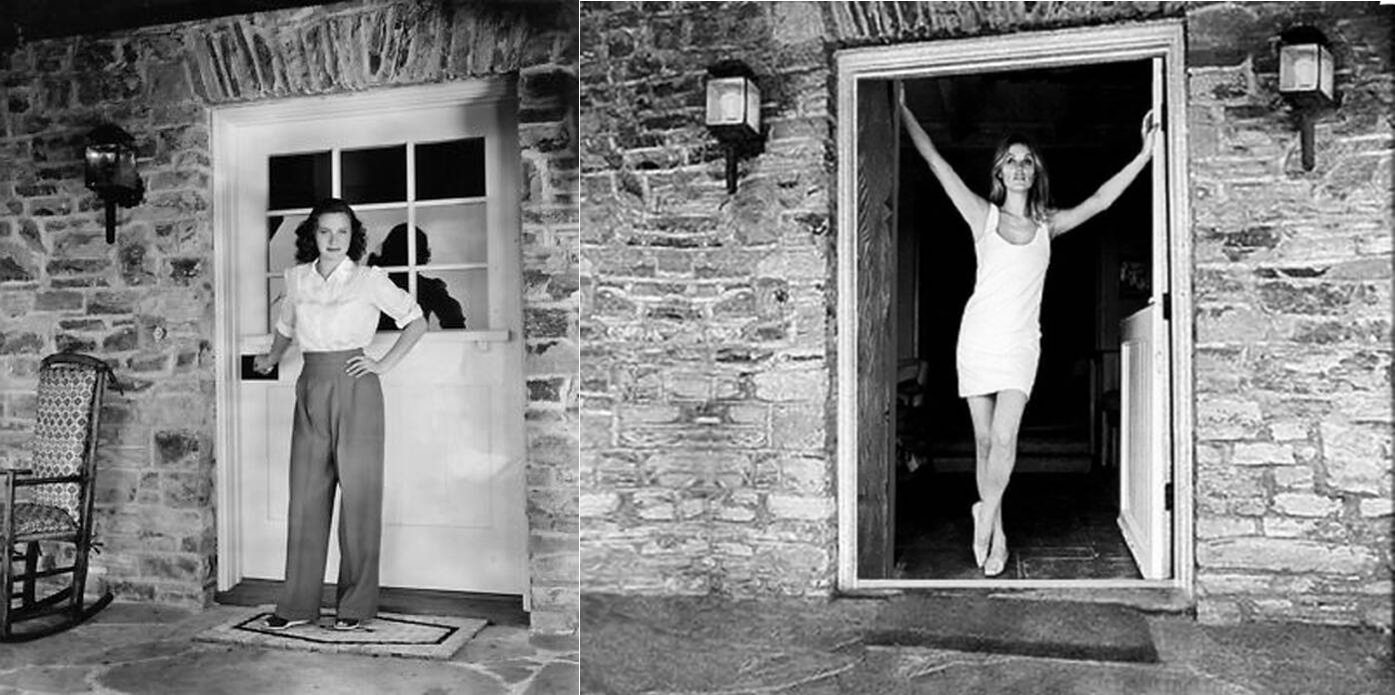
At left, Morgan at the front door of her new home in 1942; at right, Sharon Tate there 26 years later.

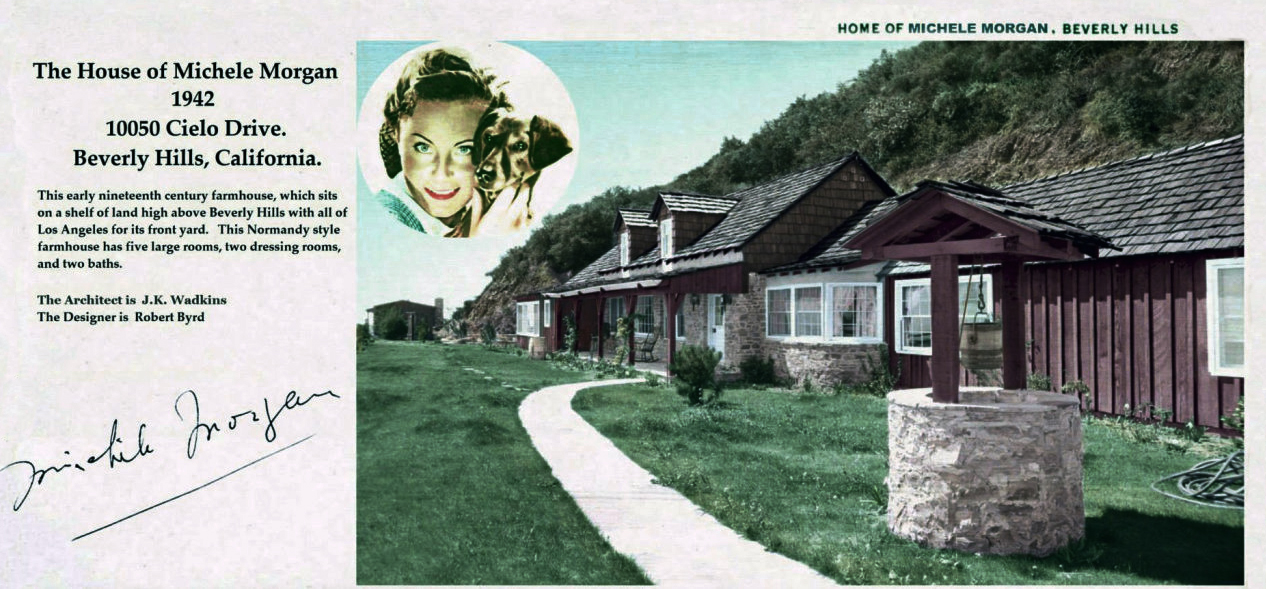
But the fact Michèle Morgan tested for and almost landed the role of Ilsa is only half the reason she worked her way into the storyline of Season of the Gods. The other involves the paranormal, and unspeakable evil, in the modest farmhouse Michèle built in November of 1941. The address was 10050 Cielo Drive in Beverly Hills, just off Benedict Canyon. In her autobiography, published in France, Morgan tells how her agent had advised she place her a new house on available cliff-side land at the end of a quiet street because its dramatic location would make good publicity, and indeed, many movie star magazines depicted every angle of the interior and exterior. However, in 1941, the spot was also remote. Very remote. She said, “This wild hill above Beverly Hills was quite isolated. I faced the former estate of Rudolf Valentino [Falcon Lair]. At the bend in the canyon was Ray Milland’s home, closer to Harold Lloyd’s. Still, I would have had time to scream for an hour and die 20 times before anyone heard me.”

Michèle poses in just about the spot Sharon would be found.

Despite the fact that the home was new construction and smelled of fresh-cut lumber, things went bump in the night immediately after move-in. She said, “In vain I reason with myself, tell myself that a new house, barely completed, cannot be haunted, but I am afraid.” It seemed logical there were prowlers—but no one was ever seen. She bought a guard dog, a Great Dane that took over the house but turned out to be as frightened as she was. Finally, her pal Madeleine LeBeau, another young French actress of only 18, moved in with Michèle so both could experience what they finally determined were ghosts. And, at that time, LeBeau was working on Casablanca as Rick’s friend with benefits, making another interesting storyline—LeBeau was cast in Casablanca while her friend Michèle was not—that I ultimately had to cut because of the length of the narrative.

Please note that the dog pictured is not the Great Dane that would sequester himself in her bedroom and bare fangs when she tried to reclaim her bed. As a result, she slept on the couch–the better to hear bumps in the night.

After Michèle Morgan married and sold the house, many Hollywood celebrities lived there as renters, including Lillian Gish, Cary Grant and his bride Dyan Cannon, and later, record producer Terry Melcher and his girlfriend Candice Bergen. It was during this time that a young musician named Charles Manson first stopped by the place, and aficionados of true crime know 10050 Cielo Drive all too well: on August 8, 1969, the Manson family would strike here and kill Sharon Tate and her friends Jay Sebring, Abigail Folger, and Wojciech Frykowski, along with random visitor Steven Parent.

Michèle Morgan returned to France after the war and enjoyed a long and decorated cinematic career. In 1969, when she heard where Sharon Tate had been murdered, Michèle was shocked but not surprised. In her book she asked, “How could a house without a past, which I had built, be haunted by its future?” An intriguing question, Michèle. I wonder that myself.

Season of the Gods will be released by GoodKnight Books on October 3, 2023.