Carole Lombard television

PASSION THAT KILLED

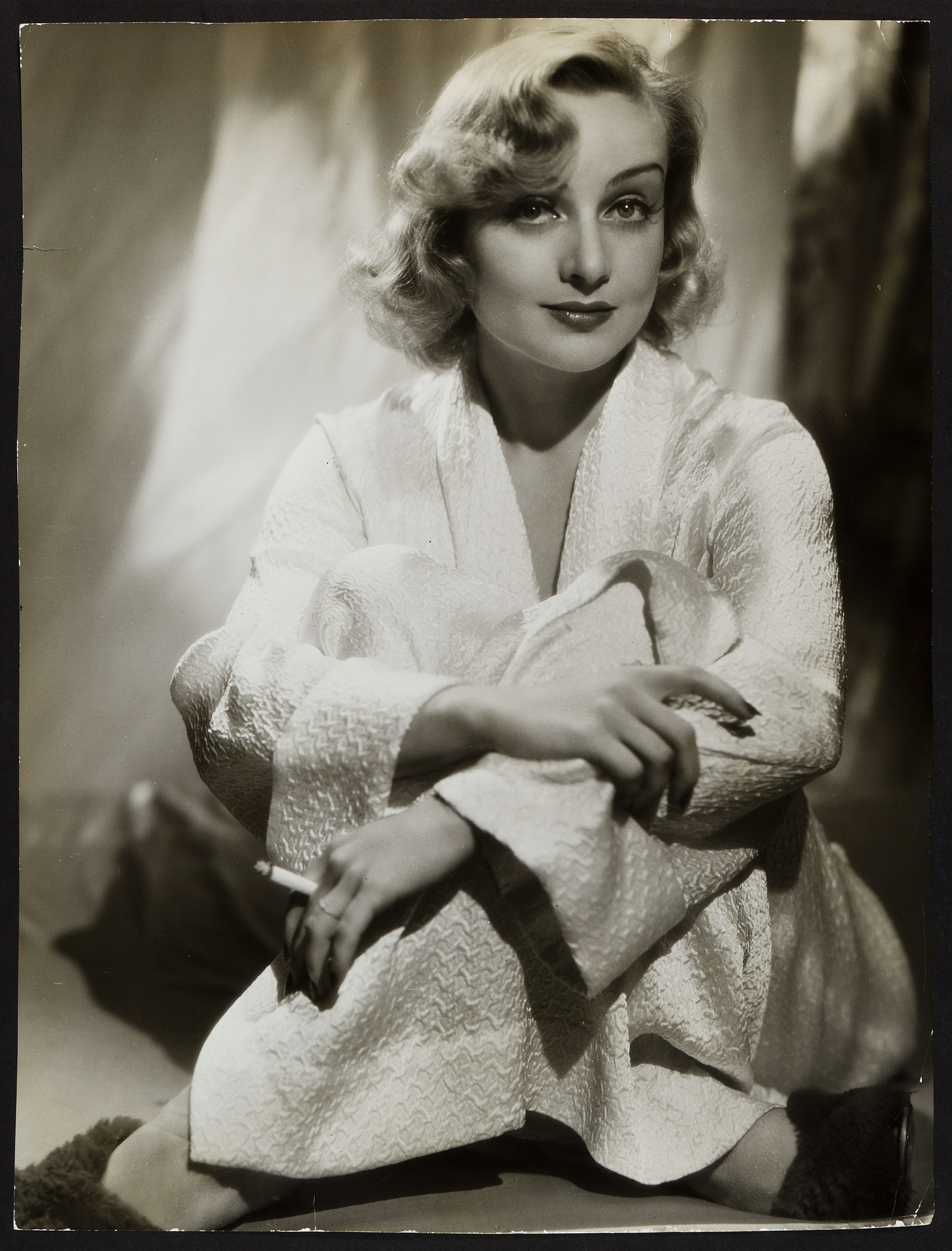
Star of the day, Carole Lombard, as usual, with a cigarette.

Can you believe it—it’s been 84 years since the plane carrying Carole Lombard and 21 others smacked into the cliffs atop Mt. Potosi, Nevada, 35 miles southwest of Las Vegas. I’ve spoken often about the climb I made to the crash site in 2012 over the route taken by first responders (I did it in October; they did it in a foot of January snow), as I’ve related how I heard—as in, actually heard—the people on the plane whispering to me while I was there: “Don’t forget about us.” That experience led me to track down the story of each of the 21 souls aboard TWA Flight 3 along with Lombard.

But today let’s focus on the former Paramount starlet turned free agent performer and American patriot who undertook a perilous trip from warm and secure Los Angeles to snowy Indianapolis via Chicago in deepest winter to sell war bonds. Remember, America had just been sucked into World War II six weeks earlier and she was first among Hollywood stars to hit the road for fundraising. She was a passionate woman in everything she did, which she said herself. In whatever pursuit, according to Carole, “I give it my all and I love it.” That same passion would kill her, ironically enough. She didn’t have the patience to take three days to return to LA by train after the big success of the bond sale, and so she demanded to fly home. Her handler for the trip, MGM publicity man Otto Winkler, secured three tickets to Burbank (Carole’s mother Elizabeth Knight Peters also along) on a TWA cross-country flight that hedge-hopped from LaGuardia west. They picked the plane up in Indianapolis early on January 16 and spent the next 12 hours flying, getting off the plane, stretching legs, and getting back on again. We’re not talking about an Airbus here; the cabin of a DC-3 was about as big as the interior of a mass transit bus, meaning everyone spent the trip uncomfortable and very cold despite cabin heaters. Oh, and deaf thanks to two big radial engines droning away three feet outside the fuselage.
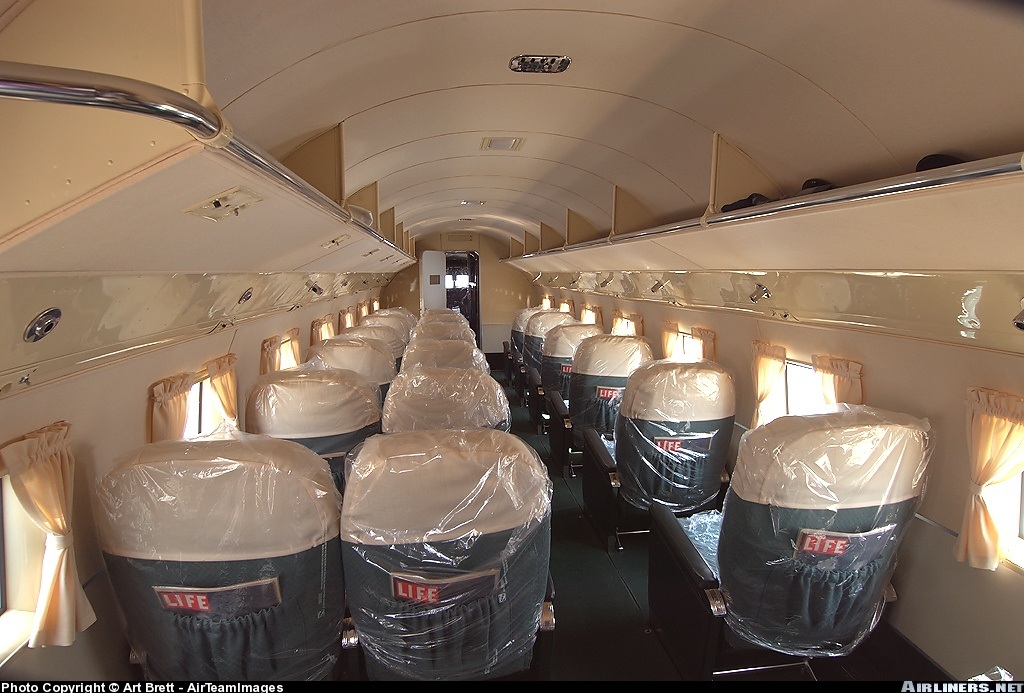
Interior of the restored sister ship to TWA Flight 3, which was only a few months old at the time of the crash. Room for 18 passengers, although I have to say, the seats look pretty nice compared to what we have today. (Photo credit to Art Brett, AirTeamImages and airliners.net.)

As documented in my 2014 book Fireball, the plane hit the mountain at about 7:30 p.m. local time on January 16. Initially rescue teams scrambled up the mountain hoping for survivors, but there weren’t any—although a few of the passengers had been tossed out of the plane into deep snow and may have lived past impact, if briefly. Carole was near the front of the plane and was found at the base of the cliff, under a wing.
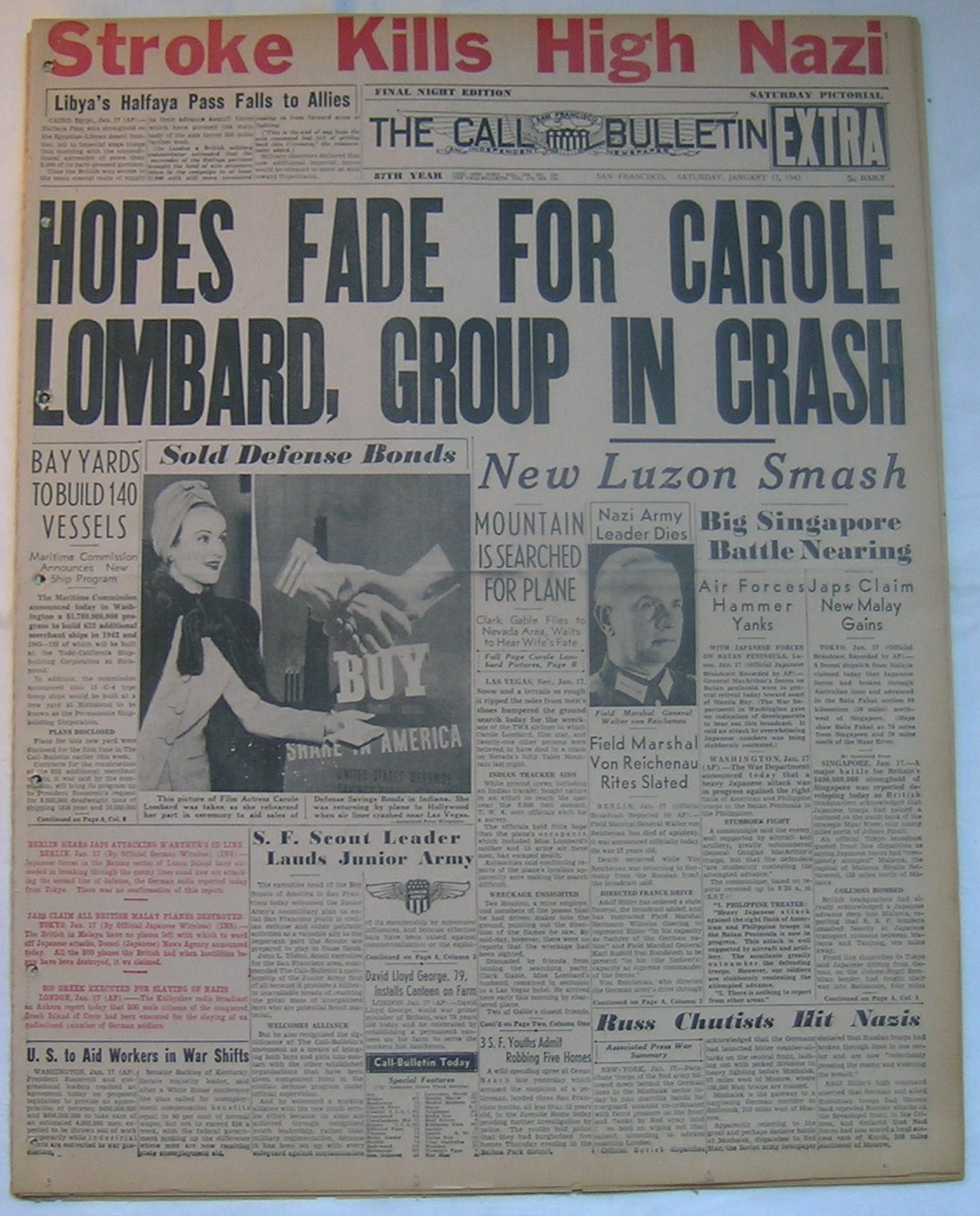
Initially, search teams started up the mountain with hopes of rescue–but rescue soon turned to recovery.

For Carole, time stopped at age 33, and I’ve often pondered what would have come next if she had lived. Her career was on a downswing, although the picture she had just made, To Be or Not to Be, was a brilliant sendup of life in Poland under Hitler. Hard to say if the world was ready to laugh at the evil one in great enough numbers to make the picture a hit, but it stands today as one of her three best films. After that, she was set to make a sequel of sorts to her 1936 screwball comedy, My Man Godfrey. It was to be called “My Girl Godfrey,” with Carole the butler this time. And then, who knows where she would have gone.

Here are my suspicions. I believe she would have been the one to blaze the trail that Lucille Ball established (neither Carole nor Lucy being singer/dancers). Some comedies, some film noir, and then, television with a capital T. Ball always credited Lombard as her mentor; Lucy said that Carole appeared in her dreams offering career-altering advice. I don’t put that past Lombard at all; she didn’t have the opportunity to master the new medium, so she did the next best thing.

Lombard was an OK dramatic actress but excelled at comedy. She was so naturally funny, with great timing, that success on the small screen would have been inevitable for Carole in her middle years given the prevalence of star-driven TV series of the 1950s. Loretta Young, Donna Reed, Gale Storm, etc. etc. Pushing back against that success might have been declining beauty, a la Paulette Goddard and Ann Sheridan, both heavy smokers. Sheridan grew so alarmed at her fading looks by the late 1950s that she resorted to cosmetic surgery and then resurfaced in the 1960s TV series Pistols N Petticoats before dying suddenly of lung cancer. And that was another risk for a heavy smoker, which Carole had been since adolescence.
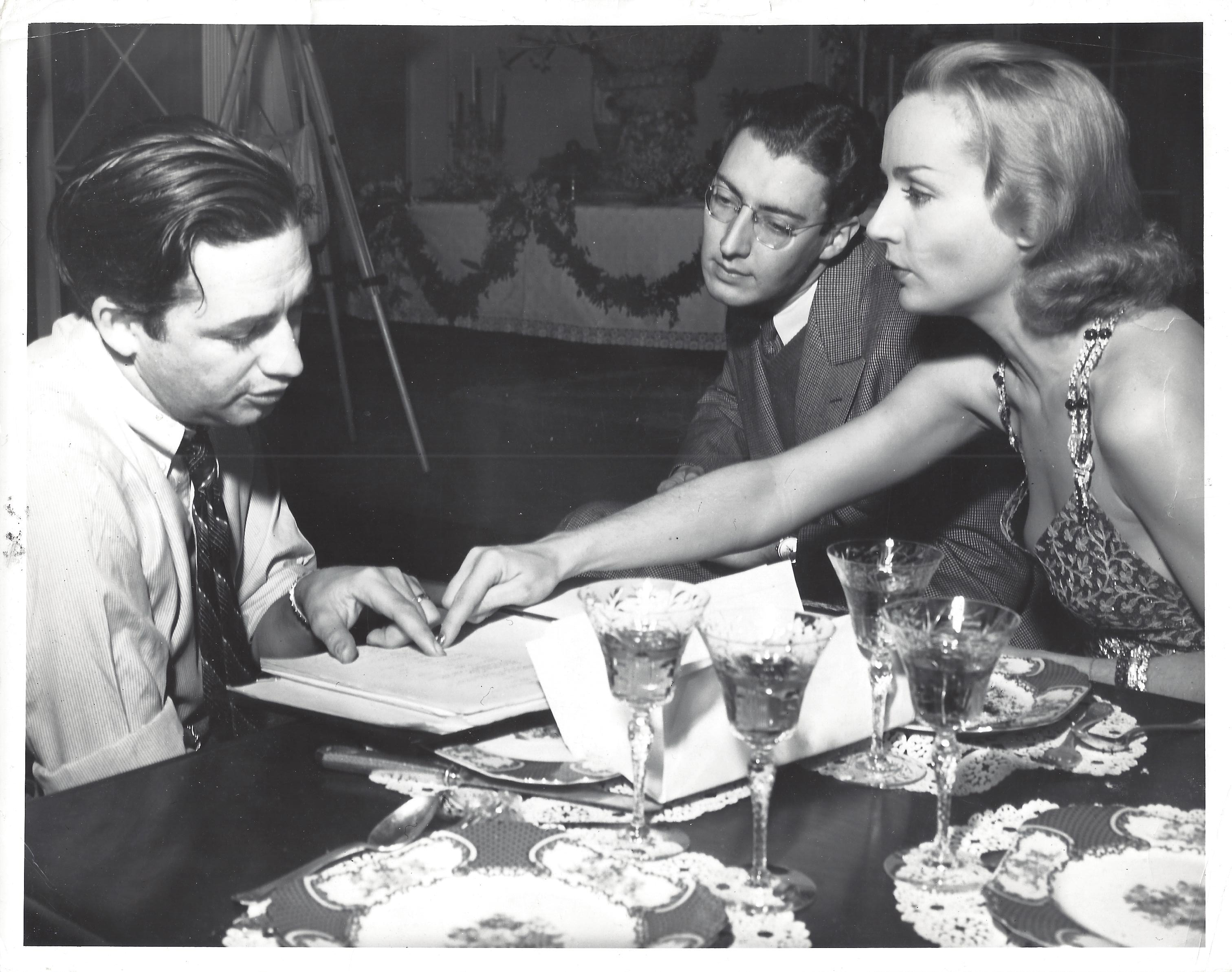
Lombard arguing script with director Mervyn Leroy in 1938. And no wonder, they were making her worst picture (Fools for Scandal) at Hollywood’s unfunniest studio, Warner Bros.

If she truly had gone the debauched way of, say, Talullah Bankhead, she could have slipped behind the camera as did Ida Lupino to direct features or television. She was whip-smart at the business end of Hollywood—witness the fact that in 1937 she was the highest-paid star in town without a resume to back it up.

I like to think, looking back on this anniversary, that Carole Lombard had another 40 years in her at least as a triple threat—actor/director/producer. Unfortunately, she gambled it all on the flip of a coin and lost. No, really, she flipped Winkler for it, heads the plane, tails the train. Let that be a lesson to all of us: There are consequences when you least expect them. If only you had taken that train, Carole, so that we could all have enjoyed six or eight seasons of The Carole Lombard Show, which would still be running today on MeTV.
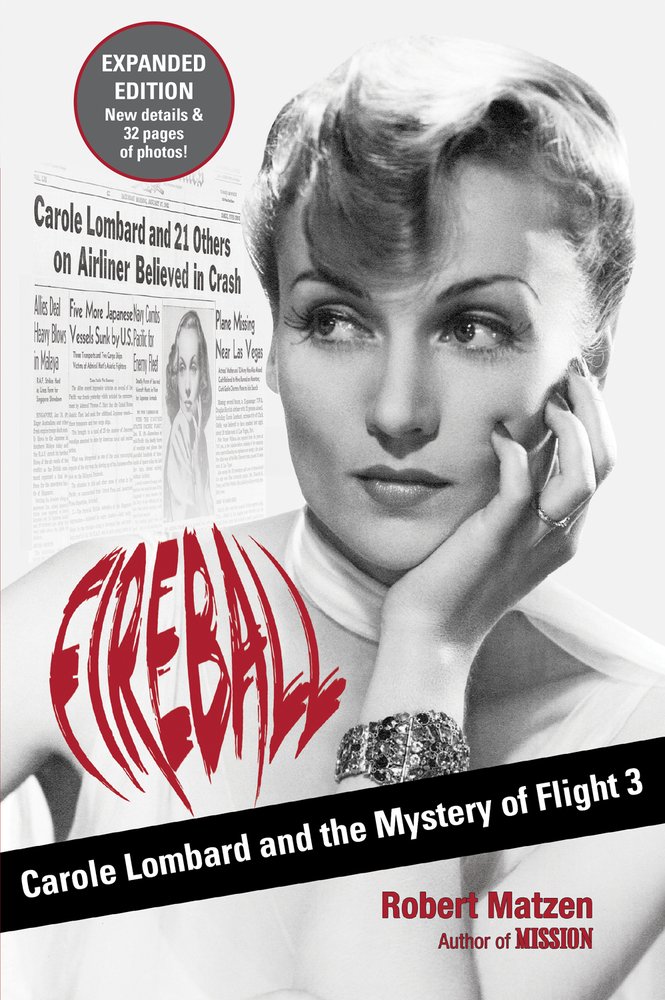
Fireball: Carole Lombard and the Mystery of Flight 3 is available at bookshop.org, barnesandnoble.com, and Amazon.com. The audiobook was read by the incomparable, award-winning Tavia Gilbert.

Meanwhile, in an Alternate Reality…

For Immediate Release

MOVIE AND TV COMEDY STAR CAROLE LOMBARD TO PEN MEMOIR

Actress vows to ‘come clean’ in Putnam hardcover

HOLLYWOOD, May 1, 1961/AP —G.P. Putnam’s Sons announced today that the publisher will release the autobiography of motion picture and television actress Carole Lombard. The would-be author had stated previously that her book would be entitled, “Just One of the Guys.” Last week, Miss Lombard, who will turn 50 in October, made a public appearance after months of seclusion following the November, 1960 death of her ex-husband, Clark Gable. It is speculated that her memoir will discuss life with the one-time “king of the movies,” as well as their 1946 divorce, continued close friendship, and recent reuniting as co-stars of the romantic comedies, “Teacher’s Pet” and “But Not for Me.”

Miss Lombard’s career began in silent pictures for the Fox and Sennett studios and then continued in the sound era at Paramount. But it was the 1934 Columbia Picture “Twentieth Century” that shot her to the top. She solidified her status as “queen of screwball” two years later with an Academy Award-nominated performance in “My Man Godfrey.”

Miss Lombard and Mr. Gable began their association in 1936 and once comprised the most famous couple in Hollywood. They were married during production of the highest grossing motion picture of all time, “Gone With the Wind.” They enjoyed status as the most prolific and profitable stars of the World War II years, and, despite rumors of marital turmoil, their separation at war’s end caught Hollywood by surprise.

Miss Lombard said she has been working on the manuscript for more than two years. In describing its title, she said, “It was the men who ruled the Hollywood roost, and I had to make room for myself in the ‘boys’ club.’ Then I had to do it again when I decided to produce some pictures, and especially when I wanted to direct features and then serve as executive producer of my TV series.”

That series, “Carole of the Belle,” features Miss Lombard as Carole Simpson, a divorced newspaper reporter raising her daughter on a Seattle houseboat called the “Puget Belle.” Now in its 11th season on the National Broadcasting Network, “Carole of the Belle” was second in popularity in the last decade only to the CBS smash hit “I Love Lucy,” which starred Miss Lombard’s friend of more than 20 years, Lucille Ball.

In addition to her groundbreaking work in motion pictures and television, among the topics to be remembered by Miss Lombard are a car crash that nearly ended her career in 1925; her marriage to suave leading man William Powell; the strange death of Russ Columbo, a 1930s singer with whom she was romantically linked; a long-time friendship with tennis star Alice Marble; a brush with death when an airliner on which she had been traveling crashed in Nevada after she had disembarked; and her battles with HUAC and unwillingness to “name names.”

Famous for her salty vocabulary and known as one of the most down-to-earth of Hollywood’s elite, Miss Lombard said she would “pull no punches” in her book, although she was coy when asked if she would discuss her post-Gable romances with actor/director Orson Welles, and then her most controversial relationship of all, with actor Paul Newman, a man 15 years her junior.

Putnam anticipates an autumn 1962 release for “Just One of the Guys.”

###


How this came about…

A colleague of mine, Wendy, is reading Fireball and said to me yesterday, “The whole thing is such a tragedy because if anyone should have lived a long life and produced a great memoir, it’s Carole Lombard.” Wendy paused and said, “She’d have made a great old lady.”

Which got me to thinking. Suppose she hadn’t died on that mountaintop. Suppose she had lived a normal lifetime and worked the length of a normal career. What would have happened? Of course it’s pure fantasy, but when you have spent as much time in someone’s head as I have in hers, you get to a point where you can draw conclusions. Here they’re laid out. Somehow or other, the marriage would have ended, but Lombard didn’t hold grudges and after a time she and Gable would have been friendly. Without the tragedy of her death hanging over his head, three things would have changed: 1) Gable’s ambition wouldn’t have been snuffed out and his brand would have thrived; 2) the public would have been spared seeing Clark Gable as a mortal and he wouldn’t have aged prematurely, and 3) at age 41 and then 42 and 43, he wouldn’t have gone to war; he would have made very popular pictures from 1943 through 45, during the biggest boom in Hollywood history.

In the meantime, Lombard would have made He Kissed the Bride (retitled They All Kissed the Bride) and My Girl Godfrey, and from there, she would have been off to the races as an independent, enjoying good roles with her contemporaries until 1950. I could see her producing and directing by, say, 1948, and not comedies either. I think Lombard would have gone for gritty film noir as a form of artistic expression. She had wanted to succeed at drama but never broke through, so it’s clear she wanted the challenge of meaty work. She would have been out front with Ida Lupino as a woman director and by this time she would have amassed fortune enough to finance A-pictures as an independent.

Imagine Carole Lombard called to testify before the House Un-American Activities Committee. Always a liberal Democrat, Carole would not be the one to rat out a colleague and it was likely she’d lean into the microphone on Capitol Hill and state clearly for newsreel cameras, “Senator, with all due respect, you can kiss my ass.”

In 1954, when MGM severed with Gable, Lombard would have been there as his biggest supporter and sooner or later she would have made pictures with him to give her ex a boost—returning a favor done for her by William Powell in 1936. I picked Teacher’s Pet because I could see Lombard in the Doris Day role, and But Not for Me where she would have been perfect in the cynical ex-wife part played by Lili Palmer.

Carole would not have spoken about Clark during his lifetime, but because she was indeed a “ham” and because she loved to tell stories (never letting the truth get in her way), I could see Miss Lombard following the trail blazed by Errol Flynn and publishing a scorcher of a memoir.

Romantically, she may well have slipped into a romance with Robert Stack, a premiere Hollywood stud and nice guy who was in love with her. The problem was that Bob didn’t need rescuing, and Carole was a rescuer/nurturer who went for powerful men. Always powerful men. Who fit the bill at this time? Obviously, Orson Welles, who would have been available after his divorce from Rita Hayworth. I asked Carole Sampeck to play along and it was she who labeled Welles a likely candidate, and also young Paul Newman, the next big thing in the late 1950s at a time when Carole would have just been turning 50 but, knowing her, still mindful to play the field.

And finally, I believe Lombard would have turned to television, the rival medium. In a White 1950s America dominated by traditional family values, the formula was for aging female movie stars to play wives and mothers, but not Lombard. Carole would have scratched and clawed to play a woman with guts, a divorcee and career-minded mother. A woman making her own way and suffering romantic misadventures week in and week out, making jokes at her own expense and guiding an onscreen child in lieu of the one she could never produce in life.

Notice that the press release gets Lombard’s age wrong by three years. She had already shaved a year off by 33 and sleight of hand would have killed another couple by the early 1960s. Nobody enjoyed pulling a fast one more than Carole Lombard.

So this is my version of the alternate reality wherein Lombard lived out her lifetime–what’s yours?