When the idea of Fireball came to my attention, the seed planted in my head by pal John McElwee, and I started investigating elements of the story, I couldn’t believe that some writer hadn’t already turned it into a book. The more I looked at the event, the more angles I found, so many in fact that when I talked to writer Scott Eyman about the idea, he sat there stunned and murmured, “That’s commercial. That’s commercial.”
Considering that Scott had written the bestseller Lion of Hollywood about Louis B. Mayer among many other successful biographies, and experienced the publishing landscape from a lofty perch, that reaction affected me. I realized then that I was writing something that had the potential to cross over into the mainstream. It’s one thing to write a niche book about Errol Flynn’s house, a book you know will appeal primarily to Flynn’s fans and secondarily to Hollywood buffs in general and perhaps fans of Rick Nelson, the last owner of the house. It’s something else to find a concept with the potential to jump niches and find a broader audience.
But in establishing the parameters of the Lombard story, I felt I had something akin to A Cast of Killers, Sidney Kirkpatrick’s account of the 1922 murder of silent-film director William Desmond Taylor. After its 1986 release, A Cast of Killers reached an audience far broader than those interested in old Hollywood. It’s been 25 years since I read it, but I remember I couldn’t stop turning the pages of a spooky mystery that felt so authentic I could smell the must of an aging Mary Miles Minter’s home. I aspired to take the readers of Fireball to a similar place where the pages had minds of their own and demanded to keep on turning as the complex story unfolded.
And Fireball is complex. It’s a juicy dual biography of two juicy people, Carole Lombard and Clark Gable. It’s about Hollywood’s glamorous golden age in the time of My Man Godfrey and Gone With the Wind. It’s about scandal for what Gable did with Lana Turner and what Carole felt compelled to do in response. It’s about 21 other people—all the souls aboard Flight 3 with Lombard as it lifts off one last time in Las Vegas on a course for Burbank, California. It’s about lives interrupted on the ground in Vegas when a fireball suddenly appears on the southwestern horizon and about heroism as brave men rush to the spot of the fireball in hopes of finding survivors of what they know to be a plane crash. It’s a true crime story as victims are plotted and the scene is scoured for evidence. It’s a mystery as investigators try to determine how in the world TWA’s most experienced pilot controlling its most reliable aircraft on a clear night could fly straight into a mountainside. It’s about aviation now in adolescence after a childhood spent barnstorming, and of how they still can’t quite figure out how to make air transportation run. It’s the story of a world war newly begun for the United States, of sacrifice for the cause, of a great call to action. Perhaps most of all it’s romance—a king, a queen, a love lost.
I had the equivalent of a basket of parts and looked at the basket and wondered how to make this story work. Should I tell it as straight biography? Carole Lombard’s life from birth to death, from stem to stern, from 1908 to 1942? I couldn’t imagine it that way because lives are experienced chronologically, but stories are not. This needed to be a story, like A Cast of Killers. One scene kept playing in my mind, on an endless loop: Night in the flat basin of desert. Cold, lonely, quiet night. A plane flies overhead. I hear it more than see it. Then I spot running lights. The plane flies right over me and off into the distance, and the growl of its engines spreads out and echoes and then goes away.

Flight 3 slammed into Potosi just below the ridge line at right center, in the saddle of the mountain.
A plane flies over. No big deal, right? We all experience planes flying over at all hours. But Flight 3 flying over? That’s a hook. That, I realized, was where the narrative of Fireball had to begin. The plane flies over, people who witness it go back to the task of the moment, and a little later a fireball is seen on Potosi Mountain in the distance. If the chapter ends there, tell me you don’t have to turn the page.
Then and only then, with the forward push established, could I flash back to start telling the story of Carole Lombard’s life and how she got to be on that plane and in that fireball. Flash back to a portion of her life. Flash forward to those moments on the ground in Las Vegas. Back. Forth. I knew this was risky because the reader would be jarred every time, practically a fender bender each time it happened. But it’s a jarring story anyway for so many reasons, so why not go with it? So I did.
One of the first reviews of the galleys was from Library Journal and I awaited it the way a political candidate awaits the votes. Guess what: the LJ reviewer made it a point to hate this construction above all the other things that annoyed him about Fireball. He didn’t damn it with praise, faint or otherwise, he just damned it. And then he recommended that Fireball be added to library collections. Go figure.
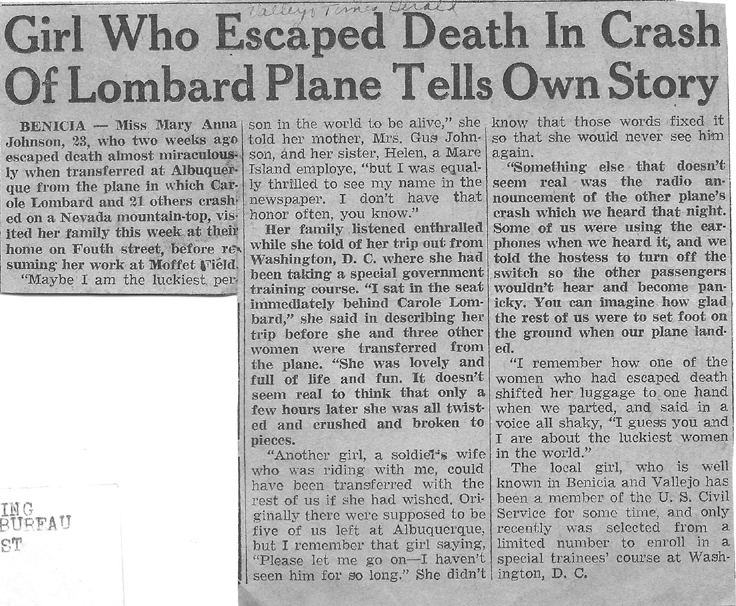
I won’t lie; his criticisms stung, and I had to wonder if I had miscalculated. He also said I “did the writerly thing” and presumed to know what was going on in people’s heads. I took umbrage at that one because I did know what was going on in people’s heads. I had researched this thing so thoroughly and found so much detail that I didn’t have to make up what people were thinking, saying, and doing. I had it in 2,000 pages of official testimony about the crash. Plus I had dug up so much on Lombard and Gable that I knew their characters inside and out and from every other angle.
There were a few other pans of Fireball, but just a few. Praise for the book poured in from the start, from the time it hit NetGalley in September, and by now I’m feeling vindicated by the positive comments in reviews and by those I’ve heard in person at book events. I don’t prompt people to talk about the story construction; they can’t help but tell me they love the way the story unfolds and often it’s the first thing they have to say about the book. I guess the lesson is, trust your gut. If it feels right, go with it.
I knew as I was writing Fireball that it was the book of my lifetime, to date at least. I dreamed about the characters, received break after break, met great, helpful people, and Fireball became an inferno in my computer. That doesn’t happen many times in a writer’s career. Will it cross over? It shows signs, but since GoodKnight Books isn’t Simon & Schuster, the headwinds remain strong, and only time will tell.


 Robert Matzen