Lure of the Forbidden

Fireball: Carole Lombard and the Mystery of Flight 3 by Robert Matzen

Almost 40 years before Ana met Christian, there was The Story of O, as sold in this vintage Italian movie poster.

I’m not sure how the 50 Shades of Grey phenomenon happened. It’s a mystery to me how this exercise in juvenile erotica found its way into supermarkets and other retailers across America. In my long and checkered literary career, I have been an erotica-for-hire writer, and out of curiosity read 50 Shades. I was appalled, not because of the salacious subject matter, or because the depiction of women might set their cause back a couple generations, or even because the writing lacked sophistication. I started flinging 50 Shades around the room because of the presentation of Christian Grey as a dominant. Kids out there trying this writing thing at home: your characters have to be consistent, and no dominant male acts like Christian Grey acts in this story—it is a cloistered adolescent female’s imagining of what a dominant male would be like as he is “tamed” by a girl who in real life would bore the guy stupid in a couple of dates.

The writer in me applauds E.L. James for capturing lightning in a bottle and selling a gajillion copies of her B&D trilogy. Somewhere there’s another book waiting to be written called “Revenge of a Wallflower” where we learn about E.L.’s upbringing and long-ago snubbing by a bad boy who dumped her after a couple of dates and thus the 50 Shades phenomenon was born.

However, I’m not really here to talk about 50 Shades of Grey. We’ve heard enough about it all month. As I sit here and write in the pre-dawn murk of a frozen Friday the Thirteenth, this picture is about to shatter box-office records in these United States, riding a wave of hype that goes far beyond merely trailers on TV. There are 50 Shades tie ins across the straight-laced retail world; 50 Shades of nail polish, 50 Shades hairstyles; 50 Shades shoes. It’s being pitched on QVC and via email, and I get the feeling that somewhere, one-time movie flakmeisters like Russell Birdwell and A-Mike Vogel are beaming. Today’s blockbuster is the latest in a long line of pseudo-kink that promises the forbidden, lures you inside, and then laughs all the way to the bank as you stumble out of the theater wondering how you had been hoodwinked.

In my misspent youth, the X on a movie poster always enticed me. Of course, I’m far too young to have seen in first-run the films I’m going to mention. But…

Midnight Cowboy, starring my “twin brother” Jon Voight, proved to be an interesting picture but not the Dante’s Inferno of naked flesh that I envisioned.

Emanuelle was my first exposure to simulated sex, but today has a sanitary sweetness about it.

The Story of O offered a more realistic dominant-submissive story than what you will see this evening. In fact, save yourself 40 bucks and rent The Story of O. If Ana had a worldly grandmother, it would be the girl code-named O.

Last Tango in Paris was utterly boring and seeing dissipated Marlon Brando naked upset my stomach.

I won’t waste your time relating my frustration at Crown International sexploitation pictures that swindled me, like The Teacher and The Stepmother. Only A Clockwork Orange felt like an X to me even as a kid, and that wasn’t because of the sex but rather the ultra-violence.

There’s a sucker born every minute, and I was it. Finally I gave up on pictures that were sold as smut but never fit the bill and saved my money by avoiding Nine 1/2 Weeks until I could rent it on VHS for a buck. All I remember about it now is that it unspooled so slowly that I knew where the name came from. It was also relatively tame and I couldn’t understand much of Mickey Rourke’s dialogue because he’s a mumbler. (I spared myself entirely the experience of yet Another Nine 1/2 Weeks.)

Fireball: Carole Lombard and the Mystery of Flight 3 by Robert Matzen

From Showmen, Sell It Hot: Baiting the lure with “It” way back in 1932.

Greenbriar blogger John McElwee wrote a fantastic coffee-table book about showmanship in Hollywood’s Golden Era in which he examines the production of classic pictures and the ways they were sold to the masses by people like A-Mike Vogel. In Showmen, Sell It Hot! there’s a chapter called Titillated to Distraction detailing the lure of the forbidden in Hollywood’s naughty pre-Code years of the early 1930s. I’m reminded looking at McElwee’s work that in terms of attitudes about sex, America hasn’t come very far in 80 years. We were spawned of Puritans after all, making forbidden sex practices repugnant and therefore all the more irresistible.

As documented in Showmen, the 1932 feature Bird of Paradise “promised island beauty Dolores Del Rio au natural and indeed delivered via nude swim scenes.” Other examples by the author: “’Give me a job—at any price,’ says Loretta Young to Warren William in a teaser ad for Employees’ Entrance, and by February 1933 customers knew Warner Bros. wouldn’t let them down. Hold Your Man bade audiences to ‘Learn how to do it in one easy lesson,’ with Clark Gable and Jean Harlow more than capable instructors.”

Fireball: Carole Lombard and the Mystery of Flight 3 by Robert Matzen

This still from Virtue showing Carole Lombard and Mayo Methot appeared in the risqué movie magazine, Film Fun. As per usual, the picture itself didn’t sizzle.

The Carole Lombard of Fireball fame posed with Mayo Methot for a lingerie shot that remains today pretty suggestive as they were hyping the 1933 Columbia picture Virtue. It didn’t matter that Virtue was bland stuff; by the time a healthy American male found this out, the theater already had his money.

An ad for the Barbara Stanwyck picture Baby Face depicted Missy Stanwyck in a provocative pose beside an ad line that read, “She used everything she had … to get everything men had … She stopped at nothing and made ‘It’ pay.” And audiences knew what ‘It’ was, even in 1932. In all caps below the credits was a sobering warning: PLEASE DO NOT BRING YOUR CHILDREN.

I don’t know how many of you will queue up to see 50 Shades of Grey today or over the weekend, but if and when you do, be aware that you are carrying on a proud tradition that goes back as far as the motion picture itself. You have been summoned into the dark to see forbidden things. Enjoy whatever salacious moments you can wring out of this picture, because odds are you will return to the open air a little worldly wiser … by feeling hoodwinked yet again.

Fireball: Carole Lombard and the Mystery of Flight 3 by Robert Matzen

One more from Showmen, Sell It Hot: Joan Blondell was a nice girl selling naughty, pre-Code style. I can’t figure out, is she leaving a little or a lot to the imagination? Or is her expression merely saying, “Look out, people! Your wallets are being lightened!”

Curves

Fireball: Carole Lombard and the Mystery of Flight 3 by Robert Matzen

Carole Lombard in 1928 after Mack Sennett had labeled her “scrawny” and ordered a weight gain.

When did “unnaturally thin” and “emaciated” become desirable for women? Mack Sennett told Carole Lombard to put on a few pounds when he hired her in 1927, and I think she never looked better. Otherwise, Lombard spent her career dieting and sweating to be as thin as possible, mainly I think because she tended to put on weight in her legs if she gained an ounce and she didn’t like it.

I have grown so bored, my friends, of women who are proud because their ribs are showing. We have long been at the point where women brag about starving themselves, brag about every ounce lost in an effort to be a 4 instead of a 6 or a 10 instead of a 12. Women don’t even seem to do it for men; they do it to one-up the competition—other women. Is it a billion-dollar or a trillion-dollar industry, the companies selling the message that if you aren’t skinny, you’re miserable? It’s a brainwashed world gone mad.

Fireball: Carole Lombard and the Mystery of Flight 3 by Robert Matzen

Ashley Graham: Sports Illustrated-bound.

The so-called “plus-size model” who will appear in an ad in the upcoming SI swimsuit edition, Ashley Graham, is, to me, as sexy as it gets. The xylophone-ribbed waifs who will surround her on the pages—not so much. To me they all look exactly alike. They’re up and down and boring.

Why the rant against anorexia? Because women’s obsession with weight and the negative consequences of being anything but ribby is nothing new. Case in point: Carole Lombard’s close friend and confidante Madalynne Fields. I’m reading a 1936 article from Modern Screen magazine that Vincent Paterno posted on his Carole & Co. web site. My friend Marina had tipped me off to this article during the research phase of Fireball, and I remember being frustrated back then by the typically fluffy nature of the piece. “Fieldsie” spent her lifetime hiding in shadows, and all we get are glimpses of Carole’s fun-loving companion from the early 1930s when Lombard and Fields rampaged through Hollywood as a distaff Laurel and Hardy.

Have you ever wondered why there seem to be just a couple of photos in existence that show the supposedly inseparable duo of Lombard and Fields? Carole never met a camera she didn’t like, but Fieldsie managed to avoid cameras most of her life. The truth is not pretty.

Straight dope on Madalynne Fields was impossible to obtain until I accessed old audiocassette tapes in the Academy’s Herrick Library, one of which was an interview from 1976 by Gable biographer Lyn Tornabene with Fieldsie’s son, Richard Lang. Richard’s mother had just recently passed on at the time of the interview, and his voice is tinged with sadness as he describes this woman whom he knew as “the General.”

Fireball: Carole Lombard and the Mystery of Flight 3 by Robert Matzen

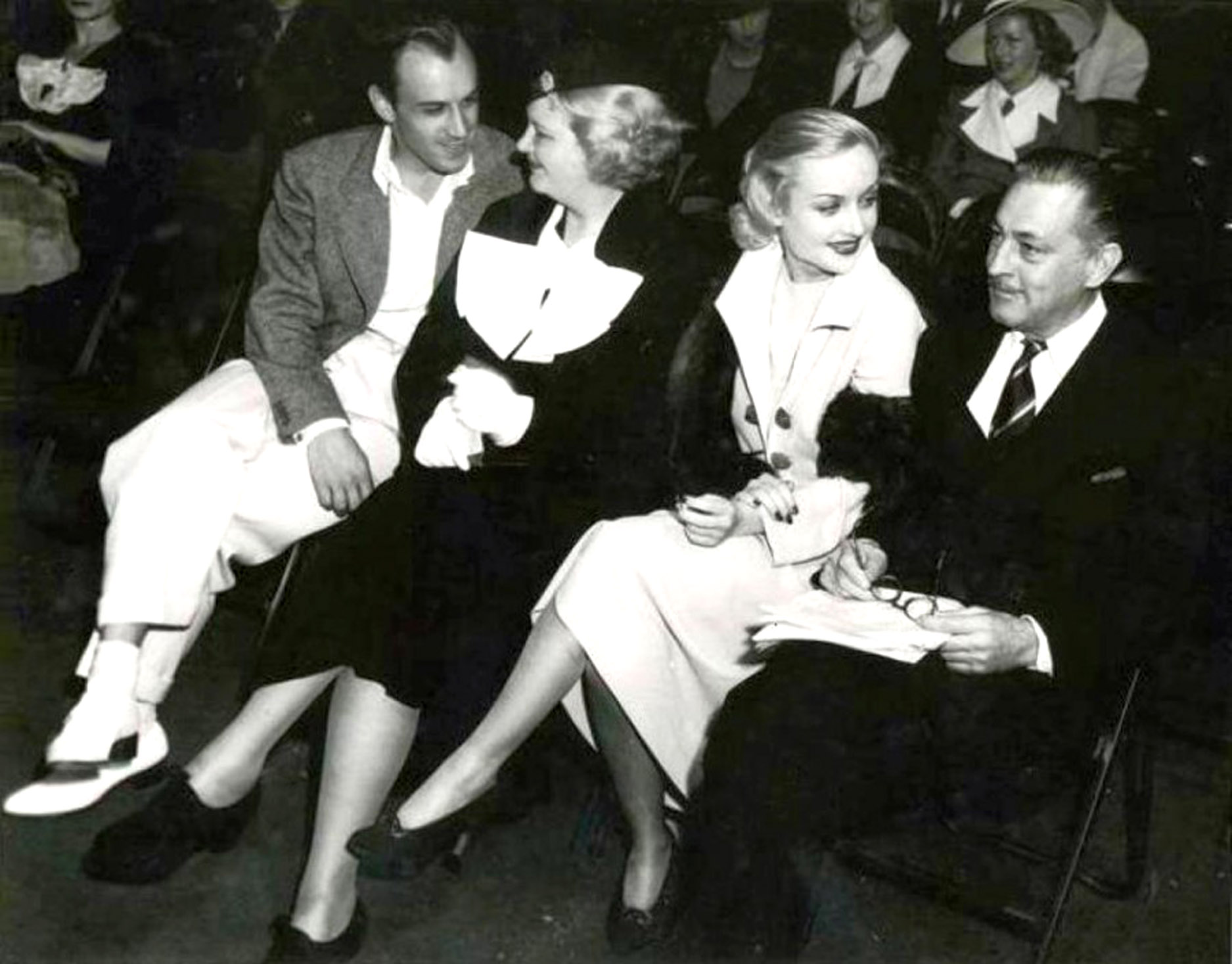
One of two photos you’ll see of Carole and Fieldsie. Here they attend an event for Carole’s picture, Twentieth Century. Fieldsie is looking not at the camera but at Russ Columbo, a man she disliked, as described in Fireball. Lombard looks at her Twentieth co-star, John Barrymore.

The real Fieldsie was brilliant, meticulous, demanding, driven, and unhappy. She didn’t want to be six feet tall. She didn’t want to weigh in a range that fluctuated around 250 pounds. She didn’t want to stand out in a crowd and draw everyone’s stare. It was the most difficult thing in the world for Fieldsie to be Carole’s comic foil, and she became trapped in the role when Carole hit it big in 1934 with Twentieth Century and then bigger in 1936 with My Man Godfrey. Fieldsie had a tremendous sense of humor that became central to the Lombard legend, but it was humor as a defense, humor as a shield, humor to hide the pain.

The 1936 Modern Screen article gives us hints of the life Fieldsie faced. She describes herself as a thirty-five-dollar-a-day motion picture actress—but that was on the days when she could land work as a walk on or extra, and those days were almost nonexistent because she was so big. As a result she went to school and learned secretarial skills that allowed her to become Carole’s secretary. Night school wasn’t a lark as positioned in the 1936 article; for Fieldsie, the adding machine and shorthand meant survival.

The article quotes Fieldsie as saying, with tragic understatement, “Although I wouldn’t admit it, I was terribly self-conscious about my weight. I knew that Carole realized this, for without mentioning it, she used to say and do things that meant a great deal to me.” The article also mentions that Fieldsie was, as of the writing, under a doctor’s care and had lost 60 pounds, and soon she was marrying director Walter Lang, who had directed Carole in the features No More Orchids in 1932 and Love Before Breakfast in 1936.

I used to wonder why Fieldsie suddenly departed the scene upon marrying Lang in 1937. It seems as if she left Carole high and dry as secretary and business manager and, in truth, she did. As Carole’s star neared its zenith, Fieldsie vamoosed because she couldn’t take it anymore. She couldn’t stand to be seen towering over her perfect little svelte clothes-horse of a best friend. She couldn’t stand the heat of the spotlight and sought nothing more than a quiet life away from it.

Fireball: Carole Lombard and the Mystery of Flight 3 by Robert Matzen

Madalynne Fields makes a rare public appearance with Clark Gable and Irene Dunne at the launching of a ship named for Carole Lombard. Not only are Fieldsie and Clark the same height; she was the General and he was only a major so she out-ranked him.

So effectively did Fieldsie go on to avoid that spotlight that only in January 1944, when the liberty ship Carole Lombard was christened, did Madalynne Fields make a public appearance in range of cameras, and how uncomfortable she appears.

Fieldsie was 18 months Carole’s senior and appointed Carole to be godmother of son Richard, who was born in 1939. He would be Fieldsie’s only child. Fieldsie transitioned from power behind the Lombard throne to power behind the Walter Lang throne as Lang progressed through a successful career as director of pictures for James Stewart and Clark Gable, among many others. It’s easy to see Fieldsie living to 80 or 90 but her life was cut short at 67, not by ill health from carrying around extra weight but from a mugger who cracked her on the head with a lead pipe. The incident took down a woman whom Richard described as “fierce” and she died soon thereafter.

Of the millions of women out there struggling to force themselves into the media’s accepted norm of body shape, Fieldsie was an early casualty. She had the misfortune to grow up in the 1920s when “boyish” became the figure of choice for women, and she was anything but that. Carole Lombard, empathetic soul, did all she could for Fieldsie, but the association proved to be both blessing and curse, and so here is the uncomfortable truth behind the legend of Carole’s fun-loving sidekick.

Fireball: Carole Lombard and the Mystery of Flight 3 by Robert Matzen

Courtesy of Tom Hodgins: a shot from the Sennett days with Fieldsie center and Carole foreground left of frame, highlighting the problem for the larger of the girls.

Mocked by the Mockingbird

Fireball: Carole Lombard and the Mystery of Flight 3 by Robert Matzen

Clifford Irving, the cat who thought he ate the canary. It turned out to be the other way around.

Clifford Irving is alive and well and writing books more than 40 years after being caught peddling a fake autobiography of Howard Hughes. It’s a great story that was made into the movie The Hoax with Richard Gere. By 1970 Howard Hughes was a recluse seen by no one, and Clifford Irving figured that nothing could drag Hughes out into the sunlight, even the publication of a fake autobiography of Howard Hughes.

As was accurately depicted in the picture The Aviator with Leonardo DiCaprio, anybody messing with Howard Hughes was going to come out bloody as long as that man’s heart continued to beat. Hughes didn’t exactly step into the sunlight to fight Irving, but he held a press conference by telephone that I remember very well and blasted Irving for the fake book. Clifford Irving gambled and lost and spent a year and a half in prison as a result.

Call me a skeptic, but I can’t help but wonder if history is repeating itself, this time in foolproof fashion. It’s a sad world we live in when the surprise headline about publication of Harper Lee’s second book causes me anything but glee. Her simple story of Atticus Finch and Scout and Jem bowled over the literary world and has continued to sell a million books a year for decades. To Kill a Mockingbird won the 1960 Pulitzer Prize and then transitioned seamlessly into a great motion picture, which doesn’t always happen. The film version earned five Oscar nominations and three wins, including Best Actor for Gregory Peck as Atticus. I can’t imagine that any of you haven’t seen the movie—it’s a humdinger.

To Kill a Mockingbird is the great American novel, and its author has frustrated us ever since the book’s publication because this was all she wrote. She saw the avalanche of publicity that resulted and fled. Case closed. Harper Lee, one-hit wonder of the ages.

But wait! I read the New York Times article yesterday about another manuscript by Harper Lee being discovered and thought: This is too good to be true! But my immediate second thought, knowing the circumstances, was: Wait, this is too good to be true.

Fireball: Carole Lombard and the Mystery of Flight 3 by Robert Matzen

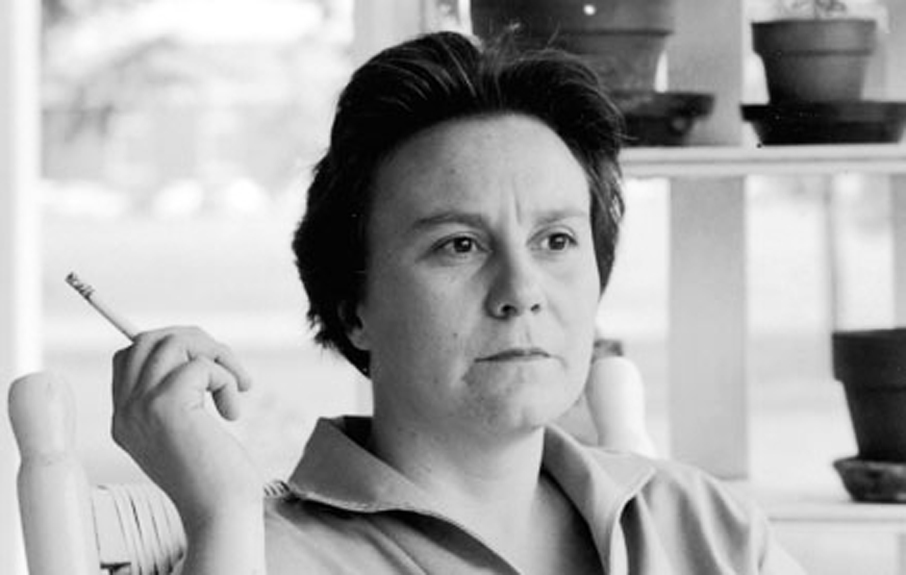
The real Harper Lee, back in the day.

Supposedly, the manuscript for Go Set a Watchman, a novel that picks up the story of Atticus and Scout 20 years after events in Mockingbird, was discovered attached to a copy of the original Mockingbird manuscript. Watchman is described as a sequel written prior to Mockingbird.

Here’s the thing. At age 81, Harper Lee suffered a stroke in 2007, apparently a big one. Her sister Alice, an attorney who had been Harper’s caregiver and companion, died in 2014. Alice’s death not only devastated Harper; it left her without protection in making decisions like using her name and that of her famous book to hawk another book. Based on lifelong behavior, this is the very last thing one would expect from Harper Lee, yet the very thing that happened yesterday when news rattled the publishing industry to its bones about another Lee novel. Press releases quote the incapacitated woman, who according to witnesses at her sister’s funeral may no longer be all there, as saying of Go Set a Watchman, “[I am] pleased to hear that they considered it worthy of publication. I am humbled and amazed that this will now be published after all these years.”

As of this writing, Go Set a Watchman, almost half a year from release, has shot to #1 on the Amazon bestseller list and To Kill a Mockingbird is #2. Oprah is gushing with excitement. That’s fine, but I have been dealing with New York publishers for 30 years, and I’m here to tell you that today they are soulless corporate monoliths in survival mode. Oprah may be gushing, but I’m sitting here thinking about this 88-year-old, wheelchair-bound sweet soul who’s imprisoned in a withered body and no longer capable of rational thought. Given her situation and the timing of her protector’s death, I can’t help but smell a rat. A big one.

Caveat emptor, my friends. Caveat emptor.

Hail to the King

Happy Birthday, Clark Gable. Today, had you taken better care of yourself, you would be 114. Let that be a lesson to you.

Come to think of it, Mr. Gable, I guess no matter how many cigarettes you had eschewed, no matter how many bottles of Chivas Regal you hadn’t consumed, you wouldn’t be around at 114. That’s a lot of years, and how they do fly by.

Some places reflect the years better than others. This past week I found myself in a city that feels very old: San Francisco. I was there on business, business so intense that I had barely a moment to see the sights, but a friend and I scaled Telegraph Hill from Chinatown to Pioneer Park and Coit Tower and looked out at Alcatraz, my first-ever glimpse of The Rock. Hard not to think about Al Capone or Clint Eastwood’s Escape from Alcatraz. Or his Dirty Harry, for that matter. It’s going on 70 years since Capone died; almost 40 since Escape was made; more than 40 for Dirty Harry. Hell, it’s already been 52 since The Rock closed as a prison. Years, years, years, speeding by.

Fireball: Carole Lombard and the Mystery of Flight 3 by Robert Matzen

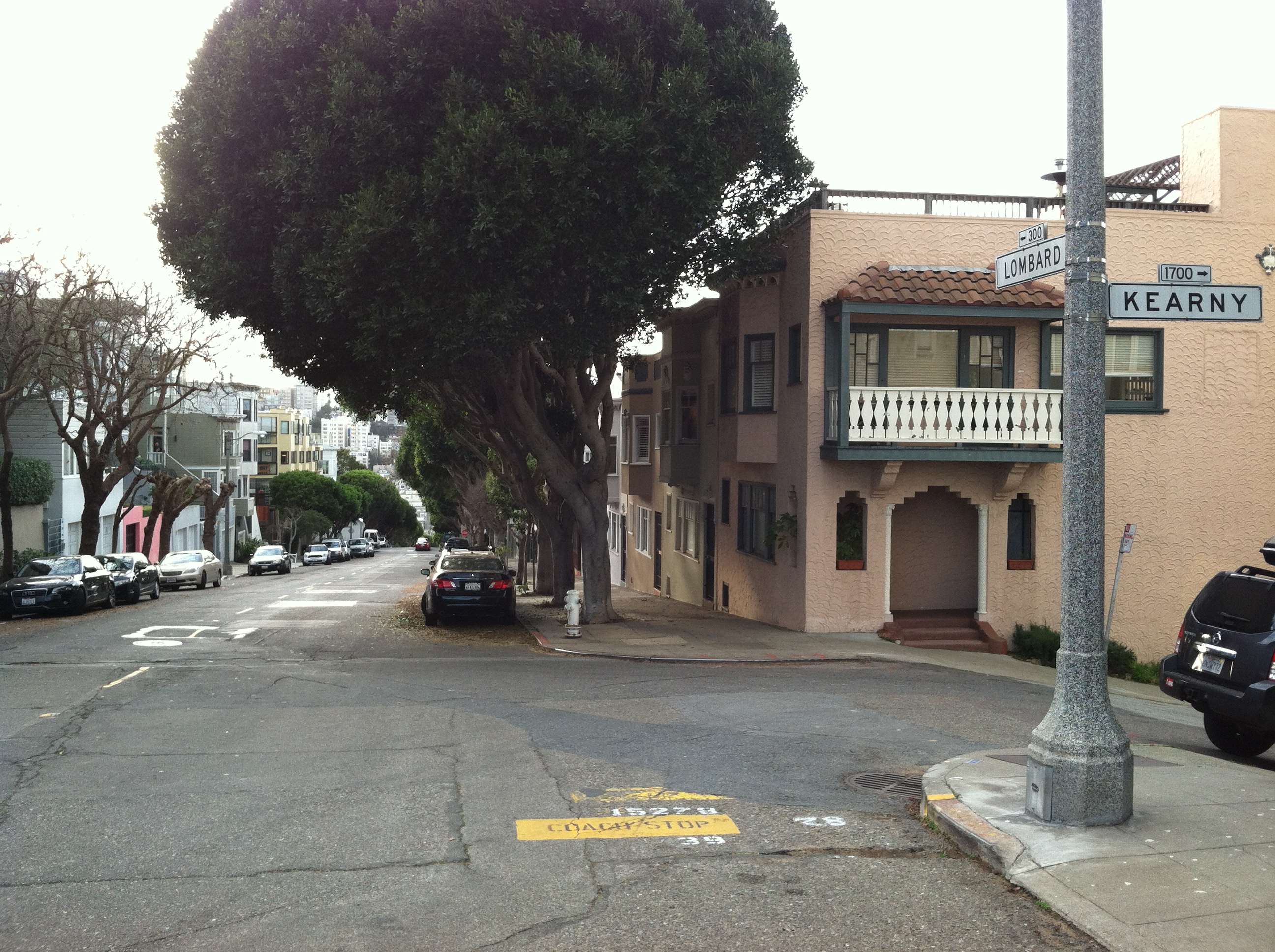
My discovery: the top of Lombard Street. Pioneer Park is above.

Fireball: Carole Lombard and the Mystery of Flight 3 by Robert Matzen

It’s a long way down Lombard Street from here, all the way down Telegraph Hill to Columbus Avenue in the Italian part of town.

Exploring the streets that radiate out from Pioneer Park, I stumbled on Lombard Street, and it was one of those moments when my mind went boinggg! I had read someplace decades ago that Jane Peters took the name Lombard because of Lombard Street; it was here in San Francisco that mother Elizabeth Peters had first lighted with the kids in 1914 after leaving Fred in frosty Fort Wayne. Now, here I was at the head of Lombard Street all these years later, in another century, feeling some magic about the name and exploring on down the long hill to Corso Cristoforo Colombo—yes, Lombard intersects with Colombo. (Another intersection of the two would take place in 1933. Sort of.) Up yonder hill to the west Lombard Street turns serpentine in a crazy little section that’s a kick to drive down as I found out later in the evening.

I asked Carole Lombard authority Vincent Paterno, proprietor of bold and sassy Carole & Co., if he had ever heard this story about the origin of Lombard’s name, and he said he thought she took Lombard from family friend Harry Lombard. I had heard this too, but part of me wonders if she would have appropriated the name of a friend, which could have made an awkward moment or two had he said no. But I could see her using the name of the wildest street in San Francisco, Lombard Street.

Fireball: Carole Lombard and the Mystery of Flight 3 by Robert Matzen

Original poster art from San Francisco, selling the bad boy and the warbler with the gams.

Birthday boy Clark Gable made a picture about San Francisco called San Francisco while banging his new girlfriend, Carole Lombard, in the spring of 1936. The picture San Francisco featured a different kind of banging as it details the earthquake of 1906 that leveled parts of the city. Does anyone know if the picture premiered in San Francisco? I like to think it did, back in the day when studios took their stars and the press on junkets amid much ballyhoo to launch the A-pictures.

This was a landmark film for its recreation of the Big One and shows off Gable at his finest as yet another black-hearted rogue, the kind of role that established him as a man’s man and bad boy who made the ladies swoon. Women didn’t want to own Clark Gable because they knew he couldn’t be owned—but they spent a great deal of time imagining what it would be like to get roughed up a little by Clark Gable, who was 35 at the time of San Francisco and in his absolute prime. It became a great part of the legend between them: Lombard in her prime, the year she made My Man Godfrey, landed Gable in his prime, causing a great stir among the gods. It was quite a year on Olympus.

Fireball: Carole Lombard and the Mystery of Flight 3 by Robert Matzen

Clark and Carole early in their relationship. Customary Coca-Cola in hand, she wears a look that admits she just ate a canary.

Carole was always very big on birthdays, so somewhere, maybe up there on Olympus, she is calling Benny Massi to make sure the catering from Brown Derby is perfect for Pa’s surprise party to celebrate this, his 114th birthday.

Flyboy

Fireball: Carole Lombard and the Mystery of Flight 3 by Robert Matzen

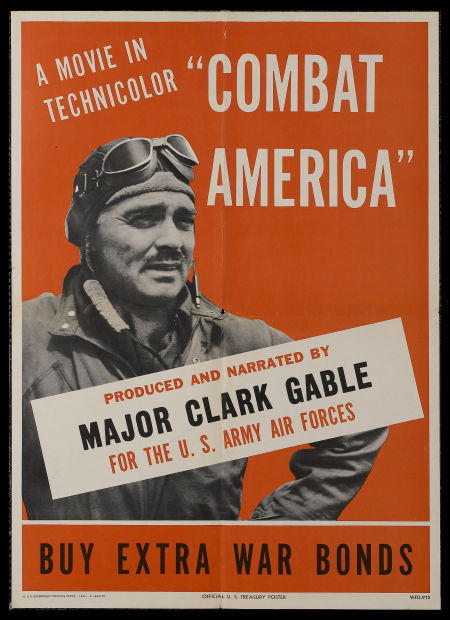
A 1944 Government Printing Office poster for Gable’s wartime feature. Notice he was Major Clark Gable by the time of the picture’s release in the second half of 1944.

I don’t know why it didn’t occur to me sooner to check out Clark Gable’s 1944 propaganda picture, Combat America, as background research for my new book project. But it took prompting from my pal Tom before I went ahead and sought out Combat America.

For those not in the know, Gable enlisted in the Army Air Corps in August of 1942, seven months after the death of wife Carole Lombard aboard TWA Flight 3. At this time Gable was making no secret of the fact that he didn’t care whether he lived or died. In fact, he preferred the latter over the former, and if he were to cash in, he would like to go the way Ma did.

Meanwhile, at MGM of Culver City, Louis B. Mayer and his lieutenants had spent many of their waking hours worrying about their multi-million-dollar investment, Clark Gable, king of the movies, getting mixed up in the war. Whenever the subject would come up they would hammer into Gable’s ear: You’re too old to go. For God’s sake you’re 41. Stay stateside where you can do the most good for the greatest number of people.

Gable was the hardest-headed man in Hollywood. Lombard had learned this sideways and in their six years together developed ways to penetrate that cement noggin—but mostly she just surrendered and did thing’s Pa’s way.

After Ma’s passing, Pa Gable was a sleepwalker, at first numb and somewhat pliable, and then after some months his old cement-head self. When it became inevitable to MGM that Gable was going to enlist, the powers that be dealt with ways to keep their man in one piece. He told them flat-out that he would not be a paper soldier who stayed stateside and wore a uniform for show and appeared on camera reading scripts about how hard the war was. He was going over. He was going up.

Of all the studios, MGM was tightest with Official Washington, so it was no great feat in summer 1942 for Mayer’s brain trust to arrange for Gable to be inducted into the Army Air Corps with the mission of making a motion picture about the importance of aerial gunners on heavy bombers that would soon be flying dangerous missions over the wartime industrial heart of Nazi Germany.

Gable went in in August 1942, fulfilled 13 weeks of officer’s training in Florida with men half his age, and emerged an officer for assignment in the Polebrook-based 351st Bomb Group in the Eighth Air Force. Gable was thus a member of the Mighty Eighth and in the middle of the great air war in Europe at its most devastating point. Daily, he saw bomb crews go over and not come back. He saw B-17s come limping home to base shot to pieces. He was there to record all of it on 16mm color film with an MGM camera crew.

Fireball: Carole Lombard and the Mystery of Flight 3 by Robert Matzen

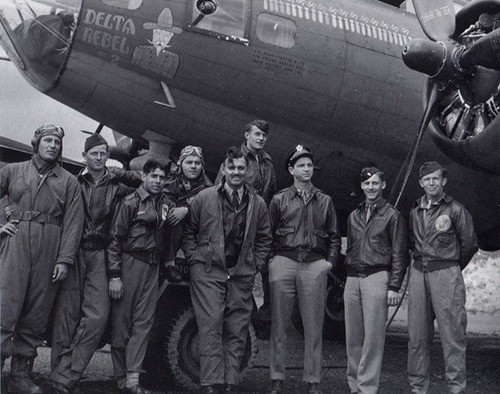
Gable poses for a photo with the crew of the B-17 Delta Rebel after a flight with them in 1943.

For Gable personally, there were problems and they were significant. MGM couldn’t let him serve as an enlisted man—how would that look for a king to be a private or noncom? So he served as a captain with a specialty in aerial gunnery…but gunners on B-17s were at most noncoms, not officers. The officers on a B-17 were the pilots, navigator, and bombardier. Plus, Gable hadn’t been assigned to a crew from the beginning and hadn’t trained with that crew for grueling months and years in preparation for service with the Eighth. He flew from May to September 1943 on five missions, mostly “milk runs,” which were shorter hops from eastern England over the Channel to targets in German-occupied countries. Practically speaking, Gable had to go on shorter runs because he was an extra man on the plane, taking up space and adding weight. You can see a recap of the Gable missions here. On his only mission to Germany as a gunner/observer, one man in the crew was killed and two others wounded, and this was the mission during which a piece of ordinance nicked Gable’s boot in his gunner’s position in the waist of the plane.

Gable’s bigger problem in the service was being Clark Gable and a center of attention. If ever an organization did not thrive with a celebrity in its midst it was the United States Army fighting the most brutal war imaginable in 1943, and there was Gable distracting air crews just by being around base. It wasn’t going to work; it couldn’t work. So when Gable “ran out of film” after exposing 50,000 feet of 16mm footage, he was sent home to MGM to cut together a feature that would become Combat America.

Gable’s biggest problem was how fast the air war had changed. Since his enlistment in August of 1942, the Eighth Air Force had converged on Great Britain like so many swarms of bees and set up massive operations in and around Norwich. They started sending concentrated bombing missions into Germany right away and got shot out of the skies with sickening frequency. By the time Gable got over there and into the war and made his film and came home, there was no need to make a movie explaining to the civilian population what it was like to be a machine gunner on a bomber—the whole thing was daily news and men were enlisting by the thousands to be glamorous flyboys.

That’s a lot more backstory than you needed about Gable’s feature documentary, Combat America, which meanders through 62 minutes to remind us how little direction Gable had making his picture and how frustrated he must have been with the entire enterprise. He wanted to go and fight and die in the air. Instead he went, fought a little, spent too much time on the sidelines filming and drinking, and lived. Lived to sit in the dark back at MGM looking at real fighting men on a moviola.

The title itself sucks. Combat America: what the hell is that? Audiences had no chance to feel a sense of mystery, a sense of, “I have to go see Gable’s new war picture.” On the other hand the title didn’t matter because the picture got negligible distribution. In the end, Gable had gone overseas on what might have been the greatest snipe hunt in recorded history.

Most of the footage shot in England was MOS (picture with no sync sound). A few times cameras rolled with audio to show Gable interacting with the brass or with other soldiers—non-actors all, men who were terribly self-conscious in the presence of the king. Gable narrates throughout and he’s sincere in the effort. He takes us on tours of ancient British sites, he takes us to character studies of the men of the 351st, he takes us inside pre-flight briefings and through missions all the way to landings back in England. It’s a bittersweet experience watching Combat America because we know where Clark Gable was at this point in his life. A widower who had been launched into mid-life crisis; a man who wanted to serve but ended up (in his own mind) a buffoon among those fighting and dying; a filmmaking professional denied a real goal and the support to do what he did best: make movies, and convey to the people back home what he had seen, heard, and done in the war. It soothed Gable not at all that he earned the Air Medal and a Distinguished Flying Cross, or that Adolf Hitler put a bounty on the king’s head.

Combat America is available complete on YouTube, although the print looks like Lake Erie stands between it and you; one only wonders how it could benefit from Blu-Ray restoration, if the original elements even exist in the MGM vaults.

Marathon

Here we are on Sunday, January 18, 2015. Seventy-three years ago today, Sunday, January 18, 1942, recovery teams were combing the unforgiving mountainside of Mt. Potosi, Nevada at the site of what one Civil Aeronautics Board investigator called “the most completely destroyed airplane I have ever seen.”

This year of 2015, the events covered in the book Fireball occurred on the same days of the week as they did in 1942, which led me (after the germ of the idea was hatched by Carole Sampeck) to launch a Twitter effort to replay key events in Carole Lombard’s last days in real-time, as they happened, beginning at 1:35 P.M. Central on Thursday, the moment Lombard and her party—including her mother Elizabeth Peters (“Petey”) and press man Otto Winkler–were greeted at Union Station, Indianapolis, by the Indy mayor and other officials. I then followed her progress through the day, which included five big events and interactions with at least 20,000 people, and her sudden decision made on Thursday night to fly home instead of take the train.

This past Friday, two days ago, the Twitter reports transitioned to updates from TWA as Flight 3 progressed across the country.

I learned a couple of things through this Twitter campaign. First, I learned how many people still care. The effort drew many new Twitter followers who were eager to participate. Second, I was struck by how fast events transpired for 19.5 hours, from the moment she stepped off the train to the moment Flight 3 struck the mountain. She was in almost constant motion one way or another. For example, from the train station at 1:35 she was driven to the state capitol for a speech and flag raising at 2:00, a bond sale from 2:30 to 3:30, another flag raising at the Claypool Hotel at 3:45, more driving to the governor’s mansion for a tea and reception from 4:15 to 5:30, private dinner with VIPs back at the Claypool at 6:30, a bond rally in a local civic center before 12,000 at 8:30, and a private reception for her friends and family once more at the Claypool at 10:30. Then did she retire for a long sleep? No, of course not. After midnight, Carole, Petey, and Otto packed up for a trip to the airport to wait for a flight that came in late, and you know how easy it is to catch a few winks in an airport terminal. The travelers didn’t board until 5:00 A.M. and then proceeded through a day of hops from city to city on a DC-3 (an uncomfortable plane to fly in) that ranged from the shortest of 1 hour, 11 minutes to the longest of 2 hours, 56 minutes in duration. During the Lombard portions of Flight 3’s intercontinental progress, the plane took off seven times and landed six. Get off the plane, climb on board. Get off the plane, climb on board. For any of us today, one layover is too many and two is torture. But six?

Fireball: Carole Lombard and the Mystery of Flight 3 by Robert Matzen

Detail of one of Myron Davis’s photos for Life, this one taken at the governor’s mansion, shows Carole Lombard with her guard down for a moment and already exhausted–hours before beginning her cross-country trek. Was she capable of rational decisions by the time she ordered Winkler to book plane reservations?

The first landing out of Indianapolis was into a bad weather situation in St. Louis that caused a two-hour delay in a crowded terminal. Living that in real-time was difficult (because I wanted to get on with the story), but I was sitting at my computer after a good night’s sleep. Imagine those two hours when you’re on Coca Colas, snack bar sandwiches, and upright naps all night and through the morning. Another weather delay followed at the next stop in Kansas City and this one made the local papers because of so many delayed flights and stranded passengers. From there the plane dragged its passengers to Wichita, then Amarillo, then Albuquerque where what was left of Carole Lombard was told she must vacate her seat and wait for another flight.

As I tracked events real-time, I realized that any human—even good-hearted, down-to-earth Carole Lombard—would snap. She must have been seeing polka-dotted koala bears by this time when all she wanted to do was get home.

Many have asked the unanswerable questions: Why was she in such a rush? Why did she drag her companions on a plane when both expressly wished to avoid the dangers of air travel? Was it all about her husband Clark Gable cheating on her? Or was there something more than this? It’s been hypothesized that Carole believed, or had it confirmed in Indianapolis, that she was pregnant and wanted to rush home to tell Gable. This explanation would solve the problem of obtaining the buy in of her companions to get home ASAP. But after at least two miscarriages and a procedure at Johns Hopkins to “clean her out” in efforts to get pregnant, would she put her reproductive system through this particular 19.5 hours of hell? We will never know the answers, assuring that this aspect of the mystery of Flight 3 will remain.

I ended my Twitter effort on Friday night with TWA Control cutting off any further public information about Flight 3 when it was clear that the plane had crashed. Several people confirmed for me later what I already knew: Those last moments are chilling to re-live, no matter how often we do it.

Some people heard of the real-time Twitter feed and signed on after events had transpired, so I have been issuing sporadic updates about goings-on at the scene and thinking about the fact that when Carole Lombard’s marathon ended, Clark Gable’s began. With no warning what was coming or how brutal it would all be, Gable never had a chance.

Carole Lombard: As It Happens

Attention readers of this column and Carole Lombard fans everywhere. Join me on Twitter tomorrow and Friday for a very special event: “Carole Lombard: As It Happens,” with live Twitter feeds as we follow her realtime through her planned day in Indianapolis selling war bonds. We will then follow her home for a reunion with Clark Gable. Coverage begins early tomorrow morning, Thursday January 15, and continues Friday January 16 on Twitter. Join me at @Robert Matzen. For those of you not currently on Twitter, here’s your chance to sign up and get acquainted.

Last Flight

The anniversary of the crash of TWA Flight 3 is coming up again this Friday, January 16. Last January 16, the day of the launch of the Fireball hardcover, I stood at the base of Mt. Potosi and stared up at the crash site thinking about all that went on 72 years earlier. The crash, the fireball, and the emergency response from Las Vegas. I possess a decent imagination and stood there in the quiet desert morning reliving all the events, retracing the steps of Deputy Jack Moore, Major Herbert Anderson, Lyle Van Gordon, and dozens of others as they tried to save the people on the mountain. I thought about Clark Gable’s stay in Las Vegas and his endless glances toward this angry giant of a mountain that had swatted Ma out of the sky.

Fireball: Carole Lombard and the Mystery of Flight 3 by Robert Matzen

Mt. Potosi on the 72nd anniversary of the crash. Wreckage of Flight 3 remains below the cliffs in the saddle of the mountain ridge about dead center in the photo.

After paying homage at Potosi, we drove down from Vegas to Santa Monica for the launch event at the Museum of Flying, a fraction of a mile from the factory where Douglas DC-3 number NC 1946 was manufactured in February 1941, less than a year before it would crash on Potosi. At 7:07 P.M. last January 16, I stood in the quiet and the dark outside the museum under a DC-3 that’s mounted on stanchions there—a display item to commemorate the Douglas Corporation and its remarkable aircraft. The DC-3 is a sleek, beautiful aircraft that revolutionized commercial air transportation. It’s military version, the C-47, helped to win World War II.

I continued to stand under the plane until 7:22, the moment of impact. What an eerie feeling, looking up at the belly of a DC-3 and thinking about the physics of such a beast, fully loaded with passengers and cargo, striking rock cliffs at about 185 miles per hour. Shivers ran up my spine as I stood in the January cold and darkness as 22 lives were extinguished. Boom. Gone.

Fireball: Carole Lombard and the Mystery of Flight 3 by Robert Matzen

Under the belly of the beast in Santa Monica.

When you read accounts of the crash in 1942 newspapers, the DC-3 Sky Club is referred to as a “giant airliner,” which today is funny because the DC-3 is dwarfed by passenger jets we’ve all flown in. Still, standing underneath the vintage twin-engine plane is an eye opener. It is a giant all on its own, with a broad fuselage, lots of storage capacity, and engines powerful enough to provide dramatic lift even with the plane crammed to the hilt, as it was that fatal January night.

Fireball: Carole Lombard and the Mystery of Flight 3 by Robert Matzen

The Douglas aircraft plan in Santa Monica in 1952 next to Clover Field–later Santa Monica Airport. The plane that would be Flight 3, NC 1946, made its maiden flight from this field early in 1941.

This year, January 16 falls on a Friday just as it did in 1942, making it easier to relate not only to the events of Carole Lombard’s last day, but to pick up the story on Wednesday morning January 14 as she arrives in Chicago along with her mother Elizabeth, dubbed “Petey” by Carole, and press man Otto Winkler. This coming Thursday January 15 we can recall the speech and flag raising at the Indiana Capitol building in Indianapolis, which took place at 3:00 P.M. Eastern time, the bond sale at 3:30, and the Cadle Tabernacle appearance at 9:00. Night owls among us can think about Carole, Petey, and Otto sitting exhausted in taxis as they and their considerable luggage are driven to the Indianapolis Municipal Airport after 1:00 A.M. We can think of them climbing the aluminum TWA staircase and stepping onto Flight 3 in the darkness at somewhere around 4:30 A.M. Eastern.

Anniversaries are always a time to stop and reflect, and this one will be especially meaningful to all who have been drawn to the last flight of TWA’s DC-3 with wing number NC 1946 and its precious human cargo.

Fireball: Carole Lombard and the Mystery of Flight 3 by Robert Matzen

This DC-3, renamed “The Spirit of Santa Monica,” was built in the Douglas Corp. at the end of 1941, prior to the crash of TWA Flight 3, delivered to the U.S. Army Air Corps in February 1942, and transferred to the U.S. Navy that same month. At the end of World War II, it was purchased by Nationwide Airlines and flew as a commercial liner until 1953. Like the plane on which Carole Lombard and her companions died, the wing span is 95 feet and the length from nose to tail is 64 feet.

The Year of Fireball

Fireball: Carole Lombard and the Mystery of Flight 3 by Robert Matzen dust jacketI’ve told this story often: When I climbed Mt. Potosi with my guide, Jim Boone, on a cold October day, I stood at the site where TWA Flight 3 struck rock cliffs and exploded, and I felt an electric connection with the people who died on January 16, 1942, all 22 of them. It’s easy to feel a connection with Carole Lombard, the movie star that you see in the movies and in thousands of photos on the internet. But I also experienced a direct link to the pilots and stewardess, to Carole’s mother, to her press representative, to a quiet war bride, and to soldiers whose names I didn’t even know at the time. They were all there on the mountainside—I mean vividly there—and they communicated to me that once they had been alive, and they were important, with stories to tell.

I came back from the mountain and started putting their stories together, sitting in my office all alone writing Fireball week after week, month after month, researching Carole Lombard and these people and thinking to myself, Will anybody care? What if nobody cares?

Fireball has been out almost a year now, and there are at least four people who truly don’t care. If you go to Amazon and look at the reviews you will see all four there, with comments like, “interesting to someone who lived during that era, but the author spent too much time writing about people and their lives who were killed on ill fated flight.” Set against this view are tens of thousands of people who eagerly consumed the book and now know the story of how Carole Lombard lived and died. So many readers have said to me, “I didn’t know anything about Carole Lombard when I started.” If they didn’t know Lombard, they probably didn’t know Gable, and none would have known Carole’s mom or Otto Winkler, or pilots Wayne Williams and Morgan Gillette, or stewardess Alice Getz, or Lois Hamilton the Army wife, or soldiers with names like Barham and Nygren and Varsamine.

I knew up on the mountain that this book would be different and not what a reader of Hollywood biography might expect. It’s a mile-a-minute story, so why would I want to pound it into a standard format? These people lived and breathed and so must their story, and so I told it on two parallel tracks: The story of the crash, and the story of the passengers in life. Mostly it’s Carole Lombard’s story of course; she was as memorable a character as lived in the twentieth century, and people want to know about her. They want to know about Clark Gable as well, and the dynamics between Carole and Clark as lovers and spouses. The trick was to weave all the other characters into the story, the people Carole knew and loved, and also the other passengers, the rescuers, and the crash investigators. So many cool, competent, heroic people for one book, and I got to be the first to tell their story.

Fireball: Carole Lombard and the Mystery of Flight 3 by Robert Matzen

Best broadcast media coverage: six TV and three radio appearances in Las Vegas.

I am sitting here on the last day of 2014 looking back at the year of Fireball, a book now in its second printing, feeling such a sense of satisfaction that people do care about this story and these people. I know because I met them at lectures and book signings. I looked into the eyes of veteran television interviewers who couldn’t learn enough about the story; I heard interest in the voices of radio personalities who had invited me on the air. There are so many angles to pitch—Carole Lombard’s trail-blazing career as a liberated woman in Hollywood; the tempestuous love of Carole and Clark; his infidelities and how they contributed to his wife’s death; Otto Winkler’s premonition that he would die on a plane; the mystery of how TWA’s most experienced pilot could steer a perfectly running airplane into a mountainside on a clear night; the fact that all 19 passengers were traveling on government business related to the war; my own trek up the mountain and what it was like to find the last thing I expected: human remains at the crash site after all these years.

Fireball: Carole Lombard and the Mystery of Flight 3 by Robert Matzen

Biggest crowd: more than 130 in Carole Lombard’s hometown of Fort Wayne, Indiana.

It was a fantastic year for Fireball, from the book launch in Santa Monica, California, in January to all those lectures across the country to the featuring of the Fireball trailer at www.bookreels.com just two days ago. Some dude named Pitbull even wrote a song about Fireball. Personally I can’t hear any mention of Carole Lombard in the lyrics, but I guess he liked the book anyway. I’m pretty sure Carole would have liked his song.

I don’t know what 2015 holds, but I’m excited to find out. Happy New Year everybody; may 2015 be a spectacular year for you—a Fireball kind of year.

Nobody Saw It Coming

New Year’s Eve; the year winding down past the last sunset into the quiet and the dark, to the dim glow of holiday lights and the anticipation of New Year’s celebrations ahead. I’m sitting here reflecting on the year past, and figured I would write a column called “The Year of Fireball,” but my friend and colleague Tom Wilson has reminded me that this is the anniversary of two other plane crashes that affected me deeply when they occurred. Pittsburgh Pirates baseball star Roberto Clemente crashed at sea on a charter flight on his way to Nicaragua on December 31, 1972. The other air disaster involved rock ‘n’ roll singer Rick Nelson, who went to his death along with the other members of his band on December 31, 1985, when their plane crashed in Texas.

Fireball: Carole Lombard and the Mystery of Flight 3 by Robert Matzen

Clemente signed this for my sister the day she introduced me to him.

It’s amazing that I hadn’t thought about these anniversaries until Tom mentioned them because I had been such a fan of both of these titans lost on New Year’s Eve. I grew up a bigtime Pirates fan and had met Clemente when I was a kid. He was on a first-name basis with my big sister Janet, and she would take me to Pirates games and we’d sit in the right-field bleachers for day games. It would be deserted out there, just the two of us, and between innings my sister chatted with Clemente. It was that easy to do in the Forbes Field bleachers. As a kid I saw some of those plays that continue to be shown today, plays that carried Clemente into the Baseball Hall of Fame—spectacular catches and rifle throws of a baseball 300 feet to an exact spot. I remember when he got hit number 3,000 right before the 1972 playoffs. For those of you outside our shores or for whom baseball isn’t on the radar, 3,000 is a big round number glorified by baseball fans. If you get that many hits, you are a legend. Well, Clemente was that, plus he had this dignified air about him and went around with his nose held high. He had an ego, no question about it, but he backed it up by being a terrific athlete, a star in two world series, both of which the Pirates won. Most of all he was, to my sister and to me, a quiet, polite guy with a nice sense of humor.

Two days prior to Christmas 1972, Managua, Nicaragua, was devastated by an earthquake. Thirty-eight-year-old Roberto Clemente, a proud Latin American, helped to round up supplies for a relief effort to Nicaragua, and decided to personally supervise the distribution of these supplies to head off pirating by corrupt government officials. Clemente’s plane, a DC-7, took off from Puerto Rico and crashed into the ocean for undetermined reasons—either overloading or mechanical failure or both. His body was never found. I can still remember how it felt to learn of Clemente’s passing on New Year’s Eve—42 years ago tonight. It hit me hard; I still feel it on a personal level.

Fireball: Carole Lombard and the Mystery of Flight 3 by Robert Matzen

Clemente had a perpetually stiff neck and was always stretching it out–the result was a nose usually in the air.

Then there was Rick Nelson, former teenage television star and rock ‘n’ roll singer who for a solid 15 or 20 years reigned as the coolest human on the planet. Listen to his first number-one song, Poor Little Fool, and tell me he wasn’t cool. Check him out in the Howard Hawks picture Rio Bravo and you see a 19 year old who was comfortable in his own skin and loved what he was doing, acting with John Wayne and Dean Martin. Nelson endured the turbulent 1960s and emerged a busy performer who appeared at Madison Square Garden to play his new material but found himself ridiculed by a massive audience expecting teenaged Ricky Nelson. The result was his most famous song, Garden Party. In it, he laments his treatment by that audience but sums up his feelings with, “You can’t please everyone, so ya got to please yourself.”

Fireball: Carole Lombard and the Mystery of Flight 3 by Robert Matzen

Rick Nelson, still cool at age 40–around the time he purchased Mulholland Farm.

One of the spookier aspects of Rick Nelson was that he moved into Errol Flynn’s aging mountaintop estate, Mulholland Farm. Nelson was a big Flynn fan and expected it to be a blast to live at the Farm, but the place had bad vibes (and possibly a malevolent ghost) and to this day Rick’s children think the place brought their father down. When not touring, Nelson turned recluse at Mulholland. He became obsessed with DC-3s and began building models of them at home. Then he bought one for his band to travel in, and this was the plane that crashed on the last day of December 1985. The DC-3 was unpressurized, just as they were in Carole Lombard’s day, and in winter and at 6,000 feet, the cabin was bone chillingly cold. Nelson and his Stone Canyon Band mates tried to start a portable heater, and a fire erupted. The pilot landed perfectly in a field in De Kalb, Texas, but then hit trees and rough terrain. Rick Nelson, his girlfriend Helen Blair, four other members of the band, and their sound man all died. In 1942 when Carole Lombard and 21 others died on a DC-3, the Douglas plane was gleaming new and utterly reliable. More than 40 years later, the DC-3 had maintained its reputation for reliability, but the one that Nelson bought was at the end of its useful life and little more than a bucket of bolts. His obsession with the plane had contributed to his death at only 45 years of age.

Twenty-nine years ago tonight, Rick Nelson died. I sit here in the quiet and the dark thinking about my brush not with Nelson but with his home, Mulholland Farm. I think about talking to his sons about their dad, and I got to grow close to him that way, hearing the stories from Gunnar and Matthew and others who knew this polite, gentle musical giant. One of those was Leda Carmody, a Rick Nelson fan who met him on many occasions. Leda was instrumental in helping me write the Nelson chapter of Errol Flynn Slept Here, and I can only imagine how she felt 29 years ago tonight. Leda has worked hard to keep Rick Nelson’s memory alive, and she must have done her job well as there are legions of his fans out there to this day.

Tonight, we look ahead to 2015. May it be a prosperous year for all of you out there. But just for a moment I need to pause and take a look back at two great men who left us in their prime, in the same way, on New Year’s Eve when nobody saw it coming.

Fireball: Carole Lombard and the Mystery of Flight 3 by Robert Matzen

First news flash of the death of Rick Nelson crosses the AP wire.