General Hollywood History

1947: Year of Holiday Magic

Stay tuned through the dark times for a happy ending in It’s a Wonderful Life.

I’ve been away from this column for a while as I’m stuck in 1944, deep into a new book that takes a fun and funny look at D-Day.

Wait, what?

Stay tuned for more on that project. In the meantime, it’s been so long since I wrote a column that I wanted to provide something new, and what better way to do that than to talk about holiday movies?

How is it that three of the all-time holiday classic films to come out of Hollywood premiered within six months of each other? Three! Each had at its center a wise old man with mystical qualities, and each of the three pictures had ties to a devastating, traumatic world war very close in the rear-view mirror. The thing I wondered was, what environmental conditions resulted in these three particular pictures being made so close together?

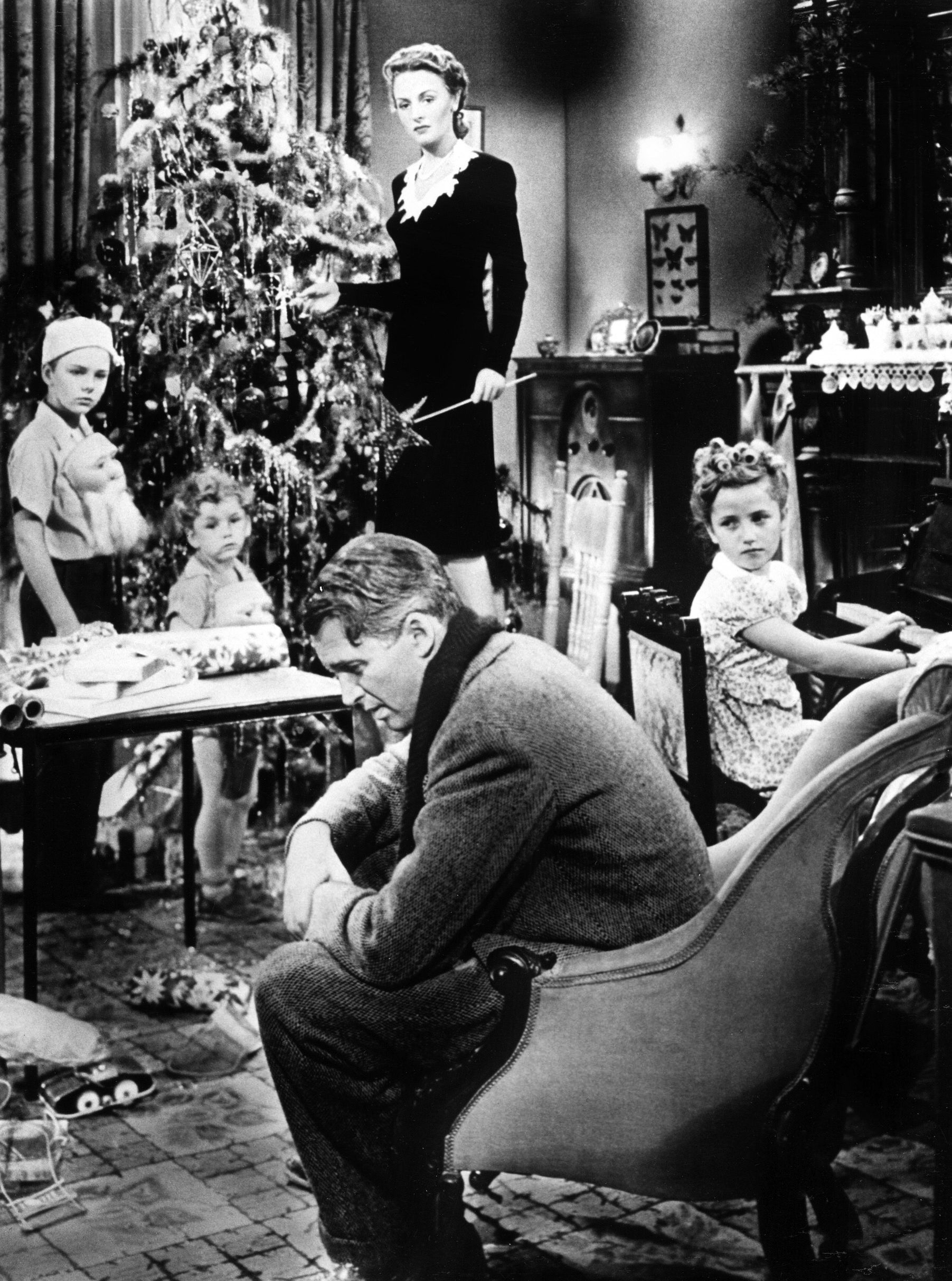
The first of the three to premiere was It’s a Wonderful Life, which entered the world after the holidays, in January 1947. I laid out my views on this dark, disturbing picture in a 2018 column. It’s a great film, don’t get me wrong, as proven by constant television airplay since the 1950s, but man, it’s a tough 130 minutes, seeing as how it features death, grief, alcoholism, depression, moral corruption, and finally, attempted suicide. And no, the picture didn’t bomb on first release; it merely cost three times the usual production budget given Frank Capra’s fastidiousness and the need to recreate Bedford Falls, New York, in the San Fernando Valley (and shoot at 100 degrees in June). With that amount of overhead, Capra’s comeback vehicle wasn’t going to turn a profit on first run.

Two old men drive the plot of IaWL, a bad guy and a good guy: scheming, villainous capitalist Henry Potter and ingenuous Clarence Odbody, George Bailey’s guardian angel intent on teaching suicidal George his lesson (that his is a wonderful life) so Clarence can earn his wings.

As noted in my earlier piece, Jim Stewart did not want to make this picture. Suicide? He’d seen men blow their brains out in the Army Air Forces rather than fly one more mission—events that were covered up for obvious reasons. He just wanted to come home and make a comedy, but this was the only part offered, and he needed to earn a living.

In the story, George couldn’t serve in the war because of a childhood accident that left him deaf in one ear. But his brother Harry had gone on to earn the Congressional Medal of Honor as a fighter pilot for shooting down a kamikaze before it could hit an Allied troop ship. Otherwise, it seems Capra caught the vibe that audiences were war-weary and he steered clear of much war talk in his script.

The next picture of today’s trio took the opposite approach with a major plot line about millions of service personnel returning home from the war only to find a massive housing shortage. This was It Happened on 5th Avenue, which premiered in April 1947, three months after IaWL. It was a story originally bought by Capra, who opted for Stewart and the other property, so veteran director Roy Del Ruth mirrored Capra’s style—little guys, war veterans all, take on a corporate behemoth and (spoiler alert) win.

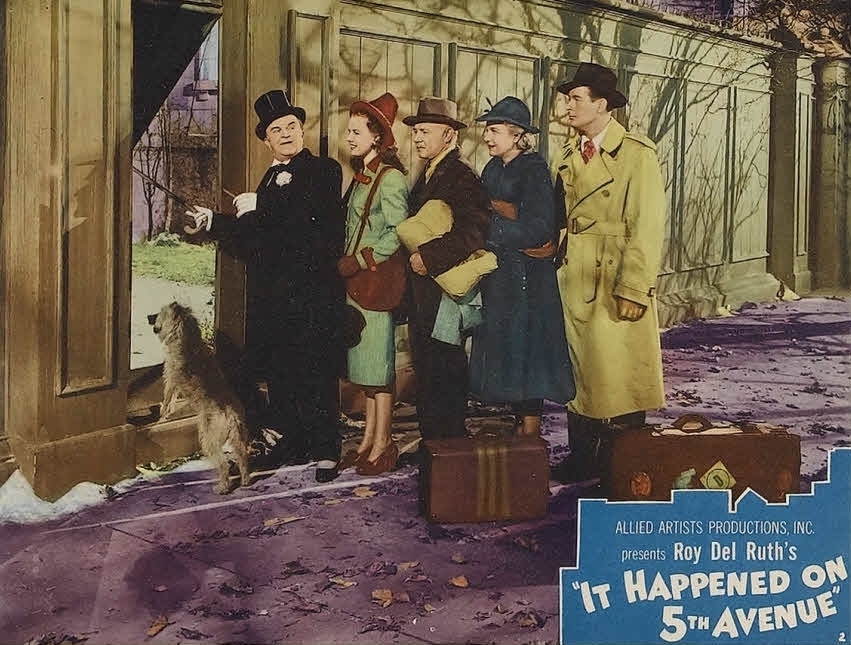
Victor Moore shows Sam the dog, Gale Storm, Charlie Ruggles, Ann Harding, and Don Defore the secret entrance to O’Connor’s 5th Avenue mansion in this lobby card from It Happened on 5th Avenue.

Another old guy drives the plot—a vagrant named Aloysius T. McKeever who devises a way to live in the New York mansion of Michael O’Connor (the second-richest man in the world) when it’s boarded up from November to March. In fact, Charlie Ruggles as O’Connor is another older gentleman key to the story—when O’Connor goes off to winter in Virginia, McKeever and his dog sneak into the mansion and live there alone. Well, this year he is pressed to help several returning warriors and their families who can’t find housing. Suddenly the mansion is bulging with people, including the rich man’s daughter who, in a very convoluted plot, pretends to be homeless. Soon O’Connor himself and his estranged wife are pretending to be homeless and squatting in the mansion and…

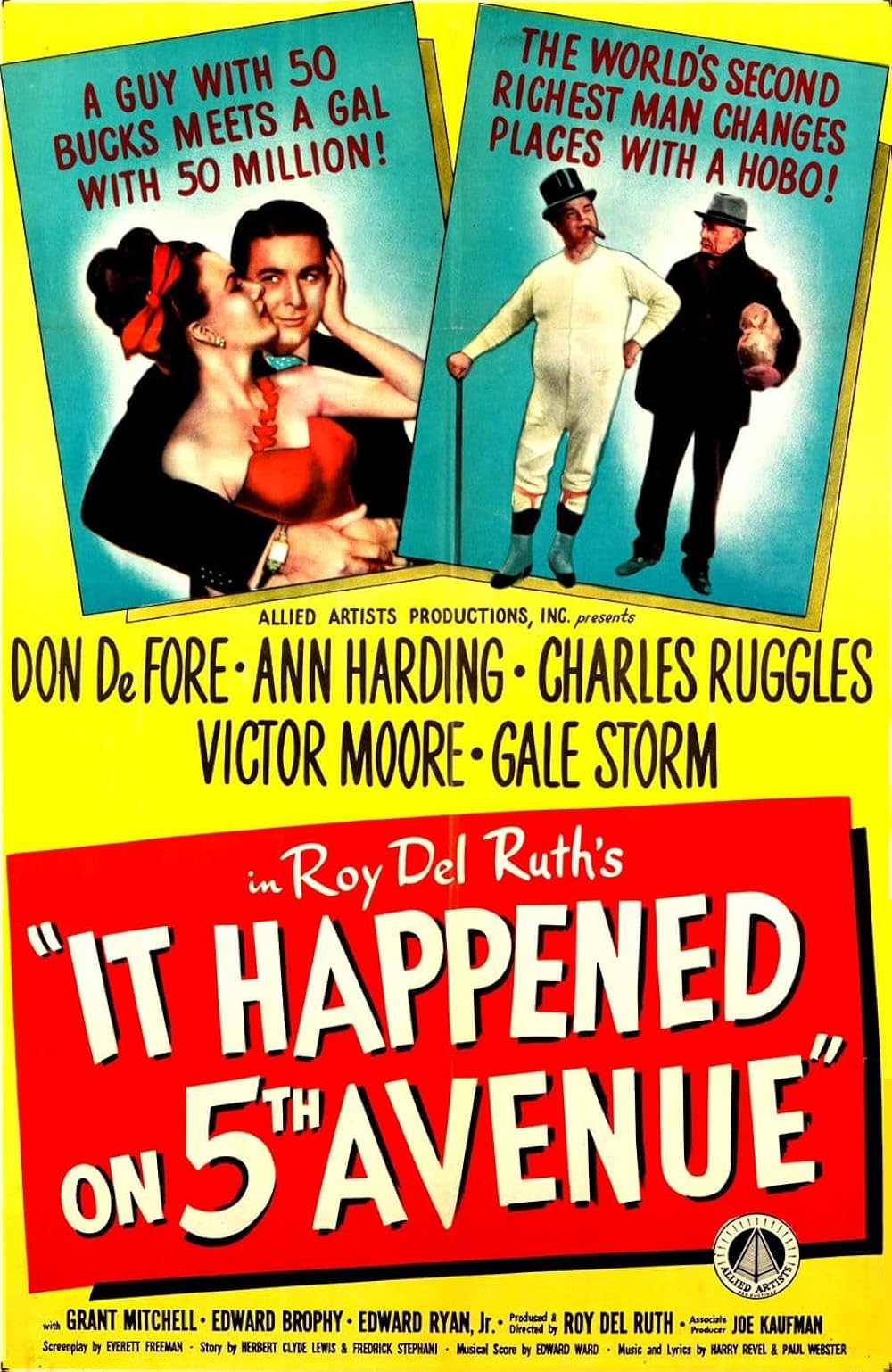
Ad art for a holiday classic that’s been regaining popularity in recent years.

Trust me, it’s a stretch finding credibility in this story. That said, it’s charming as hell and played for all it’s worth by an earnest cast of second-tier Hollywood people including Don DeFore, Gail Storm, and screen veteran Ann Harding. Victor Moore as the New York vagrant uses every ounce of experience stretching back to Vaudeville and the silents to make the part, and the story, work. For my money, Charlie Ruggles does even better as put-upon Mike O’Connor, who has lost touch with his family and reclaims his goodness through lessons learned from Aloysius McKeever, who (in place of true mysticism) does kind things throughout the run time. The best way I can describe how it feels to watch It Happened on 5th Avenue is that the goings on are sprinkled with magic dust. You need to keep watching to learn how these poor people are going to get out of their convoluted mess. Everyone behaves beautifully, with honor, until (spoiler alert) it all works out in the end. There’s no bad guy; no one has bad will. Especially in today’s world, it feels great to hang out with good people for two hours.

Finally in June 1947 came Miracle on 34th Street, which I detailed in a piece lovingly called Santa Claus and the Cold Hand of Death. I find this picture, directed by George Seaton, to be so tightly written and slickly crafted that it’s my favorite of the three. The old man in this case is Kris Kringle, “the one and only Santa Claus,” who is hired by Macy’s to play Santa Claus. He believes he’s Santa; the screenwriters craft him as Santa. At no point is the spell broken as to his identity, except perhaps when Santa turns to violence and bops the unstable, insecure Macy’s psychologist on the head with his cane. That has always bothered me—really, Santa, that’s the only way you can teach the guy a lesson? But then, how else was Santa going to be incarcerated and put on trial so he could be (spoiler alert) vindicated on Christmas Eve? Nits aside, Edmund Gwenn plays the hell out of Santa, brimming with authenticity to the extent that 8-year-old actress Natalie Wood thought he was the real thing throughout production.

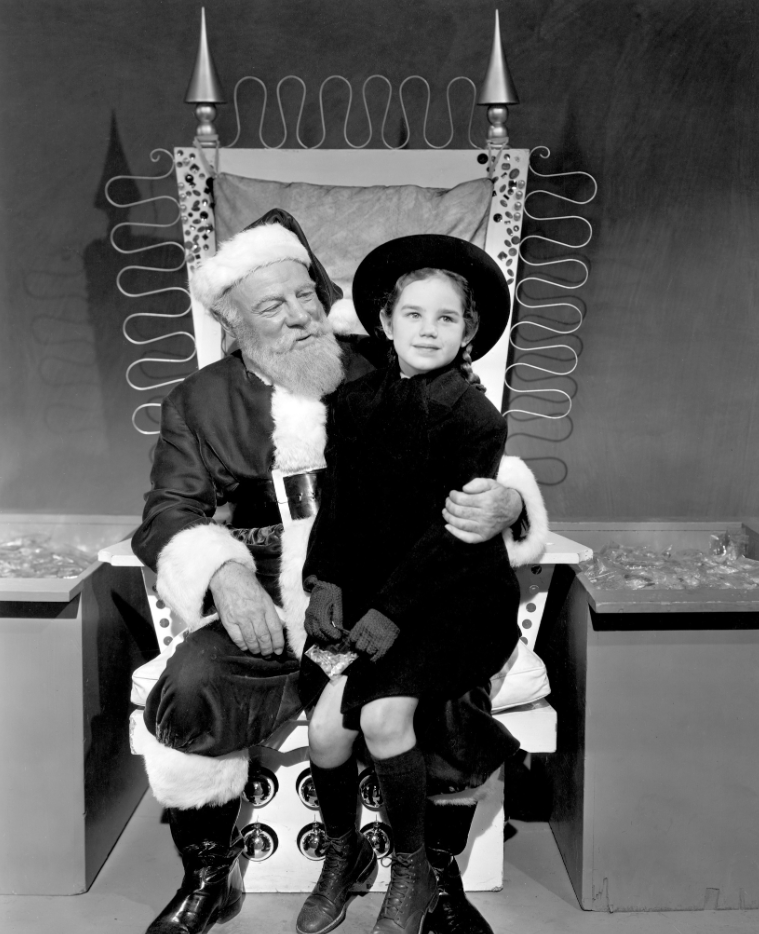
Santa with the Rotterdam survivor.

The war’s cold hand of death in Miracle on 34th Street comes only in the form of an orphan girl from Rotterdam who with her adoptive mother visits Santa at Macy’s. The 1940 bombing of Rotterdam to force Dutch surrender was known all over the world as an example of Nazi evil, so all the parent had to say was, “She’s from Rotterdam” and the implication was clear. Otherwise, this is a story that takes place in a rebounding United States, the war further in the past so that no further reference is necessary. Cash registers are now free to jingle merrily.

So why were It’s a Wonderful Life, It Happened on 5th Avenue, and Miracle on 34th Street made when they were made? When you think about it, cinema had taken a dark turn after the war. Film Noir was all the rage—many of these pictures featured war-scarred veterans. Musicals were dead except for a few at Fox with Betty Grable or Vivian Blaine. But the war-weary world clearly wanted escapism of a gentle kind, because aside from It Happened on 5th Avenue and Miracle on 34th Street, two other top-10 hits of 1947 were The Ghost and Mrs. Muir and a little farther down the road the holiday-themed fantasy, The Bishop’s Wife, about an angel visiting a minister in crisis. Yes, the aftermath of war had caused people to seek a collective restoration of hope, through George Bailey, through the veterans-turned-entrepreneurs solving a housing crisis while holed up on 5th Avenue, and through not only Santa Claus but also Fred, Doris, and little Susan. Each year, many of us seek comfort by reaching back to 1947 to experience all over again the simple beauty of happy endings in post-war America.

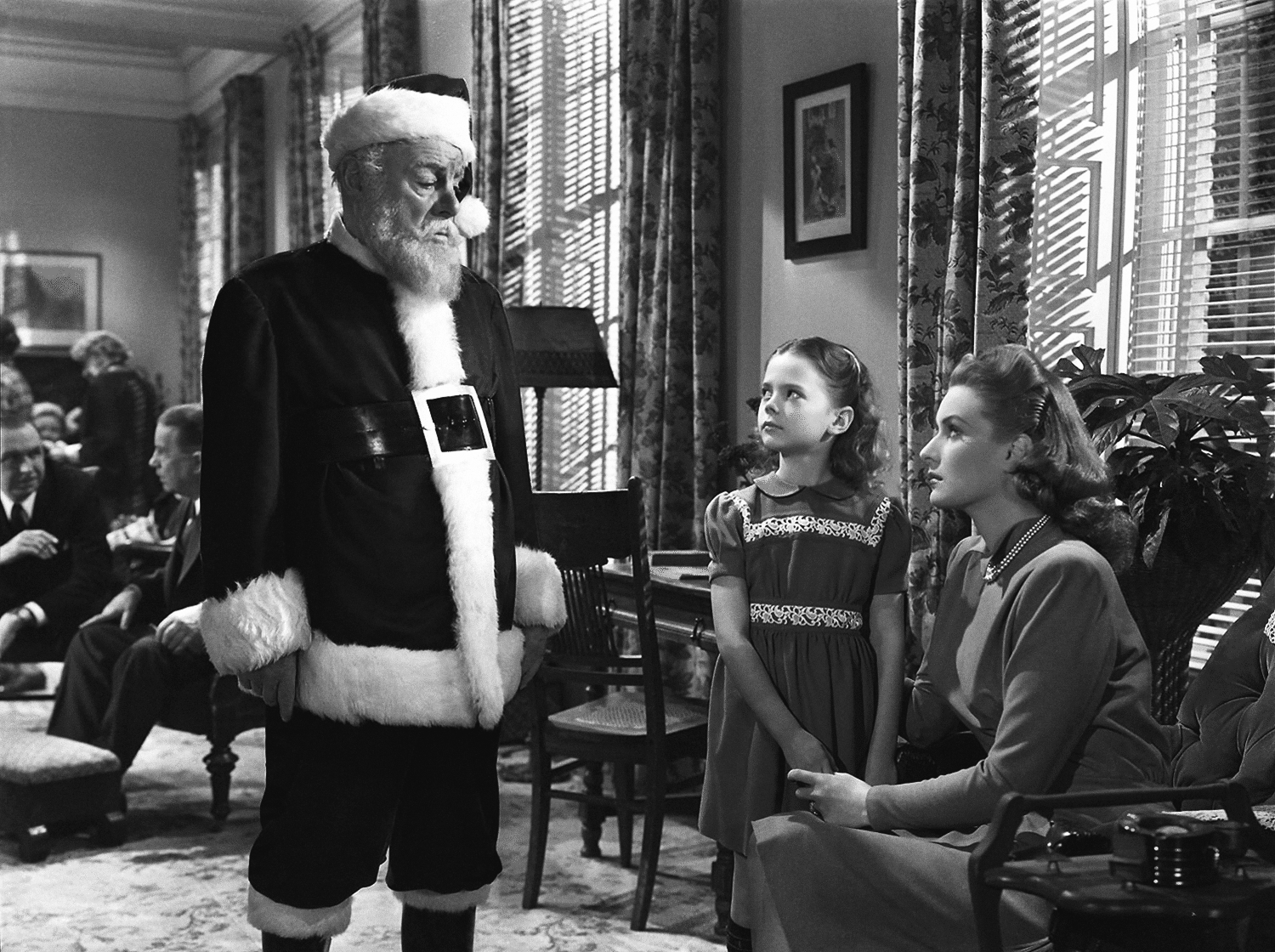
Susan Walker experiences a moment of doubt when Santa hasn’t produced the present she asked for…yet.

They Were Giants

After the rape of Ann Sheridan’s character by a German soldier, Resistance leaders led by Errol Flynn plan revenge in Edge of Darkness.

I’m working on a new book idea involving World War II, and two motion pictures I’ve watched recently on Netflix tangentially touch on my topic.

Narvik, made in 2021, depicts Norwegian civilians in the town of Narvik who watch the Germans march in as occupation begins in 1940. But they won’t accept life under Nazi rule, which leads to an epic battle that marks what came to be known as Hitler’s first military defeat. Fictional characters—Gunnar and Ingrid Tofte—form the emotional core of this real-life and very true-to-history story. He’s a member of the Norwegian army and his company takes to the hills after German occupation, while she’s trapped in town and serves as an interpreter between the occupiers and town officials.

Number 24, a Norwegian production, shines devastating light on Nazi occupation as seen through the eyes of Gunnar Sønsteby.

The other and more recently made movie, Number 24, relates the true story of the most successful Resistance fighter of the Norwegian occupation, Gunnar Sønsteby, a young accountant so nondescript in appearance that the Germans don’t consider him a threat—until continued Resistance activities finally put him in the crosshairs. Through meticulous planning and single-minded purpose, he becomes the key Resistance leader in Oslo and an MI-6 operative for the British government, codenamed “Number 24.” The first half of Number 24 is so unrelentingly tense as Sønsteby tries to evade capture that I didn’t think I’d make it through the next minute, and the second half, full of redemption as Sønsteby begins a vengeance campaign to take out top Nazis, feels better than it probably should as one after another they’re gunned down without mercy.

Both pictures serve as reminders about the brutality of the Nazi empire, and both put me in mind of one of my favorite Errol Flynn pictures, Edge of Darkness, made in 1942 and released early the next year with the war very much in doubt from an Allied perspective. Edge of Darkness also tells a story of the Norwegian Resistance, this time in the fishing village of Trollness. And while much of it was shot in the Burbank studio and on backlots, with the northern California town of Monterey filling in for exteriors, Warner Bros. managed to accurately capture life 5,000 miles away in a country forced to live under the swastika. Imagine a 1943 picture that served up the Norwegian heroine raped by a German soldier; a sympathetic Norwegian woman attracted to a different, sympathetic German soldier; townspeople forced to dig their own graves prior to their execution; and a battle of annihilation that wipes out not only the Germans but most of the villagers.

In all three pictures, the Germans get their comeuppance, and what a triple feature these three would make. Each rings true to an overlooked aspect of history, even though their production spanned 82 years. Enough attention doesn’t get paid to Norway, which—while tucked away off the beaten path of the European war—played a major role in its evolution. Norway was of strategic importance for its iron ore, as shown in Narvik, and the country saw successful raids by British commandos soon after the occupation began, raids that drove Hitler crazy as did the revolt in Narvik. He became so obsessed with what he felt was a looming British invasion of Norway that he stationed 350,000 troops there for the duration of the war—troops that were not therefore available to stem the tide when the Allies invaded France in June 1944.

Another Norwegian release captures the heroism of the Resistance during the epic 1940 battle for the port of Narvik.

The question “What’s the price of freedom?” is both spoken and unspoken in each of these films. You’re either occupied by a foreign power or you’re free. The principals in all three choose to fight for their freedom and do it in ways true to the individual. A scene in Narvik shows Norwegian soldiers, who have just taken a hill from the Germans with the help of French allies, pulling down a Nazi flag and running up the Norwegian colors. It’s a very Edge of Darkness moment and mirrors a scene when Ann Sheridan takes aim with a rifle and shoots a Nazi who’s trying to raise the swastika over her town. “Free Norway!” Judith Anderson shouts into the telephone to Nazis at one point during the Trollness revolt. And when during a Resistance meeting one of the plotters thinks about how their work will be remembered, he growls that history will proclaim, “They were giants in Trollness!”

Oh my God, do I find such stories thrilling! I’m grateful that these two recent productions have focused on the Norwegian Resistance, with both Number 24 and Narvik benefitting from Norwegian productions, actors, and exteriors. This is Norway proudly reclaiming its history, a rich, heroic history that the world needs right now as right-wing authoritarianism threatens various points around the globe. The message of all three movies is singular and compelling: People who have lived free want to remain free and will prove unwilling to settle for others making decisions for them.

Edge of Darkness: The final, seemingly doomed assault on German machine gun emplacements by the Resistance fighters of Trollness.

Tension in the Workplace

Get away from me, you psycho bastard.

It’s been a long time since I had a co-worker of the opposite sex I just couldn’t stand. As in despised. Reviled. Back when I did, it was a good thing I didn’t have to embrace and kiss that person passionately and profess my love as part of my job. So, imagine you’re an actress on an MGM soundstage working with an actor you loathed, like Eleanor Parker working with Stewart Granger.

The picture they made together, Scaramouche, is a Sabatini novel of revenge set in eighteenth-century France during the Revolution. At the turn of the 1950s, as MGM began turning out Technicolor costume adventures by the bucketful to compete with television, Scaramouche seemed a natural fit, following up on a silent version starring Ramon Novarro released back in 1923.

As usual, I’m not going to review Scaramouche except to say I find it a terrific picture in the classic sense of a vengeance swashbuckler with a couple of neat plot twists at the end. Some of you may know I’m not a fan of Mel Ferrer the movie star or the human being, but I’m the first to say he’s perfect as the antagonist in this picture, the Marquis de Maynes. Everyone’s really good in it, and the plot moves at a breakneck pace.

Headliner Stewart Granger had recently come to the States after a string of successful pictures in the UK, and his first big MGM picture in Hollywood, King Solomon’s Mines, had been a smash. So next he would star in Scaramouche opposite former Warner Bros. leading lady Eleanor Parker, whose contract had not been renewed, resulting in a move to MGM. She played the worldly wise firebrand actress Lenore, who loves and hates Andre Moreau, a self-centered aristocratic reprobate played by Granger. The onscreen relationship between Granger’s Moreau and Parker’s Lenore is tempestuous and disguises a natural animosity that existed between the players.

My pal Dick Dinman interviewed Parker in the 1990s, with Granger as one of the topics of conversation. “I can’t even say his name, I dislike him so much,” Parker began before blurting out, “I hated the man.”

Young Janet Leigh never looked better.

Then she went on to describe a pivotal moment between the actors, a confrontation that took place in a covered wagon: “I had to slap him once in a scene. Slap his face. And he said, ‘If you ever hit me while we’re doing this, if you slap me, I’m going to grab your throat and I’ll kill you.’ He said, ‘I almost killed…’ some British actress and he named her name—I can’t remember who it was now—but he said, ‘I grabbed her by the throat and I almost choked her to death.’ I said, ‘Oh, how nice.’ And he said, ‘If you dare to slap me and hurt me at all, I’m going to do it to you.’ He said, ‘I mean it.’ Oh, he was so mean. My mouth dropped open and I wanted to hit him right then. So the scene came up and we were doing his close-up or whatever and you had to see him get slapped…and I went [she grunts faintly] and my hand went up and back. I just couldn’t hit him; he’s looking at me and I couldn’t hit him. He looked proper because he couldn’t glower at me with his face to the camera. So I didn’t want to hit him.

“The director [George Sidney] said, ‘Cut! Eleanor, what’s the matter with you?’

“I said, ‘I want to talk to you for a minute.’”

Him: “You fancy me.” Her: “No, I hate you.”

They went off by themselves and she told him, “He threatened me. He’s going to grab me by the throat and kill me if I…slap his face, and I don’t know what to do.”

George Sidney said, “He’s a coward. Never mind him. Hit him as hard as you can. Don’t worry. All the crew—everybody, we’re right here to grab that man and kill him if we have to. You just hit him as hard as you can.”

They played the scene and she gave him a stage slap as instructed.

“When they said ‘cut,’ he looked at me, turned around, and he never spoke to me for the rest of the movie. He didn’t do anything, but he never spoke to me. If I walked up and he happened to be in a group, he would turn around and leave or he would stop talking and just stand there until I left. It was most embarrassing. And that’s all I was doing, what the director told me, and I had to do it because it’s written in there [in the script].”

Hearing this story from Parker years ago soured me on Granger, and nothing I’ve heard since really counters the impression she gave of the man. He did indeed have a reputation as a cold narcissist, and what strikes me now watching him is a naked attempt to copy the style and mannerisms of Errol Flynn, which he couldn’t do because he didn’t have Flynn’s charm. Parker had co-starred with Flynn twice and, despite Errol’s bad-boy reputation, said he was a pro on the set and always respectful—never the malevolent presence she described in Stewart Granger. She summed it up saying of Granger, “He was so awful, the rudest, nastiest guy; I just hated him. Everybody did.”

To Dick Dinman’s great credit, when he interviewed Stewart Granger, he asked him about the alleged difficulties with Eleanor Parker on the set of Scaramouche. “I don’t know what it was,” said Granger, “but she had great pleasure in smacking me, really belting me as hard as she could. I mean, she didn’t pull her punches. Normally we actors and actresses pull our punches; we slap it away. One scene where I’m sitting on a basket and I’m joking with her and being difficult and she says, ‘Oh, you!’ and she goes and knocked me out. She hit me so hard that for two seconds I can’t think where I am.”

Well, yes, Mr. Granger. You threatened her and the director urged her to let you have it, with 30 or 40 crewmen as backup.

But his next comment revealed the kind of misogynist that ruled in Hollywood at the time: “There were problems with Eleanor Parker. She was a darling, but she was—I guess I was a bit of a naughty fellow, you know. [I] wouldn’t play ball in the way she—I don’t know what it was, but she seemed…you know, a lot of women like to slap men really hard, especially if they fancy you. And I think maybe she fancied me in those tights.”

Hats off to both Ferrer and Granger for a commitment to excellence making this swordfight sizzle.

Um, sure, Stewart. She must have fancied you because you were irresistible in tights. Never mind the threats of murder.

Given that I’m not a fan of Mel Ferrer and I’m not a fan of Stewart Granger, Scaramouche remains for me a hoot. It’s one of those pictures that’s been sort of lost to the ages and definitely one where you need to suspend your disbelief. But, boy, the furious chases on horseback, the lush Technicolor with Janet Leigh in her prime and Parker’s flaming red hair, and the six-and-a-half-minute climactic swordfight in a theater that’s equal parts athletic and deadly, make this for me the best of the 1950s. And knowing of the tension between the leading man and his co-star makes for interesting sport as you watch them work together, especially in that scene in the wagon.

But you know what’s funny? That one female co-worker I just couldn’t stand back in the day is one I now look back on with fondness, understanding in hindsight that I generated a lot of the conflict by being young and full of myself. It doesn’t seem that any such self-reflection ever made it into the mind of the late Stewart Granger.

The Big ‘However’

It’s baffling to me to think that in my lifetime, there was a thing called segregation. In my lifetime! I wasn’t old enough to actually see a restroom or swimming pool for “colored people,” so when I’m reminded that even in the 1960s things were that way, I’m stunned. All of which points out to me the twentieth century trailblazers who wouldn’t settle for the two-tier system in America, such as Warner Bros. executive producer Hal Wallis. As detailed in my book Season of the Gods, Wallis despised studio boss Jack Warner, whose narcissism clashed with Wallis’s own fearsome ego. One of the things they clashed over was Black talent.

Hal Wallis (right) with Casablanca director Michael Curtiz and Ingrid Bergman.

Years ago, while combing the U.S.C. Warner Bros. Archives, I came across a summer 1941 Jack Warner memo indicating he wanted some “colored people” for comic relief in the Custer biopic then in development starring Errol Flynn. Warner was an advocate of comic turns in all the WB pictures—they called them “bits of business” back in the day—always done by white character actors like George Tobias or Alan Hale, or by Black actors like Clarence Muse. In the case of the Custer picture, the Jack Warner memo resulted in the appearance of a “boy” tending Custer’s hounds at the beginning of the picture, and new scenes for housekeeper “Callie” played by Hattie McDaniel, then not far past her Academy Award win for Gone With the Wind. McDaniel’s Oscar, richly deserved for a nuanced performance as Mammy, had sent shock waves through the continent—America wasn’t ready to recognize 1) a Black character as wiser or more grounded than the white characters in the piece, or 2) a Black performer as talented as Caucasian counterparts.

Hattie McDaniel with the teacup ‘bit of business’ in They Died with Their Boots On (1941).

I don’t know about you, but McDaniel’s bits of business in the Custer picture They Died with Their Boots On have made me uncomfortable for decades—the bit about the fortune telling with the teacup and rabbit’s foot and the thing in the garden with the owl. Yikes. But that was Jack Warner for you, always ready to beat people over the head with painful humor delivered in person through notoriously horrendous jokes or through his pictures of the 1930s and 40s, none of which I find funny. Whether it’s Boy Meets Girl or Arsenic and Old Lace, the humor is loud, desperate, and, to me at least, painful.

But back to the Hal Wallis–Jack Warner enmity. Wallis acquiesced to Warner in the case of Custer, but times were changing. At the turn of 1942, with America newly launched into world war, Wallis bought a stage play called “Everybody Comes to Rick’s” and jammed it into the production schedule, renaming it Casablanca. A key member of the cast was a gay “Negro” piano player called Sam the Rabbit, who was written as a stereotype of the times. However, in developing the characters and screenplay of Casablanca in February and March 1942, Wallis was seeing headlines like this one in Daily Variety: BETTER BREAKS FOR NEGROES IN HOLLYWOOD. Dated March 24, the article began, “Negroes are to be given an increasingly prominent part in pictures,” according to Walter White, head of the NAACP. White stated that “Darryl Zanuck and other production chiefs had promised a more honest portrayal of the Negro henceforth, using them not only as red-caps, porters and in other menial roles, but in all the parts they play in the nation’s everyday life.”

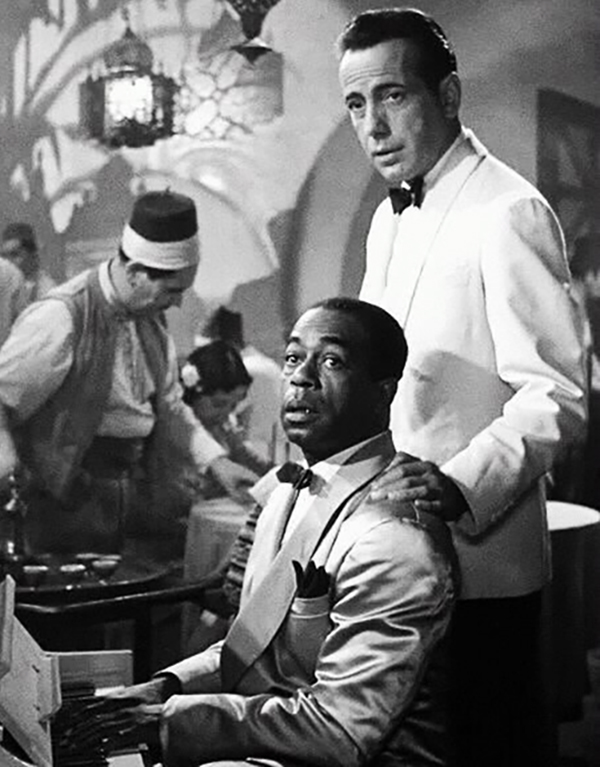
Dooley Wilson as Sam, Rick’s loyal BFF.

Hal Wallis embraced this controversial new approach, reasoning that “Negroes” were fighting and dying for their country in the war, spilling the same color blood as white people, so why not treat them as equals in pictures? First up was the role of Parry played by Ernest Anderson in the Bette Davis sudser, In This Our Life (1942). Parry was the young son of a household cook (Hattie McDaniel again) who was wrongly accused of a fatal hit-and-run accident. He’s cleared by the end of the picture and off to law school—and throughout, his part isn’t played for laughs. At all. And with Casablanca, Wallis considered the same approach—taking the character seriously. Wallis considered writing Sam as a woman and casting either Hazel Scott or Lena Horne until studio story editor Irene Lee and writers the Epstein twins won Wallis over that Sam must be a male to head off any thought that Rick and his piano player might be romantically involved—which would sap the intensity of the Rick–Ilsa dynamic.

Over time, veteran Black character actor Clarence Muse was considered for the part of Sam, and Hollywood newcomer Dooley Wilson was chosen. All the while, Jack Warner played rooftop sniper and argued against letting Sam be played as Rick’s best friend and confidant because the picture might be banned in the American Deep South for showing a Black man as Rick’s equal. And Wallis kept pointing to the war effort and the changing times, stuck to his guns, and gave the world a character for the ages in Sam, a role and a performance that holds up 100 percent today, going on a century later. There isn’t one false note in Dooley Wilson’s characterization, not one cringeworthy moment of the kind that mar Hattie McDaniel’s performances—bits forced upon her to reassure white viewers they were indeed superior.

Flora Robson as Queen Elizabeth with Flynn in The Sea Hawk (1940); Robson as a Black slave with Ingrid Bergman in Saratoga Trunk (made in 1943; released in 1945).

Now we come to the big “However.” Just months after Casablanca wrapped, Wallis started work on a picture called Saratoga Trunk, from the novel by Edna Ferber. The lead role of Clio Dulaine in Saratoga Trunk was coveted, much as had been the part of Scarlett O’Hara in Gone With the Wind. I remember how badly Olivia de Havilland in particular wanted to play illegitimate, half-Black Clio returning from France to post-Civil War New Orleans to avenge her mother. But do you know who Hal Wallis chose for Clio in Saratoga Trunk? Fair-skinned Swede Ingrid Bergman, that’s who, her hair dyed black to “satisfy” the problem of race. And for the part of Clio’s Black maid Angelique, Wallis selected very white, British-born Flora Robson, who just three years earlier had portrayed Queen Elizabeth I in Flynn’s The Sea Hawk! For Saratoga Trunk she’s slathered in hideous dark-skinned makeup because, Wallis said, “the role was so large and important that it was beyond the range of many [Black] actresses of that time.” Um, OK, Hal. Sure. Ironically enough, Robson would be nominated for an Oscar for her take on Angelique, whereas today, viewers simply take one look at her, gasp, and go, “Wut up with the blackface?” So, sometimes Wallis challenged the norms and sometimes he didn’t; after all, Wallis straddled the line between artist and businessman. When he got it wrong, the result was Saratoga Trunk, a picture known only to die-hard cinephiles. When he got it right, the result was Casablanca with its many perfections, not the least of which is quiet, steadfast Sam, best friend of the white guy. (And I’ll bet you Rick’s Café Americain didn’t hold even one segregated restroom.)

Questioning Why

Lawman moves to syndication sporting great numbers.

I work at a communications firm with a lot of younger people who are always talking about the latest movie or series they’re consuming. They get so excited talking about it, and one will mention a title and three others will chime in with enthusiasm. They don’t seem to notice that I’ve gone mute and averted my gaze because I have no idea what the hell they’re talking about and have nothing to contribute to the conversation. I remember the time the owner of the company came into my office maybe 15 years ago and asked me what my favorite television show was at that time, and I said, Cheyenne. She’s older than I am and started singing the theme song from Cheyenne, a western that ran from 1955 to 1962. Even then my boss thought it was funny that my favorite show was 47 years old. Yes, I continue to be trapped here in—wait, what year is it?—while my psyche lives in the dim and distant past. When I read a book, it’s about the Civil War or WWII; when I watch TV, it’s nothing that was made after 1975. You get the idea.

What’s your point, Robert? OK, my point isn’t anything about Lawman, per se. My point is about the nature of addiction, and are addicts born or made? Do you decide one day that you can’t live without your liquor or pills or chocolate? Or are you born with these unquenchable desires? I watch Peggie Castle on Lawman when she was 33 and 34 looking for clues about the addiction that would go on to kill her a decade later: hardening of the arteries and cirrhosis of the liver. She strikes me as such a tragic figure, this tall and willowy blonde who, you would think just by looking at her, had the world by the balls. For all I know after some quick research, Peggie Castle’s biggest problem at the time of Lawman was trouble keeping weight on to the point that her diet featured mainly pasta. Were those bags under her eyes a hint at late nights on the bottle? Or trouble sleeping caused by worry that would go on to cause the drinking?

One of my favorite shows is Lawman, a Warner Bros. western in production from 1958 to 1962. Lawman featured John Russell as Marshal Dan Troop of Laramie, Wyoming, who could draw pretty fast but lived more by an unwavering moral compass. Season one went well for Lawman in a booming period for television westerns, so for season two they decided to write in a love interest for Dan Troop (a couple of prospects had washed out in season one because of lack of pizzazz and chemistry with Russell). Warner Bros. hired 32-year-old Peggie Castle for the role, she the star of some noir B and costume pictures made throughout the 1950s. Sure, she had some roles in A pictures, but more often she made an impression as the “other woman” who was murdered in the second reel. The nasty film noir 99 River Street comes to mind.

Peggie Castle (left) in pre-Lawman days, vixen and murder victim in 99 River Street.

Four marriages by age 30 (the first in 1945 at 18 to a serviceman) make one suspect a capricious person, or an unhappy one looking for a stability she couldn’t muster on her own. The fact that she made her last motion picture right before Lawman and left television at the show’s cancellation in 1962 speaks to a general lack of ambition, or a need to get away from a Hollywood that seems to have been pretty good to her over the course of 12 years of steady work.

Russell as Lawman Troop; Castle as saloon owner Lily Merrill. Studio flak hinted at onscreen wedding bells in season four.

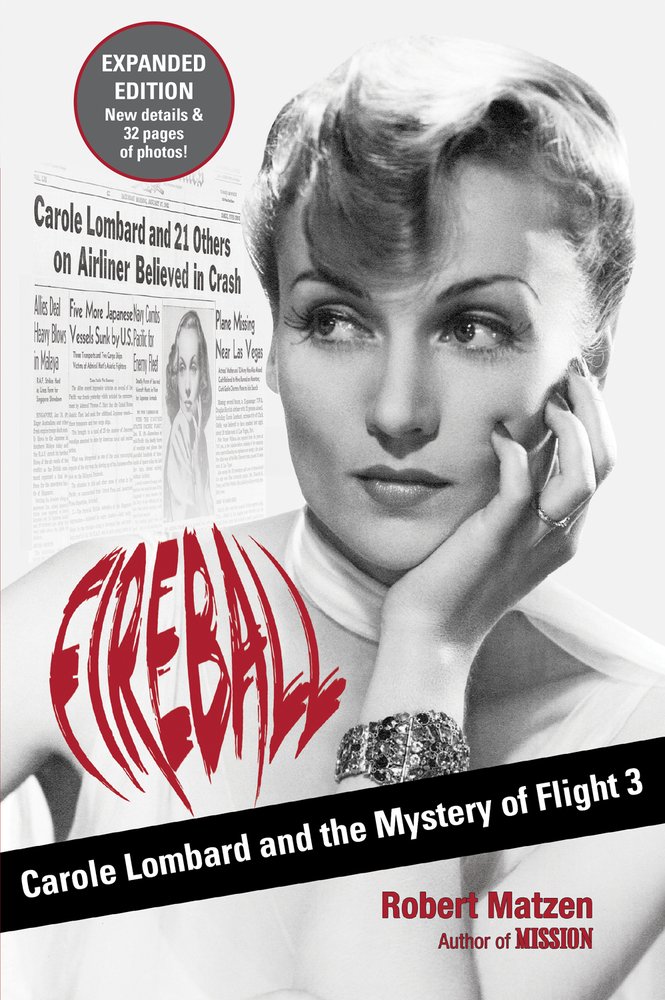
After Lawman, Peggie Castle would make just one more appearance in series television, a walk-on in a 1966 episode of The Virginian that was shocking for a couple of reasons. Her part as a dance-hall girl amounted to one scene that had nothing to do with the plot; it was something obviously written as a favor or a motivator, probably with ex-husband William McGarry pulling the strings. McGarry served as a long-time assistant director with a career that went back to To Be or Not to Be with Carole Lombard in 1942, and his many credits include Breakfast at Tiffany’s with Audrey Hepburn. (Oh, by the way, I wrote books about both actresses. Fireball. Dutch Girl. Warrior.)

I gasped the first time I saw Peggie Castle in this scene in The Virginian that was shot around the holidays 1965. Three and a half years had passed since Lawman wrapped production in May 1962, and Castle now looked like absolute hell, sporting what appears to be a black eye. They could cover that left cheek with makeup, but the swelling was another story.

Last glimpse of Peggie Castle–a one-scene curio on The Virginian.

If somebody were to write a book about Peggie Castle, I promise to buy it to learn what story arc set this woman on a path of self-destruction that ended when ex-husband McGarry found her sitting on the couch in her Hollywood apartment, dead at age 45. In an era when players earned no residuals for their movie and TV work, how did she pay rent for that apartment? How did she buy enough booze to wreck her body so fast? Most importantly, why did she lose the desire to live and work and need to be anesthetized 24/7? Did Hollywood kill her as it has taken so many others, and if she had never left Appalachia, Virginia, would everything have been different?

Lots of questions and no answers as I sit trapped in time watching Lawman.

Masters of Fear

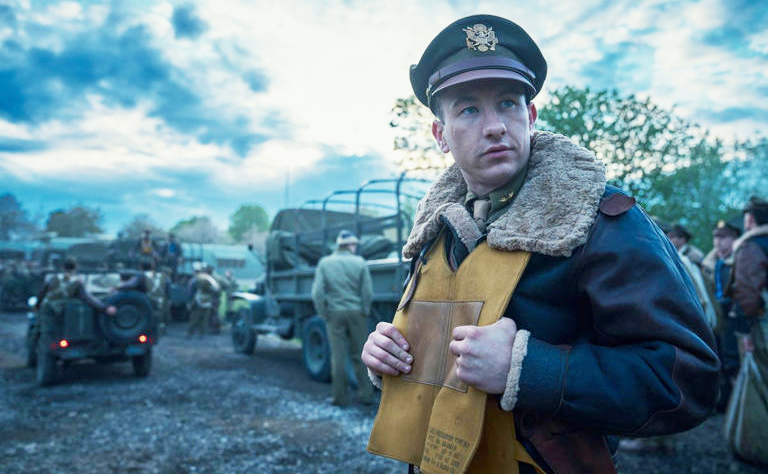
Callum Turner portrayed the real flier John Egan and Austin Butler the real Buck Cleven.

***Check out the fun exercise I was asked to complete at Shepherd.com regarding my latest book,
Season of the Gods, the true story of how the screen classic Casablanca came to be.***

I admit to some skepticism going into the Spielberg/Hanks miniseries, Masters of the Air. It had been so long in production through the pandemic that I figured the delays meant conceptual trouble—and disappointment for the viewer. Episode 1 seemed to confirm my suspicions, as the characters didn’t grab me and the darkness of frame and mumbling of dialogue hinted at trouble ahead.

You see, here’s the thing: I wrote a book called Mission: Jimmy Stewart and the Fight for Europe that saw me dive deep into the history of the air war over Europe. I became all about the Eighth Air Force and the heavies and “little friends,” with the help of fliers in their 80s and 90s who still lived life at 20,000 feet battling Germans in their dreams and nightmares. All had flown with Stewart and knew him as a damn good command pilot. My research included visiting bomber bases in the English countryside and taking rides in B-17s and B-24s because I knew if I got one thing wrong in this story, the WWII buffs would nail me for it, and so I triple-checked every detail before publication.

I grew fond of Barry Keoghan as Lt. Curt Biddick, only to see him die in an exploding B-17. Note the vividly realistic bomber base in the background.

When you get that close to a topic, it leaves an impression. I have since been driven to watch the best Hollywood picture about the air war, Twelve O’Clock High, made in 1949, over and over. The other one to watch was Memphis Belle, the 1991 feature that for the first time showed us not aging Hollywood character actors populating the cast and bomber crew but young men in the cockpit and young men manning the guns.

OK, bear with me. The average age for the pilot of an American heavy bomber in World War II was 22. Twenty-two. The pilot was the commander of the ship and in charge of the other nine living, breathing young men onboard. If the 22-year-old didn’t do his job right, those boys in the plane were dead. If he did do his job right, there was still a very good chance they were dead because these kids took to the air every day against many dangers, most prominent of them the German air force—the Luftwaffe.

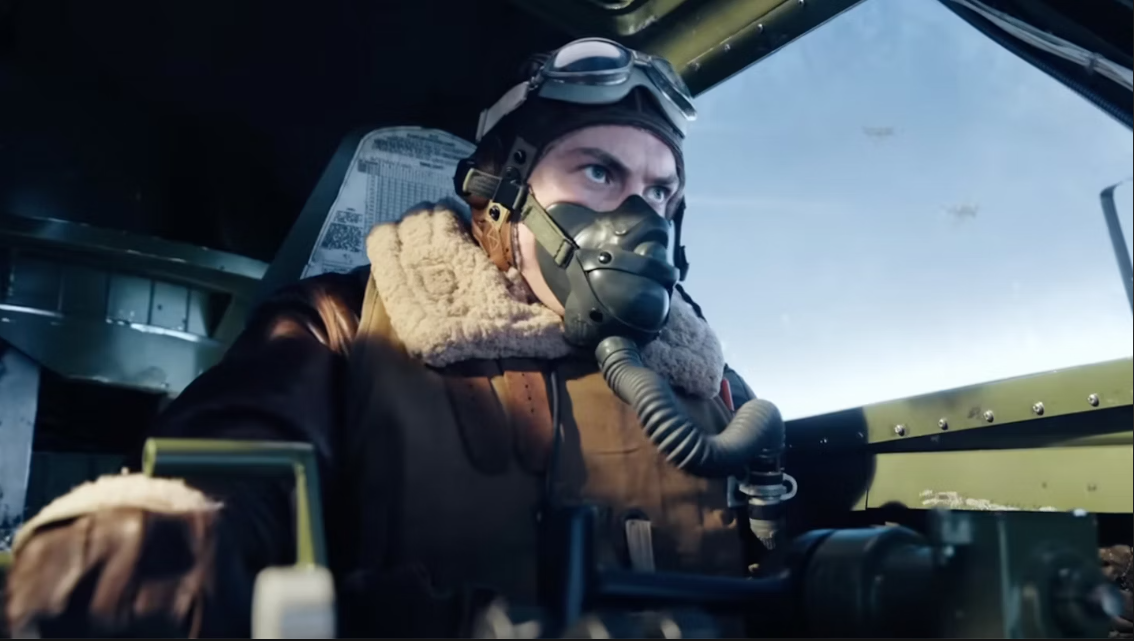
I found it fascinating as I wrote Mission to learn about all they faced. Jim Stewart didn’t fly the glamorous B-17 depicted in Masters of the Air. He flew the B-17’s ugly stepsister, the B-24, which could carry more bombs but was prone to fuel leaks. In short, you could blow up because of leaking gas at any point on a mission. If you managed to get to altitude in the horrible English weather, always cloudy, always damp, and if you didn’t collide with another bomber in the crowded skies, you’d get to altitude and put on an oxygen mask as the temps dropped to 30 or 40 below zero Fahrenheit. One of Jim’s contemporaries, Lucky Luckadoo of the “Bloody Hundredth” bomber group, said just the other day that it was so cold at altitude in European winter that if you took off your gloves for even a minute, you risked your fingers “self-amputating.” They would break off in the cold.

Nate Mann played Rosie Rosenthal, a fearless pilot who flew 25 missions to earn his ticket home—and re-upped because the job of defeating Hitler wasn’t done. Note the lack of a grotesque, foot-long icicle on the oxygen mask at altitude, one of the concessions to telling a concise story.

Now, back to Masters of the Air. For me, everything changed with episode 2, depicting the first mission of the 100th Bomb Group, which was one of the first units to take to the air to bomb continental Europe. They went up in a recently invented airplane, 10 men to a crew, and were slaughtered trying to bomb targets in various parts of Germany. Inhuman slaughter, yet these young guys kept going up, kept fighting Hitler, doing their part. And they kept getting shot down. It’s telling that the three WWII fliers who helped me write Mission all were shot down on missions to Germany. All three bailed out of a falling bomber on different missions and spent the latter part of the war in German prison camps.

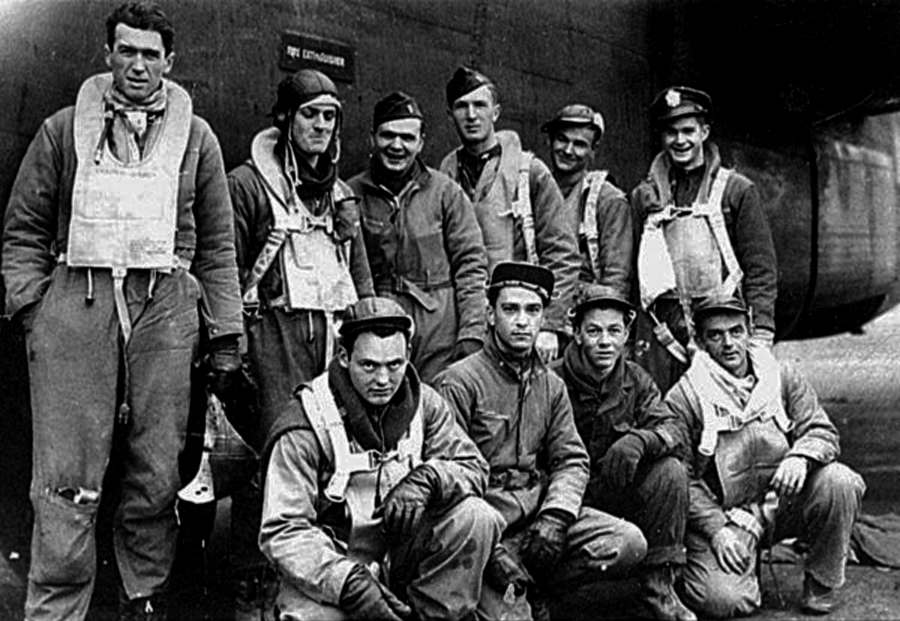
Jim Stewart at left early in 1944 with the crew of the B-24 known as “Lady Shamrock.” Masters of the Air meticulously recreated the gear worn by each flier, which included a heated flying suit under shirt and pants, overalls, jacket, boots, gloves, a flak vest, headset, mae west, and parachute.

I’m finding that Masters of the Air tells a powerful story powerfully well. Sure, there are nits to pick, as with any historical miniseries, but to me, this is spellbinding stuff. All the characters depicted in the series are real; they lived and breathed—and many died—during World War II. It’s interesting to me that of all the perils depicted, the filmmakers didn’t or couldn’t take the time and expense to show the ice that formed around oxygen masks. So much ice that fliers would have to beat it off with their fists. But this bit of realism might, I guess, amount to a distraction as the film shows you how German fighters would zip by the planes and stitch them with machine gun fire as flak bursts detonated all about. These factors alone reveal what the guys in the planes went through. Young, young men fought that air war a year before the landings at Normandy. I dare to call them boys. Imagine for a moment that your own kid of 20 or 22 has to bear the responsibility of combat missions in a plane that a few years earlier had existed only on drawing boards. For a stretch, the fliers, these boys and young men, were the only Americans fighting in Europe, doing so as described—at 20,000 feet and 40 below.

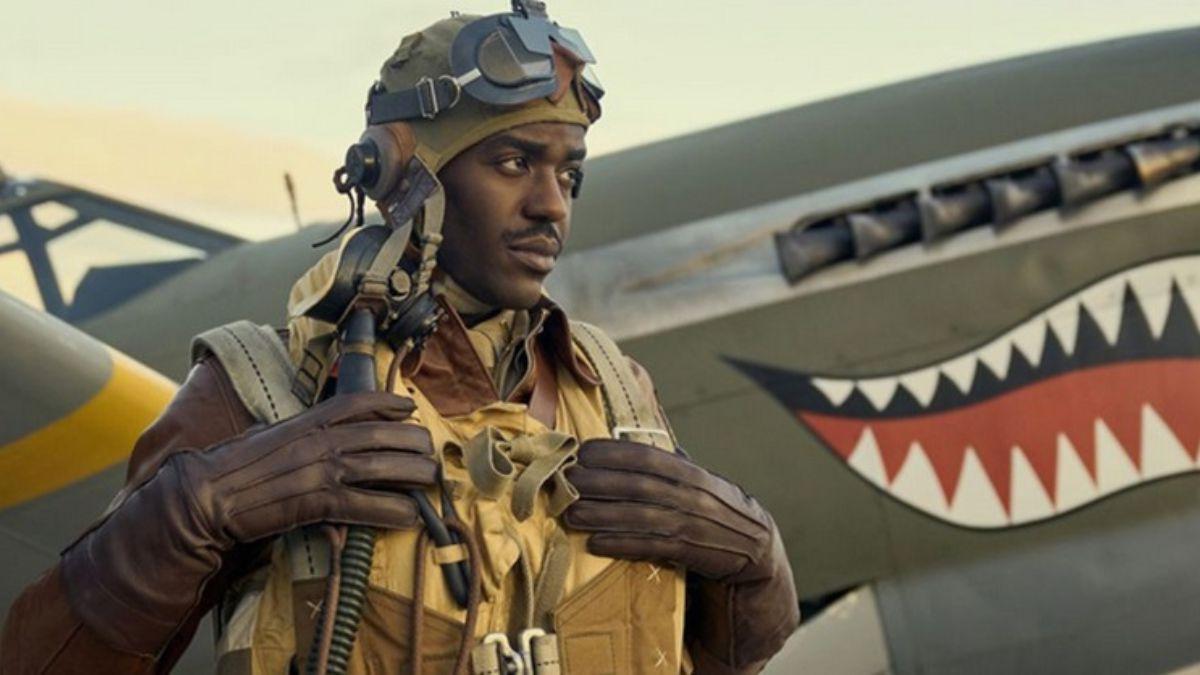
Ncuti Gatwa played 2nd Lt. Robert Daniels of the 332nd Fighter Group, better known as the Red Tails and Tuskegee Air Men. Daniels was shot down in a mission over Marseilles and then a prisoner in Luft Stalag 3.

Masters of the Air manages to cover a lot of story threads, from the psychological toll of the missions to the grief of losing friends, from the fliers who bailed out and evaded capture with the help of the various resistance movements to those who ended up in German prison camps. In episode 8 we meet the Tuskegee Airmen of the 332nd Fighter Squadron and I was glad to see them. Welcome to the war, boys! Welcome to this series, showing us what it was like for black fliers doing their part and facing a cold reception after they had been shot down and arrived at Luft Stalag 3. Sometimes you barely get to know characters before they die in battle, but guess what—that was their experience, too. You met a guy yesterday, and today he died in an exploding plane.

I’ll be sorry when Masters of the Air ends with episode 9. It has been an emotional experience for me as an author who listened to stories from men who lived this part of the war; an author who tried to do those stories justice in Mission. How did any of these fliers master their fear to climb into those planes time and again, knowing the odds? They did it for freedom, for democracy—ideals that have become so fractured in our modern day. But Steven Spielberg and Tom Hanks clearly understood these concepts when they took on the mission of giving us Masters of the Air, which provides a visceral look at what the young men of the U.S. Army Air Forces endured on the long haul to victory in Europe.

********

Miracle Baby

I’ve written a novel. I didn’t plan on writing a novel and didn’t have any ambition to write one. It’s like out of the blue I learned I was pregnant and out popped this historical novel. If you ever read the Pulitzer Prize-winning The Killer Angels by Michael Shaara, this novel is like that. Except instead of being about real-life characters fighting the battle of Gettysburg, it’s about Warner Bros. in 1942…and features all real-life characters fighting studio battles while they live their lives at the beginning of U.S. involvement in World War II.

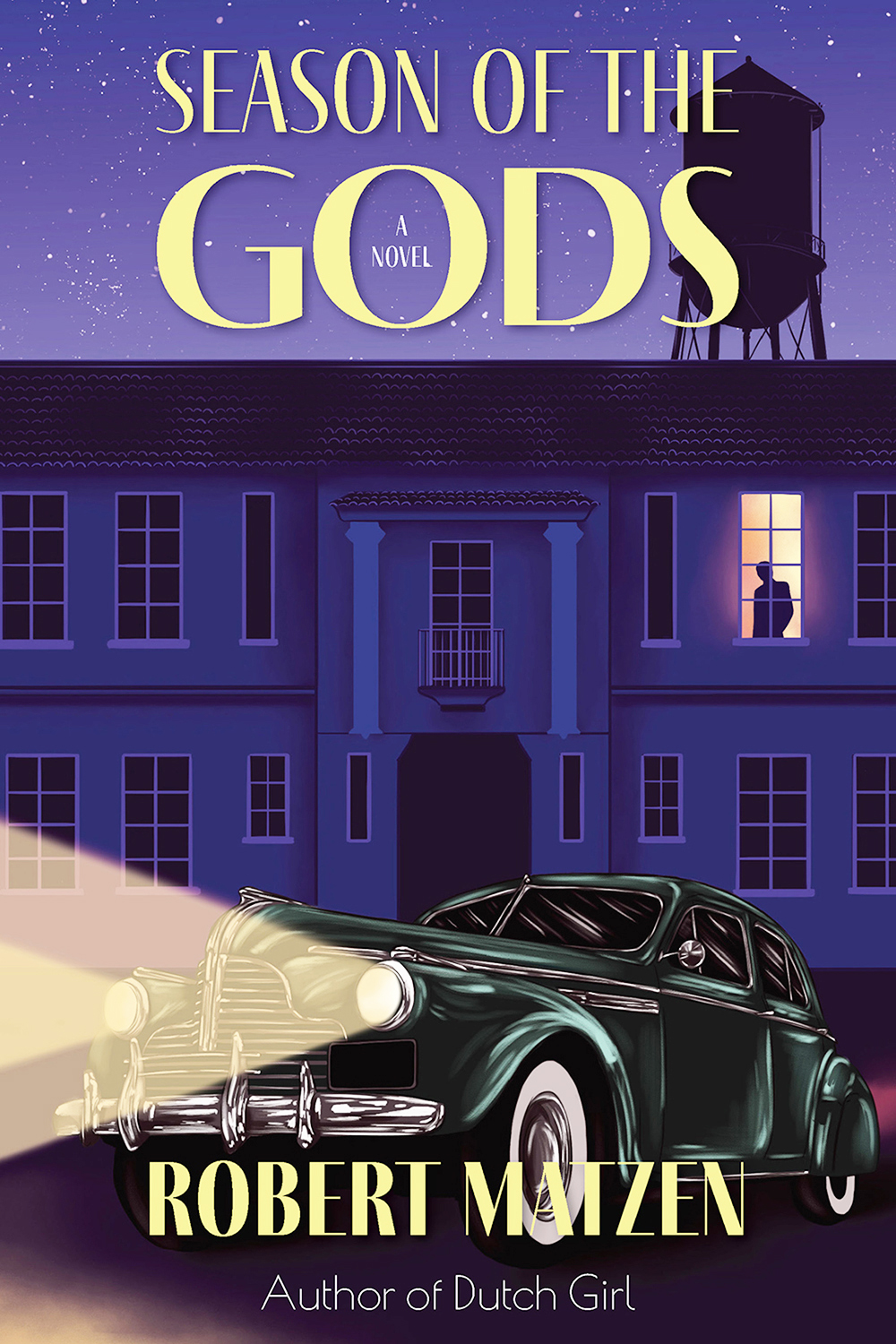
It’s called Season of the Gods, which is an allusion to the power held by Hal Wallis as the Zeus of his Burbank Olympos, and all the lesser gods who schemed and feuded in the name of art on the one hand, and commerce on the other. Reactions to date from Hollywood experts who had read the manuscript are positive. All systems are go.

I’ve learned plenty about the craft of fiction in the last year courtesy of this experience. My knuckles are black and blue from being rapped by my editor for using nonfiction techniques instead of fiction techniques. I’d write a biographical paragraph and, WHAP! Right across the knuckles. I’d summarize some episode or other and, WHAP! Another one across the knuckles. Don’t summarize, she’d say. Live the moments. It’s almost like I wrote the novel twice, once the wrong way, and then again the right way.

I knew what I wanted the story to be about, but I didn’t know that once characters come to life, they have minds of their own and suddenly what you thought was going to happen doesn’t happen, or doesn’t happen the way you figured it would. And that led to the most fun I’ve ever had writing, finding out what these people would say or do next.

Season of the Gods concerns how a woman executive named Irene Lee (yes, a woman executive at Warner Bros.) had a funny feeling about an unproduced stage play and approached Hal Wallis about buying it. He had just bought rights to The Man Who Came to Dinner and was negotiating for Watch on the Rhine, so when Wallis hears it’s a stage play out of New York, he asks Lee, “Which theater? Who’s starring?” She confesses it’s unproduced and he says, “No track record? No stars? No press? Pass.” But Lee’s a sharp cookie and develops her own game plan to work the system and get the property in the door. Then she’s involved every step of the way through all the twists and turns and politics and serendipity and genius day by day as the unproduced stage play becomes an ever-more-important component in the Warner Bros. production schedule for 1942.

Irene Lee had served as story editor at Warner Bros. for eight years at this time. She stood five-foot-nothing and weighed a hundred pounds soaking wet, but by age 31 was going toe to toe with Wallis and with the chief himself, Jack Warner. Irene sought to become a producer—which was unheard of at the time, a woman producer—and even after Wallis shot the idea down, she became the de facto producer of her pet project, proving you shouldn’t get in Irene Lee’s way.

Her unproduced stage play arrived at the studio on Monday, December 8, 1941, the day after Pearl Harbor, and within two months, Hal Wallis had changed his mind about moving forward with it, despite the fact the play had no track record, or stars, or press, and its plot about all manner of illicit sex couldn’t be filmed because of censorship restrictions. The idea and setting were too good to pass up, and the concept could be adapted as a war picture, which was key because the day after Pearl Harbor, the United States and Japan were at war, and a couple of days later came a U.S. declaration of war against Germany.

As the novel unfolds, everyone in Hollywood worries about a Japanese invasion every moment. Were the carriers that had taken out Pearl Harbor going to steam east and flatten Los Angeles? Nobody knew. And, in fact, Japanese submarines did shell the coast in January, so Californians had reason to worry.

Throughout pre-production of Irene’s picture, the Allies were losing the war. It wasn’t until after cameras rolled, after a very long stretch of script development, that the U.S. fleet kicked Yamamoto’s ass at the battle of Midway, and so up until that moment in June 1942, nobody from Hal Wallis and Irene Lee on down knew if their movie would make it to release, or if America would already be beaten. All they knew for sure was that the world needed this story she had found. As the passage of time proved, the world did indeed need it, and continues to need it. Season of the Gods shows how it all happened. I guess it’s sort of one miracle baby describing another miracle baby. Cool.

Season of the Gods will be published by GoodKnight Books, with release on October 3, 2023.

The Masked Man

Dec. 17 update: My friend Walt Powell sent me this treasure: an autographed photo of the Lone Ranger pitching Amoco gasoline in the late 1960s. Note gas pump nozzle in his holster! That day at the Dodge dealership, I did not think to get the Lone Ranger’s autograph; thanks to Walt’s generosity, now it’s as if I did. Thank you, Walt. Hats off–white hats, that is–to Clayton Moore, the Lone Ranger, for remaining relevant during the most turbulent period in American history.

The time I met the Lone Ranger in person, it struck me all at once that he was in color! He wore a powder-blue shirt and matching pants, with a red kerchief around his neck. I was maybe 10 or 11 and Clayton Moore was appearing for Dodge at a dealership only 10 miles from my house, and so my dad took me to meet him. It remains a vivid memory for several reasons, first and foremost because at that time we didn’t have a color TV and so I had only ever seen The Lone Ranger TV show in black and white. But man, oh man, seeing him in color—wow!

The Lone Ranger and Tonto as I was used to seeing them, in black and white.

Now, if you recall (that is, if you’re ancient enough to recall) a Lone Ranger feature film was released in 1981, and at that time they forbad Clayton Moore from appearing as the Lone Ranger for copyright reasons, but his promotional work for Dodge preceded that controversy, and he looked just about exactly like the hero from television. There he was in the mask, white hat, and blue outfit, with two gleaming chrome-plated Colt .45s.

It astonished me that my dad could stand there and chat with the Lone Ranger as if the Lone Ranger was just a person and not a legendary hero of the Old West. And that Saturday, late in the morning, for whatever reason, there was nobody there to see the Lone Ranger but my dad and me, so there was my father engaged in this serious conversation with the masked man who had bested Butch Cavendish and his gang and so many other villains, which increased my admiration for my dad by, like, 5 billion percent.

Among the things your future Hollywood historian did not ask Clayton Moore, aka the Lone Ranger, while in his presence: What are your best stories from Warner Bros., where you had bit parts in five pictures in 1938? How did you make the transition from WB to MGM, where you worked in a half-dozen pictures in the golden year of 1939? Talk about your rapid rise to become a king of serials at Republic in The Perils of Nyoka, The Crimson Ghost, The Ghost of Zorro, and many others. In the contract dispute when you walked off The Lone Ranger series for a year, did you fear you’d never wear the mask again? What were the differences working on the weekly TV series from 1949-57 vs. the splashy Lone Ranger Warner Bros. feature films of 1956 and 1958? Noooo, none of that. As an idiot pre-teen, I didn’t dare squeak more than “Hi” when my dad introduced me to the Lone Ranger.

The Lone Ranger in color, as I saw him that day.

One of the upper cable channels is back to showing The Lone Ranger and I’ve been DVRing them. The last season was in color, and I’ve been admiring the pretty-good stories and the abundant action. By that last season, they had polished the production to high gloss and Clayton Moore had matured as an actor. In retrospect, however, he was no match for Jay Silverheels as Tonto, a god of a human generations ahead of his time—brave, wise, loyal, and able to match the Lone Ranger’s heroics move for move, punch for punch, and shot for shot. How many times did Tonto save his white friend’s bacon…a hundred maybe over the course of the series. The presentation of Tonto as a hero whose indigenous roots gave him an advantage over friend and foe alike stands out to me today as astonishing and progressive.

My father died in 1982 and Clayton Moore 17 years later. The Dodge dealership where I met him was razed decades ago and I couldn’t even find a photo of the place to post here. And the silver bullet given to me by the Lone Ranger that day, which was the most beautiful thing I had ever seen, has likewise been lost to antiquity. All I have is the memory of a Saturday when two heroes met and stood toe to toe, the Lone Ranger and my dad.

Mystery Brothers

Epstein brothers Julius left and Philip right in 1944.
Julius Epstein (left) and his twin brother Phil (right) during their heyday at Warner Bros. They were rock stars before there was such a thing as rock stars and this portrait would have been at home on any 1970s rock album cover.

Full disclosure: I am loath to watch any Bette Davis picture. In my mind, of all the actors who haven’t stood the test of time, she heads the pack. Rules the roost. Stands head and shoulders above the rest. I’m the first to acknowledge her perfection in All About Eve, which I find to be one of few perfect pictures ever. But in general, Bette and I don’t mix well.

This is the price—141 minutes in the dark with Bette Davis—I was willing to pay last night to watch her 1944 film Mr. Skeffington for the first time, having successfully steered clear of it all my life. My interest certainly wasn’t Davis, but rather Julius and Philip Epstein, twin brothers who wrote and produced Mr. Skeffington as their successful follow-up to key involvement in the writing of Casablanca. I’ve been spending a lot of time lately with the Epsteins, who are shrouded in mystery and legend to what I feel is the detriment of Hollywood history.

As a researcher, I’m shocked how little survives about these two screenwriters beyond the few stories repeated ad nauseum about their verbal fencing with Jack Warner, their completion of each other’s sentences, and their general brilliance as both writers and wits. They were also individuals with separate lives and families and that part is just gone from the record because they were only screenwriters in a town ruled by the stars, and neither cared to blow his own horn. Nor did they date starlets or write tell-all memoirs. They were in their 30s when they co-wrote Casablanca (for which they shared an Oscar with Howard Koch) and produced Mr. Skeffington. Then Phil died suddenly and horribly of cancer at age 42, leaving his collaborator Julie to go on another 48 years alone. That part of their story rips my guts out because of how close these guys were. Julie said that after Phil died, he never successfully recaptured the collaborative spirit with any other writer. Imagine that degree of loss for not only a twin brother but also a twin creative spirit.

Every line in Casablanca that you know is coming and still don’t see coming is thanks to Phil and Julie. “Waters? What waters?” “OK don’t have a drink.” “That is my least vulnerable spot.” Etc. Sure other writers had their hand in the Casablanca script and made critical contributions, but the wit that greased the skids and propelled the story was theirs. No, Jack Warner didn’t care for the Epsteins, but he knew they were good and agreed to make them producers as a reward for the success of Casablanca. And so, in my investigation into what made the Julius and Philip Epstein tick, I watched Mr. Skeffington.

What struck me was how ambitious this project was as their first attempt at co-producing, this epic spanning 30 years, and the social issues it took on—anti-Semitism, narcissism, mental illness, and finally, Nazism. It’s the story of a flighty woman who’s the belle of the ball in the beginning and turns down suitors right and left but marries a Jewish businessman played by Claude Rains to keep her mentally ill brother from going to jail. Several reels and relationships later she’s an old hag and reunites with Rains who has proven time and again during the course of the picture that he’s much too good for her.

The screenplay rings true as pure Epstein, or at least what I have come to understand of the Epsteins, who were brilliant, creative, energetic, and socially conscious. They threw everything into the story including the kitchen sink and every other fixture in reach and veered from comedy to tragedy so fast you could lose your lunch. Davis is Davis, affected and unbelievable at every stage of the story, so it’s left to Claude Rains and the always able Walter Abel to lug this picture on their backs for a long running time; no easy chore, but they’re up to it. When the inevitable payoff comes, I managed some tears only because Rains made it all work. He’s so damn good.

Bette and Claude. Ever the pro, he lugged the picture on his back.

And OMG Davis; what a ham. I know this is a Warner prestige picture, and Davis naturally got all the studio’s A-picture roles. But this time she was simply miscast as a raging beauty. I never bought her as a “catch” in this picture and found her shrill and unsympathetic from start to finish. The part called for Lana or Rita or Linda Darnell or somebody who could start out radiant and gorgeous, although none of these actresses had Davis’s range to fully execute the maturation of the character. But why was Bette so (frankly) bizarre in this picture? Supposedly, decades later she apologized to the surviving Epstein for being impossible during production of Mr. Skeffington; I only learned this morning the reason for a performance that feels today massively uneven.

Make-up aged Bette and make-up aged (and ever-able) Walter Abel.

The director of Mr. Skeffington, Vincent Sherman, documented its production in his book, Studio Affairs. By the time he wrote this memoir in the 1990s, Bette was gone and the story could be told. After completing the 1943 picture Old Acquaintance that they worked on together, Bette and Vince had been about to embark on an affair (both were married) and her husband, affectionately known as “Farney,” intervened and asked Vince to back off. Bette then felt doubly betrayed by both her husband and her lover when Vince deferred to Farney. One thing led to another and Bette and Farney engaged in a horrible screaming match and soon Farney dropped dead of a brain aneurism, for which Bette blamed herself. Soon thereafter, Mr. Skeffington began production and Davis was impossible for Sherman to deal with—she brought a toxic mix of guilt and resentment to the set every day that made the production of Mr. Skeffington a living hell for the entire cast and crew. For me watching all these decades later, this vibe is evident in the negatives exposed back then. Sherman concludes his chapter on Bette Davis by saying, “For some of her fans, it [Skeffington] has become one of their favorite Davis vehicles. I remember it as a turbulent, frustrating experience; I vowed never again to get emotionally involved with any actress I was directing.”

Watching the film as an exploration of the Epsteins as writers and co-producers, I came away from Mr. Skeffington impressed by their vision and ambition. The picture proved a big success at the box office (according to John McElwee of Greenbriar Picture Shows, Mr. Skeffington made a boatload of money, $1.2M in domestic profit). Despite this fact, Julie and Phil retired from the producer role after this one shot, which speaks to the sweat and blood required to go from mere screenwriters to producers responsible for every aspect of a motion picture. It was for them a bridge too far, and they realized it.

Remaking Robin Hood

Title card from Ivanhoe.

I watched the 1952 version of Ivanhoe last night. It’s the first time I really consumed Ivanhoe because I will now admit, I’m not a big MGM guy or a big Robert Taylor guy, so I have seen bits and pieces of Ivanhoe over the years but never sat down and watched it until last night. And what I saw was good and then almost-great.

What really became a thing for me as I watched was realizing that Ivanhoe was a sort of remake of Errol Flynn’s The Adventures of Robin Hood a mere 14 years—and a world war—later. In that regard, Ivanhoe is a more adult, grittier picture presented to audiences now grounded in darker cinematic themes. But there are many similarities between the pictures in that both main characters face the same time period with only slightly different points of view. Robin of Locksley’s POV as a Saxon nobleman is replaced by Wilfrid of Ivanhoe’s as another Saxon nobleman, and they share the same plot: the Normans under Prince John are in power in England because King Richard is being held prisoner for ransom by the Austrians. Combating the bigotry and injustice of the Normans is an outlaw named Robin Hood who has an army of Saxon guerrilla fighters in the forest who are determined to end the oppression of the French invaders. Robin Hood, or “Locksley” as he is known here as played by British actor Harold Warrender, is a prominent character in the screen version of Ivanhoe as he was in Sir Walter Scott’s source novel, and Locksley’s band works in coordination with Wilfrid of Ivanhoe to bring down Prince John. Spoiler alert: just as in The Adventures of Robin Hood, a regal King Richard appears at the last minute to stare down his slimy brother, end the Norman reign, and declare that great things are ahead for England. We had seen Richard briefly in reel one, imprisoned all alone in an Austrian castle, which makes his appearance at the end with 100 immaculately and identically costumed knights really stupid. It’s like they were supposed to report to another movie and got sent to the wrong location.

The storybook way Richard rides in to bring the narrative to a swift conclusion works against every gritty moment that came before in Ivanhoe. It’s way too pretty and way too pat and much more like something out of the pre-war Flynn picture.

Guy Rolfe as Prince John in Ivanhow.
Guy Rolfe as Prince John–he’s half Richard Harris, half Peter O’Toole, and 100% black-hearted.

As much as I love the Flynn version and the way he built a winning team—an invincible winning team—he was so damn competent that the outcome was never really in doubt. Robert Taylor’s older and more weathered Ivanhoe, on the other hand, wins a lot but loses sometimes and when he loses, he bleeds. Up to the final confrontation, you feel like this is a real dude doing real things.

Just to ruffle feathers, I’m going to state a personal preference for George Sanders’ Sir Brian de Bois Guilbert over Basil Rathbone’s Sir Guy of Gisbourne as a villain. As laid out in Robin Hood, Sir Guy kept saying, “I’m gonna get that Robin Hood.” “I’m gonna hang that Robin Hood.” “That Robin Hood is in sooooooo much trouble!” but we never got a sense that Errol Flynn was really in trouble because he won every battle large and small except for the time he was bored and wanted to be caught so he could escape to piss Sir Guy off. Robin Hood’s wits and athleticism rendered Sir Guy into a villain who was all bark and no bite. But Sanders’ Sir Brian de Bois Guilbert is a brawny, earthy villain with a realistic perspective and a palpable lust for the “Jewess” Rebecca, played by Elizabeth Taylor. Where Rathbone’s Sir Guy had a glancing crush on Maid Marian—something more alluded to than depicted—Sanders is like, I want this girl and she’ll do whatever I say this instant! And I mean, whatever I say! His was a dark, domineering corruption of courtly love well past anything dreamed of by Sir Guy of Gisbourne.

George Sanders as de Bois Guilbert in Ivanhoe.
The awesome George Sanders as an equally awesome de Bois Guilbert, Ivanhoe’s rival.

Then there is de Bois Guilbert’s fellow Norman knight, Sir Hugh de Bracy, played by a Robert Douglas who seemed to get off on this type of character—he played basically the same snarling evildoer in Adventures of Don Juan just four years earlier. What a pair Sanders and Douglas make as foes for Wilfrid of Ivanhoe! You just don’t know what these two will do next, except it’s probably going to be lethal.

The Adventures of Robin Hood was conceived as a fantasy with sequins and tights, and you never really lost the feeling this was a comic book shot in Hollywood USA. I’ll go a step further and say you could watch the 1938 Flynn Robin Hood with today’s series of Marvel pictures and see Sir Robin as another gravity-defying superhero. Wilfred of Ivanhoe, not so much. There is literal and figurative gravity in everything about the setup of the story and the action driving it. There are bitter interpersonal conflicts, and the oppression of the Saxons by the Normans isn’t depicted through a few token outrages—it permeates the people and times. Check out the Ivanhoe trailer.

In Ivanhoe, there are two women love interests for our hero, creating a triangle, whereas for Flynn’s Robin Hood there was only Maid Marian. It’s interesting to me that MGM cast in the Marian/female lead role Olivia de Havilland’s sister and bitter rival Joan Fontaine, years older at 34 than Livvie was at 21, but sporting similar braids and looking almost creepily alike, although the interpretations of the actresses were quite divergent. Livvie’s Marian was warm, charming, and ingenuous while Joanie’s Rowena was typical of this actress—pretty but aloof, distant, and at times unengaged. Then there was Elizabeth Taylor’s Rebecca, way younger and more passionate and ready at any moment for Ivanhoe to carry her off to destinations unknown. Whatever he wanted was OK by her.

Elizabeth Taylor and Robert Taylor in Ivanhoe.
Rebecca to Ivanhoe: Take me, I’m yours!

As conceived in 1937 at Warner Bros., Flynn’s The Adventures of Robin Hood was to open with a grand jousting tournament that established the enmity of Sir Robin and Sir Guy, but for budgetary reasons this sequence was cut from the production. Ivanhoe gives us not one but two jousting sequences, one a full-scale, thrilling set of jousts with Ivanhoe unseating Norman knights bang, bang, bang, one after another. They look painfully authentic because they were, thanks to location work in England and historical accuracy provided by the British Museum. We feel the grounding of this picture in medieval times because it was shot entirely in England with the supporting players cast there and real castles used along with a modern fortress replica constructed just for the production.

The combat depicted in Ivanhoe is raw in its brutality, up to and including the final confrontation between Sir Wilfrid and Sir Brian. Just, ouch. In The Adventures of Robin Hood, a single feint and sword thrust dispatched Sir Guy after a lengthy, well-choreographed duel. In Ivanhoe, Sir Brian dies hard after many minutes of lance, ax, and chain-and-ball attacks. It’s a vicious conclusion and praise must go to George Sanders for whipping up surprising sympathy in his final moment as he declares his love to Rebecca and then expires. And up until the very last few feet of run time, we don’t know if Ivanhoe is going to choose distant, aloof Rowena or hot young Jewess Rebecca. OK, I will leave one outcome in Ivanhoe unspoiled. You’ll have to see for yourself.

Robert Taylor and Joan Fontaine in Ivanhoe.
Ivanhoe to Rowena: This is a really tough call. I mean, you’re pretty and fair and all that, but she looks just like Elizabeth Taylor. How can I say no?