fireball robert matzen

Love Match

Carole Lombard was a tennis bum. She hung out on tennis courts from 1934 on, used tennis to stay in shape, played for hours at a stretch, took pride in her skill, and through a twist of fate changed the history of tennis with an impact felt to this very day.

Lombard came to mind this past week as Mary and I made our annual pilgrimage to the Western & Southern Masters 1000 tennis tournament in southern Ohio. It’s a tournament that’s considered a “mini-major” and right below the four grand slams. It’s Mary’s chance to hobnob with her favorite player, Roger Federer, and since I started playing tennis at age 12, I’m right there with her getting sun-baked watching match after match.

Fireball: Carole Lombard and the Mystery of Flight 3 by Robert Matzen

Carole Lombard, Alice Marble, and Clark Gable courtside in 1938.

If anyone would appreciate the way tennis has evolved, it would be Carole Lombard. Readers of Fireball know the love she had for the game, as personified in her sponsorship of down-and-out young American player Alice Marble. Carole did all but drag Alice out of her sick bed in a Monrovia, California, tuberculosis sanitarium and will her back onto the court. At the start, Marble was 45 pounds overweight and lacked the strength to walk a flight of stairs, let alone play three sets of tennis. Within a couple of years Marble was winning Wimbledon and the U.S. Open after treatment by doctors that Carole recommended. Alice played her matches in clothes bought by Lombard, with Carole courtside at every opportunity. Carole got Marble nightclub gigs as a singer and tried to land her in the picture business.

Fireball: Carole Lombard and the Mystery of Flight 3 by Robert Matzen

Carole Lombard works on her net game in 1939.

In researching Fireball I had wondered if Carole and the girl she nicknamed “Allie” were really close, or if Lombard had merely stepped in, spent some time with the girl, and moved on as was the case when she launched the career of Margaret Tallichet. In truth, Lombard and Marble were very close indeed. Lyn Tornabene’s interview with Marble—housed in the Academy of Motion Picture Arts and Sciences Herrick Library—runs more than an hour and as Marble sips cocktails and smokes up a storm, she recounts her years as one of Lombard’s best friends and a member of the Peters inner circle. Tornabene was a strong interviewer and their conversation reveals Alice’s life with Carole, Petey, tennis coach Teach Tennant, tennis cronies Don Budge and Bobby Riggs, and of course Clark Gable—happy times that ended with the crash of Flight 3.

After Lombard’s death, Marble continued as a tennis pro and turned to teaching, with pupils that included the woman who changed the modern game, Billie Jean (Moffet) King. It was King who legitimized the women’s game, advocated for prize money comparable to the men, and inspired Chris Evert, Martina Navratilova, and succeeding generations. Ironically, it was also Billie Jean, Marble’s disciple, who defeated Carole’s old pal Bobby Riggs in the 1973 “Battle of the Sexes” in the Houston Astrodome. The heavily publicized, highly rated primetime match introduced legions to the sport, making it no stretch at all for me to walk around amongst the players and matches in progress and think of Carole Lombard and her influence on everything in sight. By saving the career (and perhaps the life) of forlorn Alice Marble, Carole did a whole lot of good for millions of tennis players and fans around the world, including Mary and me.

Fireball: Carole Lombard and the Mystery of Flight 3 by Robert Matzen

The modern game so influenced by Carole Lombard and Alice Marble–Ana Ivanovic of Serbia and Christina McHale of the United States play this past Wednesday near Cincinnati.

Party Girl

My friend the High NASA Official is reading Fireball at present. She said the other day, “I think I would have liked drinking with Carole Lombard.” Yes, Diane, I think you would have, because Lombard liked the sauce (scotch and soda) and Lombard was a very sociable, outgoing person with a genuine interest in other people.

There were many questions to answer in writing Fireball. One of them involved her party period that began in 1934 at the house on Hollywood Boulevard. For much of her time here, Lombard was planning and staging wacky parties for friends that ran the gamut from filmland’s elite to gaffers, carpenters, and production assistants on her pictures. She wasn’t big on entertaining during her marriage to William Powell, which ended in 1933, and certainly not during her years with Clark Gable, but during her run on Hollywood Boulevard, Lombard was known for her spectacular social events. It became imprinted upon the legend: Carole Lombard, thrower of crazy parties.

I think it was John Barrymore’s widow who told a story of how Carole, in formal attire at a formal gathering, suddenly jumped in somebody’s pool because she was “that kind of girl.” This documentary was made when so few of Lombard’s contemporaries remained alive that John Barrymore’s last wife became relevant, but her statement shows a lack of understanding of the subject. I’m here to tell you that if there was one thing Lombard was not, it was impetuous, or capricious, or anything of the kind. Everything Carole did, she did for a damn good reason.

Fireball: Carole Lombard and the Mystery of Flight 3 by Robert Matzen

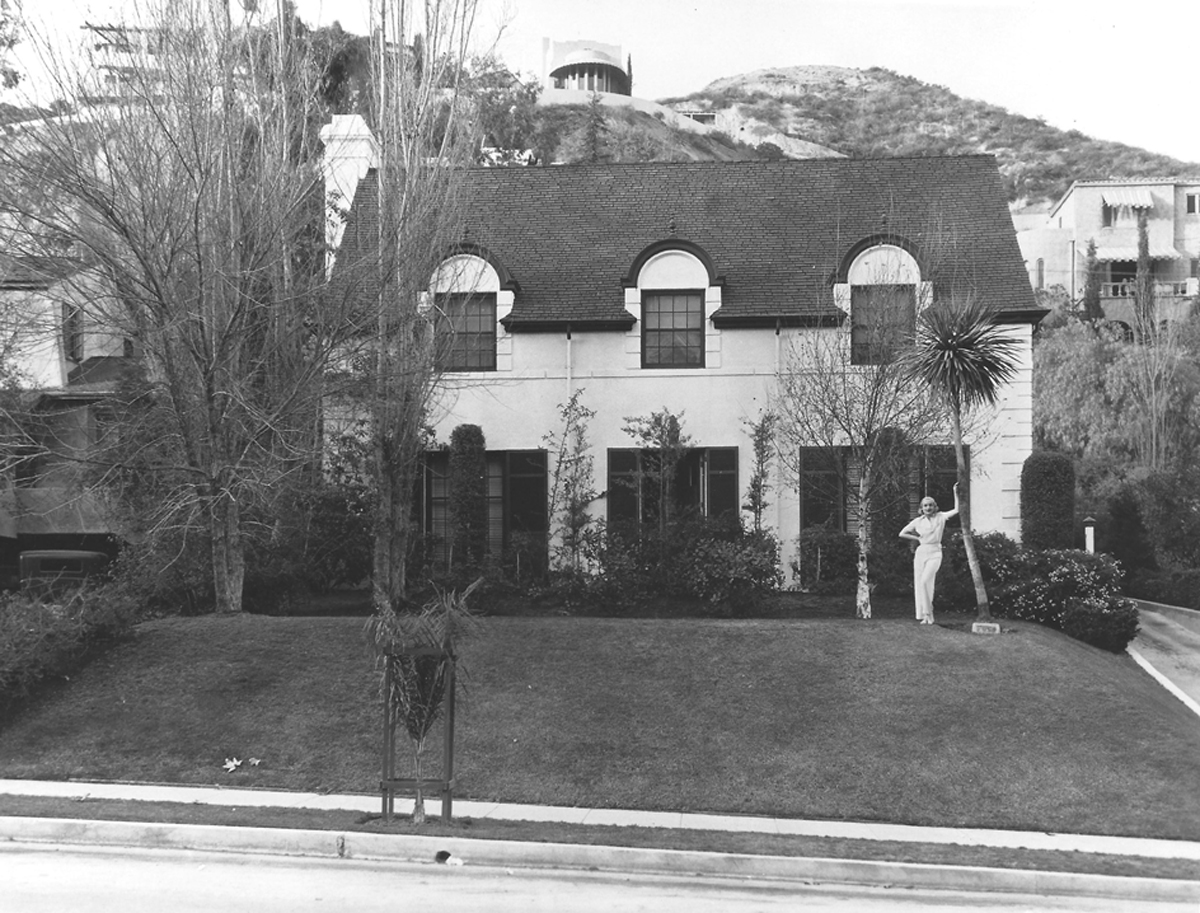
In this official Paramount Pictures publicity photo taken in 1934, Carole stands in front of her rented Hollywood Boulevard home.

Which brings us to the parties. Carole rented the 3,000-square-foot, French provincial home at 7953 Hollywood Boulevard late in 1933 at a time when her career at Paramount was on the upswing. The house sits way down in the residential section of Hollywood Boulevard near Laurel Canyon and it’s tucked back off the thoroughfare and you wouldn’t give it a second thought and certainly wouldn’t imagine it to be connected with bigger-than-life Carole Lombard.

I’ve never been inside this place but I’ve stood outside and I’ve talked to neighbors. Looking at it, you wonder how she had room for the kind of ambitious entertaining that marked her years here. But this terrific video with its then-and-now views puts things in perspective. The Hollywood Boulevard house had land behind it, including an apartment on the terrace above where Madalynne Fields (dubbed “Fieldsie”), Carole’s best friend and secretary, resided. Carole’s guests could spread out inside and out for the parties of legend.

Anyone who knows me will tell you: I hate parties. I’ll do all I can to avoid one, so you won’t see me having the willies when I describe Lombard’s parties but just know—I’m having the willies.

Fireball: Carole Lombard and the Mystery of Flight 3 by Robert Matzen

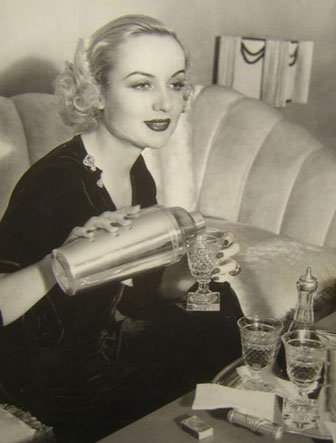
Mixology, Lombard-style, in the Hollywood Boulevard house.

She threw a “Roman party” and invited guests to come in togas. She threw a “hillbilly party” complete with barnyard animals (think cows and roosters) and wait staff in coveralls. Look close in the video because there may still be hay and feathers stuck in the baseboards from that one. She threw the miscalculated “hospital party,” where guests were asked to change into hospital gowns at the door or at the very least cover their attire with hospital gowns. Wait staff appeared as nurses and orderlies; food was brought in on gurneys and served hospital-style on trays. All that happened in the house shown in the video.

It all seems “madcap” and “gay” in the old sense of the word, but in Fireball I refer to it as Calculated Mayhem. In the wake of her performances in Twentieth Century and Lady by Choice, and the popularity of the new style of picture catching fire, the “screwball comedy,” Carole set out to claim that territory in Hollywood’s landscape. The parties were a means to an end to position Carole Lombard as the type of personality just right for screwball. It was what they call today a brand strategy concocted by Carole and her two very shrewd advisors, Fieldsie and talent agent Myron Selznick.

The strategy worked. By 1935 Paramount was putting Lombard in Hands Across the Table and The Princess Comes Across; Universal was asking for her for her most famous screwball picture of all, My Man Godfrey, and David Selznick (Myron’s brother) could imagine only Lombard appearing in his screwball entry, Nothing Sacred. Lombard’s screwball run lasted a solid three years, but these pictures with their bizarre elements could easily misfire, and that’s what ended her hot streak—the truly wretched True Confession in 1937 and Fools for Scandal in 1938. She made four straight dramas in 1939 and 1940 and only appeared in a couple more comedies before she died, but after the crash of Flight 3, the snapshot description of Carole Lombard was the “queen of screwball.” It’s how I describe her in interviews, and how she’s remembered.

In 1936 she started seeing Gable, and the house on Hollywood Boulevard became a little too high profile for the lovers, so she ditched it for digs in far-flung Bel Air. But her glory years on the social scene as bachelorette and hostess were all spent here, in this unassuming little house at the edge of Tinseltown.

Fireball: Carole Lombard and the Mystery of Flight 3 by Robert Matzen

This was my first view of the Lombard party house as it looked in 1987 with vegetation run amok. Back then it looked haunted, and some say it is.


Pretty Damn Cool

What’s going to happen when I pass on to that great movie theater in the sky? (Or find myself cast into the fiery pits of hell?) Will you look back fondly on Robert Matzen as a writer who once entertained you with Fireball—and other great books I have yet to write? As a friend or acquaintance? A co-worker? I wonder if you’ll read my obituary and find something that makes you say, “That’s pretty damn cool.”

It’s ironic that the only time we stop to take stock of a life is when it’s over. There are exceptions of course, in the case of a “lifetime achievement award” or a snapshot-in-time memoir or biography, but usually, we honor people, pay attention, appreciate as they pass out of our world.

Fireball: Carole Lombard and the Mystery of Flight 3 by Robert Matzen

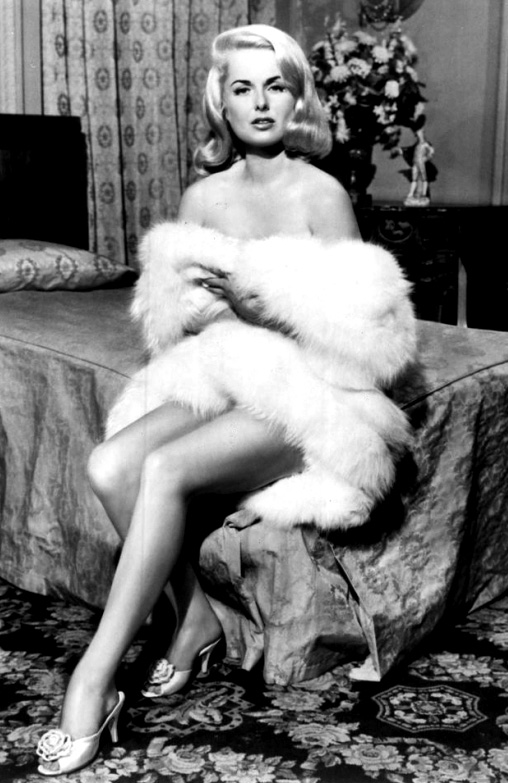
Martha Hyer at her sexiest in The Carpetbaggers.

While reading Martha Hyer’s obituary the other week I exclaimed, “That’s pretty damn cool!” Martha Hyer was a dependable-enough actress of the 1950s and 60s who worked with big stars in some A and B pictures, but overall her career was a near miss. I hadn’t a clue that Martha Hyer was an art collector who lived on an obscure stretch of Hollywood Boulevard. I thought Hollywood Boulevard ended at Laurel Canyon but son of a gun, it doesn’t. It snakes impossibly on through the hills—if you haven’t been there and driven in them, you can’t imagine those hills.

I had no idea that Martha Hyer epitomized Hollywood class in the early 1960s, with her posh home and its spectacular view of the L.A. basin and her stylish clothes and expensive art collection until I read about it in an article linked to her obituary. She was one of those stars I took for granted; a competent actress who succeeded mostly on her curvy blonde looks. Then I paid attention to Martha Hyer in an airing of The Carpetbaggers in a supporting part as a starlet-hopeful and was reminded how good-looking she was, and how winning she was, and now I knew about her swanky lifestyle as a bachelorette prior to her marriage to producer Hal Wallis. I thought to myself, what an interesting person! I should have contacted her and asked for an interview, but I didn’t know what I didn’t know, and now she’s gone.

The depth of the national reaction to the passing of James Garner surprised me. He’s another one who was roaming the earth when I was born and so I’ve never known life without James Garner as part of the popular landscape. I knew of Maverick, although Maverick was before my time. I knew that James Garner was groomed for stardom by Warner Bros. and shot to prominence during their heyday producing TV westerns. Then Jack Warner leveraged Garner’s popularity by lending him to the features unit to make Darby’s Rangers and other pictures. He was a very big star in 1960 and managed to remain relevant for the next 54 years so that when he left us, we had just seen him in something, somewhere.

I bought James Garner’s autobiography, The Garner Files, upon its release to get his take on Jack Warner. The straight shooter took aim at J.L. and plugged him right between the eyes: “Jack Warner treated everybody the same: lousy. He didn’t spare his wife, his son, or his mistress. He hated writers, he hated actors, and he was cruel to his employees.” Garner went on, “Warner was rude and crude—the most vulgar man I’ve ever met. He had terrible taste in most things and a filthy mouth. The first time Lois and I went to the Oscars, we sat at his table and listened to him tell one dirty joke after another. He actually thought they were funny. We got up and moved to another table. I told Bill Orr [WB exec and J.L.’s son in law]: ‘Don’t you ever . . . don’t you ever get me invited anywhere where he’s going to be.’”

Fireball: Carole Lombard and the Mystery of Flight 3 by Robert Matzen

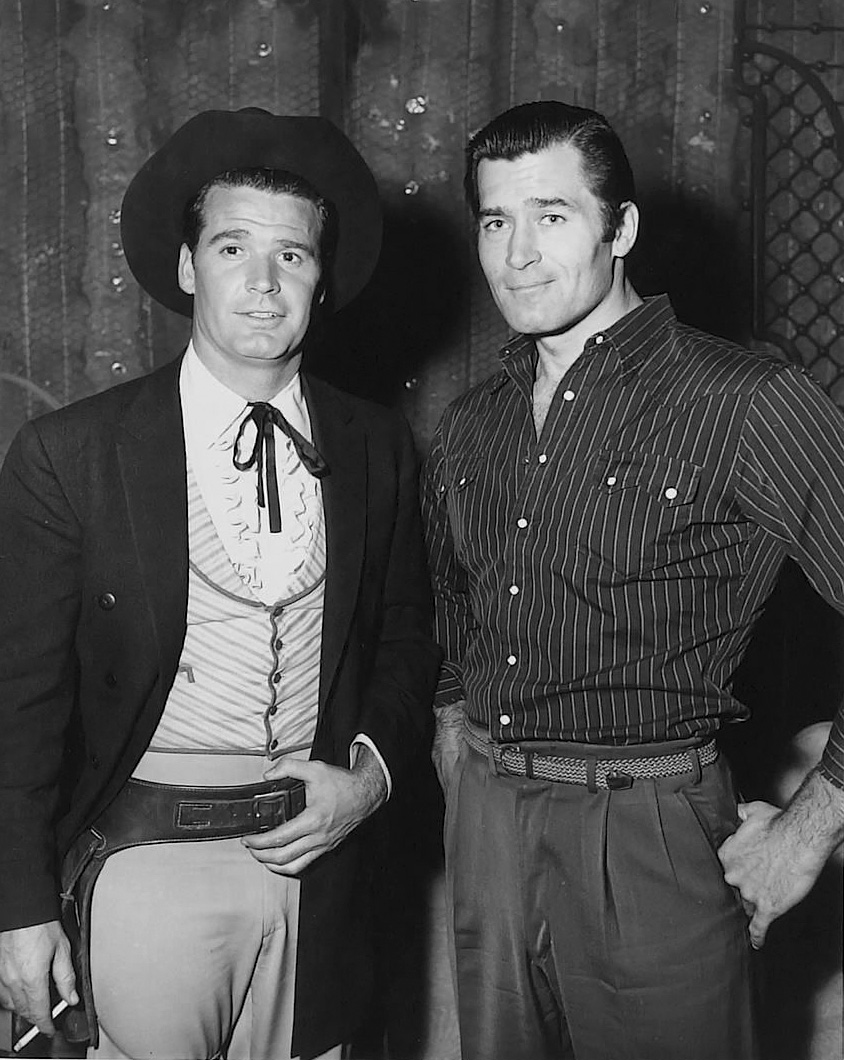
Clint Walker (right) visits James Garner on the set of Maverick. Walker was just back on the Warner Bros. lot to star in his series Cheyenne after a long-running feud with J.L.

James Garner shot from the hip about others in The Garner Files as well, like Steve McQueen: “Like Brando, he could be a pain in the ass on the set. Unlike Brando, he wasn’t an actor. He was a movie star, a poser who cultivated the image of a macho man. Steve wasn’t a bad guy; I think he was just insecure.” And of another co-star in The Great Escape, Garner said, “Charlie Bronson was a pain in the ass, too. He used and abused people, and I didn’t like it.”

To me, James Garner’s insights on these actors, people we think we know, are precious. Actors didn’t always like one another, and it’s interesting to keep in mind what they were thinking as cameras rolled. We see the end result preserved on celluloid, which in some cases proves the talent of the individuals, overcoming their feelings or channeling those feelings into the character.

With Garner, there were no scandals to look back on. I recall that he had bypass surgery in the 1980s and wondered then if he would survive. But he did. I remembered when he took over 8 Simple Rules for Dating My Teenaged Daughter for John Ritter after that star’s sudden death by aortic aneurysm in 2003 and stabilized the sitcom’s devastated cast and crew. James Garner came in and took charge because that’s what the situation required. I wasn’t a fan of that show but I well recall watching the first Garner episode when his character walked on set and very publicly comforted the characters and the actors playing them. To hurting humans he lent strength; to actors worrying about their next paycheck he conveyed, We’ll get through this. It will be OK. That’s pretty damn cool. And with his help they survived, and James Garner carried 8 Simple Rules on his 75-year-old shoulders, completing the second season and then a third full season.

This scenario sat in my head unprocessed since Ritter’s death. It took the news of James Garner’s passing for me to stop and think about how admirable he had been in that circumstance. I can only hope that when I go, there’s something in my obit to say, “That’s pretty damn cool” about.

Fireball: Carole Lombard and the Mystery of Flight 3 by Robert Matzen

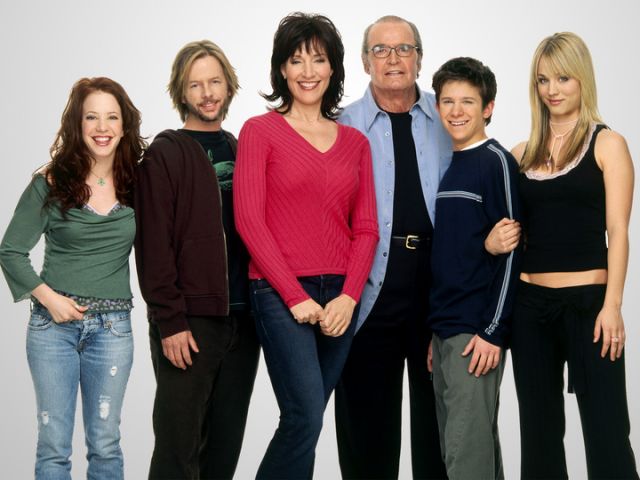
The cast of 8 Simple Rules. Said Garner, “I never used to like working with children. For a long time I thought they were unpredictable and, well, unprofessional. But Amy Davidson [far left], Kaley Cuoco [far right], and Martin Spanjers [second from right] were terrific. Who cares if they steal a scene? If any actor can steal a scene from me, they’re welcome to it.”

Scratch

Almost every day since the book’s release in January, somebody somewhere has commented on the extensive research in Fireball, and I’ve been gratified to learn that my dumpster dive into federal records accomplished its goal, as did long hours spent sifting through existing histories and biographies, newspapers, unpublished manuscripts and interviews, birth and death records, military archives, and conversations with participants and relatives of participants in the story. Oh, and a day spent eating dirt, getting stuck on cactus, and bouncing off boulders on Potosi Mountain. And other days spent walking in the footsteps of people in the narrative. When it was over I understood Carole Lombard and Clark Gable at the molecular level and also had learned about others critical to the story, from the stewardess on Flight 3 to the miner and ex-football star who led the charge up the mountain.

But that was then. It’s a good thing when you are the author of a book that gets positive reviews and that people really like. There’s gratification; there’s also pressure every time somebody says, read Fireball, loved it, big fan, what’s next? Well, thanks! And, uhhh, I dunno.

Fireball: Carole Lombard and the Mystery of Flight 3 by Robert Matzen

Oh, great, another mountain to climb. In case you are wondering, the Flight 3 crash site is along the ridge line, dead center from left to right, a few hundred feet below the crest.

It’s all organic, man. It comes from luck, or inspiration, or usually from a particular friend saying, “You know what would make a great idea for a book?” And that friend did it again two months ago, planting this seed in my brain. At first I think, no, that’s no good. It’s been done, or I can’t get at that story, or something similar, but then the damn seed starts to sprout and before long I’m believing that, yes, he’s right again. This is a story. I’m going to tell this story.

Friends, readers, I’m starting my next book. It’s a new day and a new ballgame. It’s not even the top of the first inning and the umpire isn’t about to shout, “Play ball!” [Reference to American baseball, global readers.] It’s not even time for spring training, really, because first comes determination of the theme of the book, what I’m writing to, what tone to set, how the narrative will sound, and even more basic to that, who are my characters? I’m in that nebulous period where I’m learning about the world I’m going to be inhabiting for a year or two. I’m reading existing works and visiting web sites. Just now I was reading a biography on the couch and Francois, my ten-week-old black kitten, jumped up on me and asked, “Whatcha readin’, Dad?” and before you know it, we were both asleep on the couch. So I can report that this phase is rather pleasant so far.

I’m not ready to announce what the book is going to be about, except to say it’s another World War II story with an aviation theme and part of it is set in Hollywood. (Tom, you’re a bright fellow. If you guess what the story is, please don’t blurt it out.) It’s nonfiction because to me the best stories are true stories where I say to myself as I unearth the facts, “You couldn’t make this stuff up.” Research is going to put me back in D.C. and back in Hollywood, but it’ll also require a trip to England and possibly to France and Germany and this time I’m going to have to be sifting through German records and lots of them. Sprechen sie Deutsch? My high school German teacher, Miss Diamond (who I had a crush on, but, don’t tell), would be the first to report, no, Robert does not speak German. That’s going to be a handicap to my enterprise because one thing I’m certain of is, this story is going to include a civilian’s-eye view of life on the ground in Germany during the latter phases of World War II. It’s one story line in what will no doubt be many story lines.

It’s daunting to be at this point in a book. Way down the road, I know I’m going to be holding three pounds of bouncing baby … hardcover, but in the meantime everything is squishy and Unknown. I have no idea where I’m heading. I don’t know how I’ll get there. I don’t know what I’ll discover along the way. Worst of all, I don’t know what makes my main character tick. I hate not knowing, and there’s so much mythology grown around this character that I already have a healthy dislike. Just like I had with Gable. I tell myself that it’s OK, the Gable thing worked out, and now he and I are friends and I pay my respects at his grave and everything.

Today’s confession is that I hate new people. My lifelong friend and former co-worker, Helene, would tell you that. Oh, Robert hates new people. Anytime somebody new came on staff at the company where we both worked, there was a period where I didn’t like them until I got a handle on them and then it was usually OK, except of course when it wasn’t. So now I’m at the stage where, based on everything I know so far, I don’t like this new person I’m going to write a book about. But when you’re in close quarters with someone for a long period, the ice gets broken somehow, and I’m counting on the fact that it’ll happen here. We even have some things in common, so what the hell am I worried about?

There, I’ve said it: I’m starting a new book. Monkey off my back. That’s on the one hand. On the other hand, this autumn I’m back in the saddle pitching Fireball and so coming and going, it will be an interesting time. Keep your eye peeled for dispatches from the front, which will all be delivered here at this address a couple times a week.

When the Magic Happens

As I’ll do now and again, I turned to the Beatles this morning and was listening to You’re Gonna Lose That Girl, a song from their 1965 film, Help! I sat there and said to myself, here’s a song that’s about 50 years old and yet perfect; perfect music and lyrics from the perfect song-writing duo. It got me to thinking about chemistry, how someone can have a special something with another someone over other people and their combined molecules form a powerful chemical compound. John and Paul wrote music while in their early 20s that I’m convinced will be considered classic in a century, and covered by contemporary performers and heard in commercials, but the magic was between them exclusively and when they broke up, each became “just another musician.” I can hear Ruth Peeples protesting and YES Ruth, they were great musicians as individuals, and Paul McCartney certainly thrives today. But can you argue that the chemistry between them generated the best music of the career of either? They knew they were that good together, but they broke up; the creative chemistry was genius, but the friendship chemistry managed, under the immense pressure of being “Beatles,” not to endure.

Fireball: Carole Lombard and the Mystery of Flight 3 by Robert Matzen

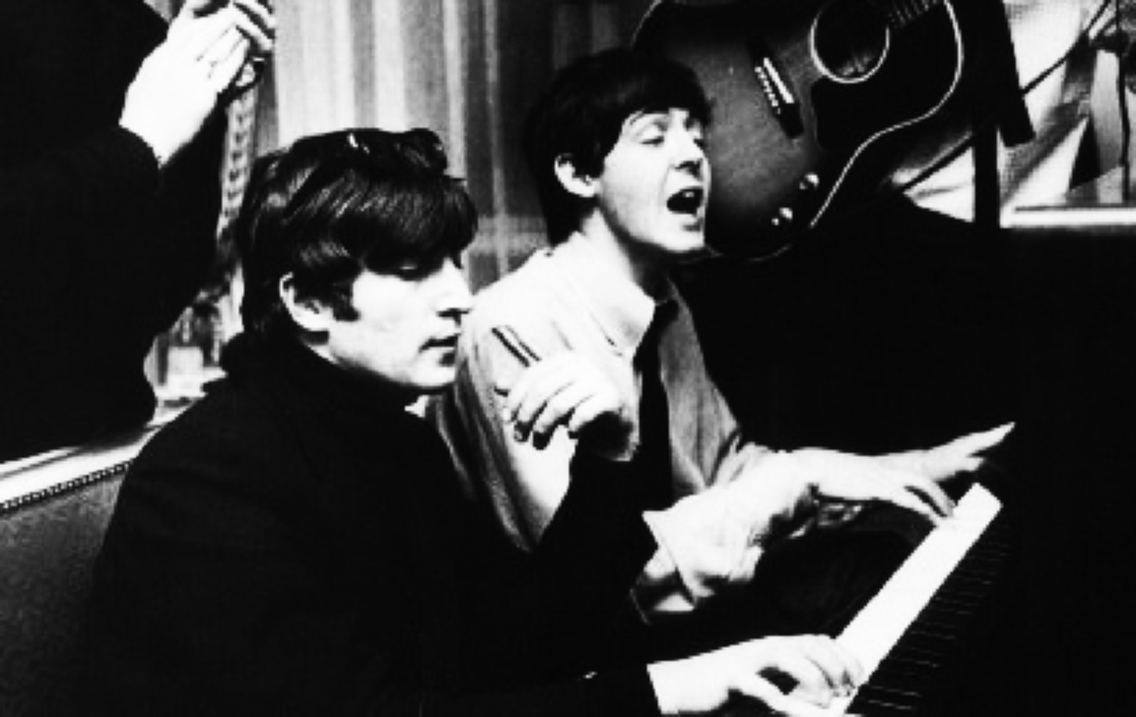
Lennon and McCartney, making music, and history.

I’ve been fortunate enough to experience chemistry of my own, personally and professionally (you know who you are out there), but I imagine there are some who never find a John or Paul, the kind of person who becomes a spouse or fishing buddy or bedmate or collaborator on songs or movies or books or cures for cancer. Chemistry comes in all shapes, sizes, and varieties. As I was listening to You’re Gonna Lose That Girl, one of the things that struck me was Carole Lombard died too young, age 33, to find professional chemistry that would have enhanced her fame and legend for future generations.

Fireball: Carole Lombard and the Mystery of Flight 3 by Robert Matzen

It was said that Ginger Rogers could do everything Fred Astaire could do–only backwards, and in high heels. Ginger wasn’t yet 23 when she met Fred; he was 34.

Think about the great movie teams. While Errol Flynn and Olivia de Havilland started early (26 and 19, respectively), other stars went years before finding the right chemistry, or never found it. Myrna Loy made dozens of pictures—you’d be surprised how many—before she found William Powell and embarked on The Thin Man and its sequels. Jeanette MacDonald was 33 when she first sang with Nelson Eddy. Astaire was 34 when he met Rogers. Abbott was 36 when he teamed up with Costello. Tracy was 42 when he started with Hepburn.

Of course, Lombard had Gable and their personal chemistry was world-beating. As I supposed here a couple weeks ago, had she lived, I doubt that their marriage would have lasted, but I also suspect that Lombard and Gable eventually would have made pictures together to follow up their lone 1932 collaboration, No Man of Her Own. Their names together on the marquee would have spelled box office, especially if she had found success on television, which Gable steadfastly refused to try through the course of the 1950s. I bet Gable thought about what might have been, had she lived—the sophisticated pictures they could have made together, maturing on screen like Tracy and Hepburn.

You could make a case that Lombard found her onscreen chemistry with William Powell in their three pictures together, but the body of evidence just isn’t there, and Powell was already busy with Loy. Lombard did well with Fred McMurray for two years, but that teaming ended when she left Paramount. Lombard and George Raft did OK for two pictures, but their rapport was better in the sack than on the screen. She had terrific chemistry with Jack Benny in To Be or Not to Be, and they liked each other behind the cameras too. I could see a professional partnership of Benny and Lombard, figuring that in their day and age, the male’s name always came first even if the female had the longer screen career. It has a nice ring to it, Benny and Lombard.

Let’s talk chemistry. How has it manifested in your life? What examples of chemistry do you most enjoy in motion pictures or the other arts?

In Carole’s case, we’ll never know what might have been, but listening to You’re Gonna Lose That Girl (Yes, yes, you’re gonna lose that girl) got me to thinking about chemistry as I’ve experienced it and as others have—or haven’t. Sitting there and listening inspired quite a stream of consciousness, or I guess you could say that the work of John and Paul was my catalyst this morning, which isn’t surprising given the chemistry at work between them.

Fireball: Carole Lombard and the Mystery of Flight 3 by Robert Matzen

Benny and Lombard camp it up in a publicity shot for To Be or Not to Be.

Carole Does Paris

Simone and I were on our own for a week while her mother was out of state, and so one evening I pulled out an old VHS copy of Fools for Scandal that I forgot 20 years ago I even owned. Fools for Scandal is the result of Jack Warner luring Carole Lombard to Warner Bros. because of a desire to get his studio up to speed on screwball comedy. Just for a little context, Fools went into release around the same time as The Adventures of Robin Hood.

I said to Simone, “Let’s watch a Lombard movie,” but Simone wasn’t interested. Then I told her that this picture was set in Paris, and that perked up her ears and she agreed to give Fools for Scandal a shot.

Thirty minutes later, Simone had been rendered unconscious and so had I. Although stuporous, I roused myself for the last couple reels and then went back the following morning to confirm for myself that I had indeed been neutron-bombed by this picture.

Fireball: Carole Lombard and the Mystery of Flight 3 by Robert Matzen

Simone at the 30-minute mark of Fools for Scandal.

Simone will tell you, and I agree, that there’s just no accounting for funny. I don’t want to scarze you off from giving Fools for Scandal a try (actually, yes I do), but let me present it this way: In one sequence, the dialogue shared between Carole and her co-star is in rhyme. I mean, for no good reason, they start talking in rhymes. Then he starts singing, shakily, in rhymes and you expect her to sing too but she knows she can’t carry a tune so she talks it while he sings it. I can only imagine that 1938 audiences knew right around now that they were the fools of this particular scandal.

The plot of Fools for Scandal is about as funny as a salvaged cinder block: A French chef becomes enamored of a woman he sees on the street and stalks her. He sends her fleeing to the safety of a taxi, then hops in the taxi and badgers her to see the sites of Paris until finally, exhausted, she relents. She manages to escape him and make her way to London but he follows, all stalker-like, and worms his way onto her domestic staff. Then he refuses to leave. Ask those poor California people in the news whose nanny refuses to be evicted just how funny this scenario is and they’ll tell you—this scenario isn’t funny; it’s horrifying.

Fireball: Carole Lombard and the Mystery of Flight 3 by Robert Matzen

The first scene, when Carole picks up her stalker on the Warner backlot. Shooting of “Paris” exteriors would take weeks–a bad sign for any picture.

Carole here portrays Kay Winters, an American movie star off to Paris in disguise for some R&R. Instead, she picks up a stalker and spends roughly 90 minutes of her life and ours shrieking for liberation and running for her life. At one point she even says to her stalker-who-refuses-to-leave, “My life was so nice and peaceful until you came along.” At the very end of the last reel, the Stockholm Syndrome dooms poor Kay Winters.

How did Miss Lombard find herself in this wretched predicament? FLASH BACK to just a year earlier when her contract at Paramount Pictures expired and super agent Myron Selznick convinced her that the grass was greener at other studios. She made the Technicolor comedy Nothing Sacred for Myron’s brother, David, and that picture scored good reviews and solid box-office returns. But there must have been a dearth of good screwball scripts out there at the second half of 1937 because the offer she decided to accept came from Warner Bros. of Burbank, a studio known for gangsters and swashbucklers and not comedy. The script was adapted from a stage play called Food for Scandal, the double meaning being that the boy in this boy-meets-girl tale is a chef who shacks up with the girl in London, causing a scandal. When the boy breaks into shaky song, what he’s singing is “Food for Scandal.”

Fireball: Carole Lombard and the Mystery of Flight 3 by Robert Matzen

Rene (Fernand Gravet), invades Kay Winters’ cab and refuses to leave. The decision that dooms her: she didn’t call the gendarmes and demand a PFA.

I guess Carole thought this thing had a chance because the Warners brought in Mervyn LeRoy to direct, and the talented Warner stock company would back her up, and the studio invited her to bring along her hand-picked cameraman, clothing designer, and hair stylist. As a result she looks like a million bucks in Fools for Scandal only to be defeated by a 10-cent script and total lack of directorial support.

If this isn’t a Hollywood axiom, it should be: It’s always dicey adapting stage plays for the screen.

If this isn’t a Hollywood axiom, it should be: It’s always dicey importing foreign movie stars to appear in American pictures.

So here is Carole set to star in a stage-play-turned movie with a French leading man of some experience, Fernand Gravet (pronounced Graw-VAY), who is new to Hollywood. If you’re thinking Charles Boyer when you hear Fernand Graw-VAY, forget it. The former had that voice and a certain debonair manner to offset average looks. The latter also sported average looks and a nearly impenetrable accent hung like bad wallpaper on a tenor voice and about as much charm as you’d expect from your average, garden-variety psycho. And speaking of psychos, Ralph Bellamy portrays Kay Winters’ boyfriend and manages to be unlikeable even in a situation where you want to root for him because his life and relationship have been invaded by a maniac. Instead, Bellamy plays cuckold in strange eye makeup that renders him a beady-eyed muppet.

Fireball: Carole Lombard and the Mystery of Flight 3 by Robert Matzen

Kay turns to her boyfriend, Phillip (Ralph Bellamy), for help with the stalker, but finds Phillip ineffective, not to mention irritating. You would think an American movie star could do better.

In researching Fireball, I went through the Warner Bros. production files on Fools for Scandal and relived anguish that began with the title Food for Scandal. How can we even fathom now that censors found it too suggestive—a man living in a woman’s house without a wedding ring in sight? Fools for Scandal better suited the negative implications of such a situation, so they changed it, even though Fernand breaks into “Food for Scandal” about 30 minutes in.

The other thing that the production files reveal is pain. Pain from all involved. Pain from Hal Wallis the executive producer, pain from the unit manager, pain from the stars. Your run-of-the-mill A picture wrapped in seven or eight weeks, but this production dragged on for three months, with endless retakes on the Warner backlot, day after day, week after week. Stalingrad went better for the Germans than Fools went for Carole.

Lombard was always at her best when she underplayed the comedy, and we can see in this picture that she knew she was in trouble because she starts playing it frantic about two minutes in and doesn’t stop until The End. Carole desperately needed the firm hand of a director here and Mervyn LeRoy wasn’t it. LeRoy made some decent pictures in his career but never excelled at comedy. You could point to another converted stage play that worked under his direction, Mister Roberts, but I’d argue that he had three men in that cast—James Cagney, William Powell, and Jack Lemmon—with impeccable comic timing and a vehicle that had been proven effective.

Seventeen years earlier, he had Lombard and a cinder block, and what happens when you attach one to the other? It’s inevitable, and that’s exactly what happened here. I don’t think Simone will ever trust me again.

Fireball: Carole Lombard and the Mystery of Flight 3 by Robert Matzen

The Warner marketing department had trouble figuring out how to sell this particular pile of rubble, given that its plot is more psychological thriller than comedy.

The Crawford Touch

Fireball: Carole Lombard and the Mystery of Flight 3 by Robert Matzen

George Hurrell captured a portrait of 1942 Joan Crawford for the ‘Bride’ publicity campaign.

I had never taken the time to sit down and watch They All Kissed the Bride, the Columbia picture that Carole Lombard was supposed to make after her return from the bond tour to Indiana and the one she would never make because she didn’t return from the bond tour to Indiana. I’m not going to go into depth about They All Kissed the Bride because I want this column to be about more than movie reviews, and I’ve spent time on a number of movies already and there’s another film analysis in the queue.

What I’ll say is that They All Kissed the Bride is a picture that makes me sad to watch. Since it’s a Columbia Picture you don’t expect much going in because by 1942, Columbia was making comedies that were loud, silly, and for the most part starred down-on-their-luck actors.

Fireball: Carole Lombard and the Mystery of Flight 3 by Robert Matzen

The Joan Crawford of 1927 had already been Carole Lombard’s rival on Hollywood dance floors for two years.

It’s telling that this is a script Carole Lombard accepted. She was to play M.J. Drew, hard-as-nails boss of a powerful shipping corporation based in New York City. Hard as nails, that is, until she meets Melvyn Douglas, at which point she goes all weak in the knees and hates herself for it and can’t understand what’s happening to her. She thinks it must be her liver.

Screwball pictures often required convoluted plots to create appropriately uncomfortable situations and this one is no exception. The surprising thing for me in finally seeing Bride is: It would not have been a hit for Lombard. In fact, Joan Crawford is probably better in it than Lombard would have been, because Crawford of the square jaw and square shoulders comports herself like a cutthroat boss. She’s believable in the part.

The backstory of how she landed Bride is much more interesting than the picture itself. Soon after Lombard’s death aboard TWA Flight 3 just after World War II began for the United States, Joan Crawford was signed to take the lead in the picture then called He Kissed the Bride, and pledged to donate to four war-related charities, in Carole Lombard’s name, the entirety of her $115,000 salary. When Crawford’s agent took his usual percentage for lining up the deal on a picture made under these circumstances, Joan fired him.

These were fantastic gestures on Crawford’s part, and yet the intertwined lives of Joan Crawford and Carole Lombard had not been conducted on friendly terms going all the way back to the 1920s Coconut Grove nightclub, where they sweated against each other in dance competitions. Joan of MGM always had more clout in Hollywood than Carole of little brother Paramount. When Lombard landed Clark Gable, it was with the knowledge that Joan had been there four years earlier and sexually enchanted the big lug.

But at the dawn of 1942 Lombard and Crawford had something in common: They were both in career slides. The script for He Kissed the Bride proves it for both of them. It’s not a bad picture, but typical of the Columbia jobs, it jumps the shark halfway through and resorts to improbability, misperception, and pratfalls. You sit there thinking, “Joan’s better than this,” the same way you would have said, “Carole’s better than this.” Melvyn Douglas was better than this, too, but it was a living and the stars took these parts because it was work and hopefully better times lay ahead.

The turbulence of Carole’s career waters is confirmed if one looked ahead to what she had signed on for next. After working at Columbia she would be going back to Universal for My Girl Godfrey, a script so slight that it was finally released as a musical starring Deanna Durbin in 1943 after being retitled His Butler’s Sister. At this time Universal was making Ghost of Frankenstein and other B-level entertainment, and had Lombard lived, 1942 would probably have been seen as another mediocre year.

Yes, the most significant thing about He Kissed the Bride (which was retitled They All Kissed the Bride, a title that in context of the script makes no sense) is Joan Crawford’s gesture, which everyone in the industry greeted with, “That’s very Joan” because, despite her five-foot-two stature, Crawford did everything BIG. This is the same Joan Crawford who served as sexual surrogate for a destroyed Clark Gable in the months after Carole’s loss. She was there for him in her home anytime he needed, without strings, and provided some TLC, some physical relief, some moments reliving the days of their impetuous youth and wild sexual fling on the MGM lot.

It’s a shame that since the 1980s Crawford’s legacy has been reduced to grotesque makeup and child abuse. Joan’s better than this. In the barren chill of January 1942 it was Joan Crawford who stepped up and on those small, square shoulders helped relieve the burden of a devastated Hollywood that had just experienced the loss of its most beloved home-town girl.

Fireball: Carole Lombard and the Mystery of Flight 3 by Robert Matzen

Crawford, age 37, poses for another They All Kissed the Bride publicity still. Her career slide had been precipitous in the year prior to Lombard’s death, but Joan’s gestures to honor Carole and comfort Clark were instinctive, and heartfelt.

Jilted by Juliet

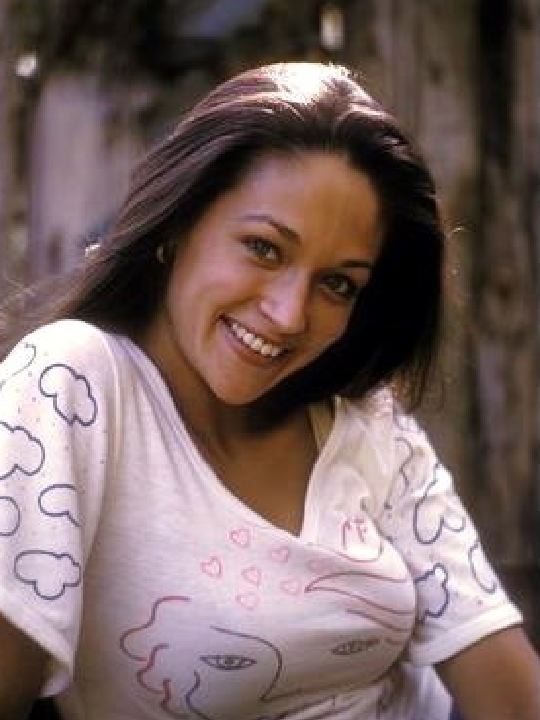
You remember when I was wringing my hands about whether to join the Twitter generation, and then it seemed like a practical business matter: If you want to be a popular author you should just try Twitter out and see what happens, especially if you’re going to be an author on tour and I’m considering some more tour dates. I’ve tweeted a few things in recent weeks, trying not to be obnoxious, and the other day I picked up a new follower: Olivia Hussey, she of the Zeffirelli version of Romeo & Juliet. How I remember being captivated by this girl, 16 when she made Romeo & Juliet, during a reissue screening of the picture when I was a mere lad. Actually I went two or three times, I think, and only because of a big-old crush on Olivia Hussey.

Olivia_Hussey2

Olivia Hussey as I imagined her, dreaming of what Robert Matzen would tweet next.

Of course she’s done much more than Juliet with her life. She was the Virgin Mary in Jesus of Nazareth on TV, and played the villainous Alicia in one of my favorite mini-series of the Bicentennial era, The Bastard. She appeared in Death on the Nile with an all-star cast and lots of other TV and motion pictures, and played Mother Teresa in a critically acclaimed biopic.

So this famous performer was now following me on Twitter, meaning I should tweet something profound—but I had nothing. I slept on it, thinking something would come to me and the next morning I learned I had another follower: Lana Wood, Bond girl, sister of Natalie, and accomplished actress in her own right. Not to be redundant, but when I saw Lana as Plenty O’Toole in Diamonds Are Forever, well, I had to go back and see the picture again. Dad was very considerate to take me back for repeat showings of these movies. Or was Dad experiencing, shall we say, the same reaction? I hear tell that the apples don’t fall far from the tree.

Fireball: Carole Lombard and the Mystery of Flight 3 by Robert Matzen

Lana Wood, Bond girl, accomplished actress, thoughtful soul, and follower of Robert Matzen.

Truth be told, Lana had just appeared at a John Wayne event in Iowa where my friend Scott Eyman was also a headliner. So she and I had Scott in common. But at any rate, now, not one but two of the big crushes of my cinematic youth were following me on Twitter, and I still had nothing. I could practically hear my tweet’s voice cracking when I shouted out to the world that I had a new column available on my blog, or said I’d be appearing on the nationally syndicated radio show, TV Confidential. But I have to be honest: Joyce Carol Oates I’m not. Joyce Carol Oates has always got eight wise things to say on Twitter and I can’t even figure half of them out, while I sit here like a frog on a rock. I’m terrible at parties, too, but that’s beside the point.

Fireball: Carole Lombard and the Mystery of Flight 3 by Robert Matzen

Oh, Olivia. Why couldn’t we work it out?

During this period of gross indecision regarding wise things to say, or witty things, or controversial things, I lost Olivia Hussey. Suddenly my Juliet was no longer following me. I was left to wonder—did she suddenly realize she was following the wrong Robert Matzen? Was she intending to follow the videographer in Cleveland? Or maybe the polar opposite Robert Matzen in Germany who’s an extrovert, loves people, and plays soccer? Whatever the motivation for the end of my personal Twitter relationship with Olivia Hussey, it was over and I was crestfallen.

Now I hang onto the fact that Lana Wood remains faithful. I cling to the faint hope that one day soon I can justify that faith by broadcasting a tweet worthy of an original Bond girl and actress who worked with John Wayne in The Searchers and nearly stole the show. The clock is ticking oh so loudly as I sit here. Jilted. And with nothing.

Rhett Butler, Take 2

Fireball: Carole Lombard and the Mystery of Flight 3 by Robert Matzen

A sign of trouble: too much to read on the movie posters in the lobby of the theater.

What an irony that Clark Gable’s last picture at MGM would be called Betrayed, because that’s exactly how Gable felt when the company that had ridden his back for two decades suddenly dumped him in 1954, the last of Hollywood’s Golden Era stars to be let go. Right about now he could have used Carole Lombard’s advice on “how to be a free agent.” As it was, Gable made several mediocre pictures in a row because now he was taking on scripts that had not been tailor-made to fit the King and his brand. He was just earning a paycheck. Then late in 1956 he considered an offer that must have made him smile the famous Gable smile, and for several reasons.

Band of Angels was a hot property at the time, a bestselling Civil War novel by Robert Penn Warren about a highborn Southern belle, Amantha Starr, who learns upon the death of her father that she is really a half-caste, born of his black mistress. As a result she’s chattel, loses everything, and is sold into slavery.

Warner Bros. owned the rights, and it was Jack Warner himself who reached out to Gable to play Hamish Bond, Southern plantation owner with a dark past. I imagine Pa heard Ma’s voice in his head squealing for him to take the part, how he’d be great in it, Rhett Butler all over again, his greatest triumph, the role everyone knew him for. Clark Gable back in the Civil War. It was a can’t-miss proposition, especially since Gone With the Wind had been reissued in 1947 and 1954 and still packed ’em in. Always packed ’em in.

Fireball: Carole Lombard and the Mystery of Flight 3 by Robert Matzen

Clark and Kay at the Encino ranch. She landed the King; he drank to numb the pain of it all.

Gable was expert at playing 50 shades of himself and never, once he became a star, enacted an out-and-out villain. Gable didn’t go taking risks like John Wayne just had with The Searchers because, as noted in Fireball, Clark was an insecure actor and sought to play it safe. Friends and directors alike noted his limited range and said there was a “Gable way” to do things. So Rhett Butler was going to resemble Gable and Hamish Bond was going to resemble Gable and any way you looked at it, with Gable’s Rhett aboard, Band of Angels couldn’t miss.

Fireball: Carole Lombard and the Mystery of Flight 3 by Robert Matzen

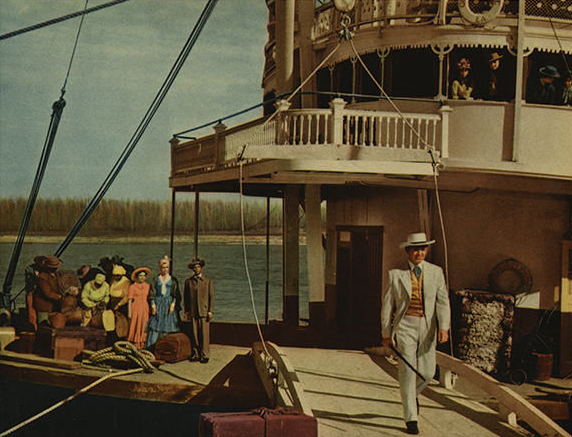
On location in Louisiana with the sternwheeler, Gordon C. Greene. This was more of the authentic Old South than even Selznick gave audiences.

Warner Bros. at the time was still a thriving studio and for the next 20 years would continue to stare down the unblinking eye of television and turn out hit pictures. Bold-as-brass Jack Warner loved the idea of luring the King to Burbank for a Civil War epic and offered him 10 percent of the net skimmed right off the top. As added incentive, all the Band of Angels exteriors would be shot on location in Louisiana, at The Cottage plantation in St. Francisville, north of Baton Rouge, and on—or in front of—the last of the old-time paddleboats, the Gordon C. Greene. The location work offered Clark and his bride of two-plus years, the former Kay Spreckels, a chance to travel together and be treated like, well, a king and his queen.

But sometimes sure things don’t work out. Sometimes planes smack into mountains for no good reason. Band of Angels was not, in the end, another Gone With the Wind. In fact, in execution and through no fault of Gable’s, it burst into flames like one of Hamish Bond’s sugar cane fields. Yes, Clark and Kay went on location, and, yes, they were treated like royalty, made the rounds, were feted, toasted, given keys to cities, and crushed by fans. Yes, Clark played Rhett Butler all over again and putting him back in sets and wardrobe depicting the antebellum South took 10 years off his appearance and son of a gun if he didn’t become Rhett Butler again. What was missing was David O. Selznick fretting and caressing and adding layer after layer of nuance, and throwing hundreds of thousands of extra dollars at the screen. Without the Selznick excesses, Band of Angels seems today almost threadbare, despite its authentic locations.

It’s hard to say when the picture’s director, “Uncle” Raoul Walsh, lost his fastball and became just another guy behind a camera. But he had lost it by The Tall Men, the 1955 picture he made with Gable, and Walsh was far more detrimental to Band of Angels. Or perhaps nothing could save a picture where the three leads are named Hamish, Amantha, and Rau-Ru. How dem dawkies love Massuh Hamish; they even sing to him in great choruses as the sternwheeler floats him on in to the dock, making this cinematic depiction of slavery problematic at best and typical of vintage Hollywood. All his slaves love Hamish Bond but one: the African child that Hamish saved from a massacre, the aforementioned Rau-Ru, who grows into firebrand Sidney Poitier in an early role. Poitier is way too sophisticated for something like Band of Angels and sticks out like a hammer-pounded thumb with all his New York, new-wave internal conflict, despising Hamish Bond and everything he stands for. Poitier, who turned 30 during production, classes up the proceedings too much. This is a picture that didn’t need class. It was bodice-ripping soap opera and needed movie stars fit to fill a frame alongside Clark Gable.

Fireball: Carole Lombard and the Mystery of Flight 3 by Robert Matzen

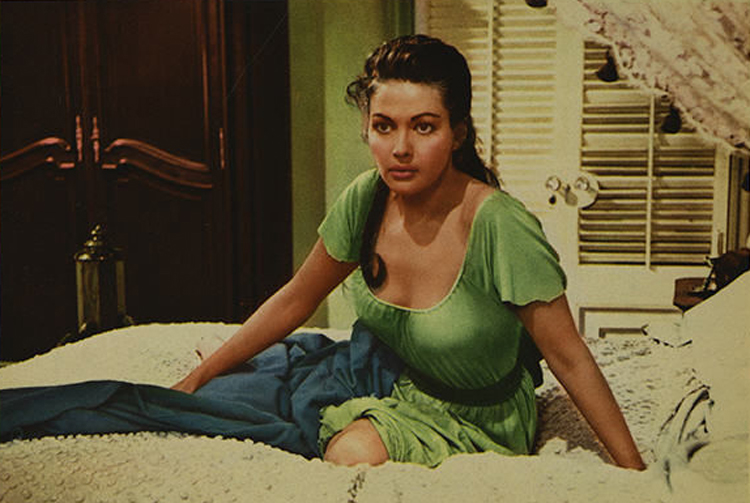
Yvonne De Carlo as Amantha Starr. Spoiler (for all of us): she survived the suicide attempt.

And speaking of what Gable didn’t have, there’s Yvonne De Carlo, a woman of so little warmth and sex appeal that when she fetches a rope and hangs herself in reel two rather than succumb to the advances of a slave trader, I cheered—and I don’t think I was supposed to.

Amantha was saved at the last minute and kept planting herself in front of the camera through the rest of the picture, giving Gable about as much to play off of as a dressmaker’s dummy. This role screamed Ava Gardner in all her sultry darkness, but posterity played a cruel joke and gave us the equivalent of Ava Gardner’s stand-in. I don’t mean to be unkind, and timing and circumstances come into play when casting pictures, but in this case DeCarlo just couldn’t infuse sympathy into this character, and sympathy was crucial.

Gable biographer Lyn Tornabene labeled Band of Angels “the nadir of Gable’s career” but I don’t see it that way. Even considering the liability of the leading lady, Band of Angels turned a slight $92,000 profit according to John McElwee of the Greenbriar Picture Shows BlogSpot. This was stout box office considering the $2.8 million cost of its production. People did flock to see Gable in another tale of the Old South, and word of mouth must have been OK or better for returns so good.

I feel for Gable as the years piled up and he coasted on reputation. He was a man of simple pleasures and little joy, lugging around guilt and grief over lost love Lombard as if bearing a lead-filled backpack. He does some nice acting in the scene where Hamish reveals to Amantha, who is now in love with him, that once he had been a villain who kidnapped Africans into enslavement. He delivers a monologue, staring off and reliving a particular dark event, and it’s effective. The moment, however, lacks a payoff because DeCarlo hasn’t established emotional parameters for us to care how she feels about the revelation. The script doesn’t help her and feels at times like a Classics Illustrated version of Band of Angels; Raoul Walsh’s lack of close-ups also saps power from this critical plot point, so much so that his decision seems to be the director’s way around Gable’s aging. The man turned 56 the second week of shooting and all the drinking, cigarettes, guilt, and grief had rendered Rhett Butler’s face into something different than audiences saw in 1939, and in more recent GWTW reissues. With the lighting and angles just right, with the sets and wardrobe and use of medium shots, the illusion works, but in a scene like the one where Hamish comes clean, dramatic tension suffers because of a lack of close-ups.

Gable made some solid pictures after this one. He was by no means out of gas and seemed to delight in poking fun at himself ever more as time went on. No, Band of Angels isn’t the picture he figured it would be, but it’s still a kick seeing self-serving, cynical Rhett Butler loose amidst the magnolias one more time.

Fireball: Carole Lombard and the Mystery of Flight 3 by Robert Matzen

Wait a minute. He’s Rhett, but she’s not Scarlett. This carefully photographed still represents the Clark Gable that Warner Bros. wanted theater patrons to see.

Note: My next column covers the 1938 Carole Lombard picture, Fools for Scandal, which TCM U.S. is airing on Thursday morning July 10 at 4:15 A.M. Eastern time.

Meanwhile, in an Alternate Reality…

For Immediate Release

MOVIE AND TV COMEDY STAR CAROLE LOMBARD TO PEN MEMOIR

Actress vows to ‘come clean’ in Putnam hardcover

HOLLYWOOD, May 1, 1961/AP —G.P. Putnam’s Sons announced today that the publisher will release the autobiography of motion picture and television actress Carole Lombard. The would-be author had stated previously that her book would be entitled, “Just One of the Guys.” Last week, Miss Lombard, who will turn 50 in October, made a public appearance after months of seclusion following the November, 1960 death of her ex-husband, Clark Gable. It is speculated that her memoir will discuss life with the one-time “king of the movies,” as well as their 1946 divorce, continued close friendship, and recent reuniting as co-stars of the romantic comedies, “Teacher’s Pet” and “But Not for Me.”

Miss Lombard’s career began in silent pictures for the Fox and Sennett studios and then continued in the sound era at Paramount. But it was the 1934 Columbia Picture “Twentieth Century” that shot her to the top. She solidified her status as “queen of screwball” two years later with an Academy Award-nominated performance in “My Man Godfrey.”

Miss Lombard and Mr. Gable began their association in 1936 and once comprised the most famous couple in Hollywood. They were married during production of the highest grossing motion picture of all time, “Gone With the Wind.” They enjoyed status as the most prolific and profitable stars of the World War II years, and, despite rumors of marital turmoil, their separation at war’s end caught Hollywood by surprise.

Miss Lombard said she has been working on the manuscript for more than two years. In describing its title, she said, “It was the men who ruled the Hollywood roost, and I had to make room for myself in the ‘boys’ club.’ Then I had to do it again when I decided to produce some pictures, and especially when I wanted to direct features and then serve as executive producer of my TV series.”

That series, “Carole of the Belle,” features Miss Lombard as Carole Simpson, a divorced newspaper reporter raising her daughter on a Seattle houseboat called the “Puget Belle.” Now in its 11th season on the National Broadcasting Network, “Carole of the Belle” was second in popularity in the last decade only to the CBS smash hit “I Love Lucy,” which starred Miss Lombard’s friend of more than 20 years, Lucille Ball.

In addition to her groundbreaking work in motion pictures and television, among the topics to be remembered by Miss Lombard are a car crash that nearly ended her career in 1925; her marriage to suave leading man William Powell; the strange death of Russ Columbo, a 1930s singer with whom she was romantically linked; a long-time friendship with tennis star Alice Marble; a brush with death when an airliner on which she had been traveling crashed in Nevada after she had disembarked; and her battles with HUAC and unwillingness to “name names.”

Famous for her salty vocabulary and known as one of the most down-to-earth of Hollywood’s elite, Miss Lombard said she would “pull no punches” in her book, although she was coy when asked if she would discuss her post-Gable romances with actor/director Orson Welles, and then her most controversial relationship of all, with actor Paul Newman, a man 15 years her junior.

Putnam anticipates an autumn 1962 release for “Just One of the Guys.”

###


How this came about…

A colleague of mine, Wendy, is reading Fireball and said to me yesterday, “The whole thing is such a tragedy because if anyone should have lived a long life and produced a great memoir, it’s Carole Lombard.” Wendy paused and said, “She’d have made a great old lady.”

Which got me to thinking. Suppose she hadn’t died on that mountaintop. Suppose she had lived a normal lifetime and worked the length of a normal career. What would have happened? Of course it’s pure fantasy, but when you have spent as much time in someone’s head as I have in hers, you get to a point where you can draw conclusions. Here they’re laid out. Somehow or other, the marriage would have ended, but Lombard didn’t hold grudges and after a time she and Gable would have been friendly. Without the tragedy of her death hanging over his head, three things would have changed: 1) Gable’s ambition wouldn’t have been snuffed out and his brand would have thrived; 2) the public would have been spared seeing Clark Gable as a mortal and he wouldn’t have aged prematurely, and 3) at age 41 and then 42 and 43, he wouldn’t have gone to war; he would have made very popular pictures from 1943 through 45, during the biggest boom in Hollywood history.

In the meantime, Lombard would have made He Kissed the Bride (retitled They All Kissed the Bride) and My Girl Godfrey, and from there, she would have been off to the races as an independent, enjoying good roles with her contemporaries until 1950. I could see her producing and directing by, say, 1948, and not comedies either. I think Lombard would have gone for gritty film noir as a form of artistic expression. She had wanted to succeed at drama but never broke through, so it’s clear she wanted the challenge of meaty work. She would have been out front with Ida Lupino as a woman director and by this time she would have amassed fortune enough to finance A-pictures as an independent.

Imagine Carole Lombard called to testify before the House Un-American Activities Committee. Always a liberal Democrat, Carole would not be the one to rat out a colleague and it was likely she’d lean into the microphone on Capitol Hill and state clearly for newsreel cameras, “Senator, with all due respect, you can kiss my ass.”

In 1954, when MGM severed with Gable, Lombard would have been there as his biggest supporter and sooner or later she would have made pictures with him to give her ex a boost—returning a favor done for her by William Powell in 1936. I picked Teacher’s Pet because I could see Lombard in the Doris Day role, and But Not for Me where she would have been perfect in the cynical ex-wife part played by Lili Palmer.

Carole would not have spoken about Clark during his lifetime, but because she was indeed a “ham” and because she loved to tell stories (never letting the truth get in her way), I could see Miss Lombard following the trail blazed by Errol Flynn and publishing a scorcher of a memoir.

Romantically, she may well have slipped into a romance with Robert Stack, a premiere Hollywood stud and nice guy who was in love with her. The problem was that Bob didn’t need rescuing, and Carole was a rescuer/nurturer who went for powerful men. Always powerful men. Who fit the bill at this time? Obviously, Orson Welles, who would have been available after his divorce from Rita Hayworth. I asked Carole Sampeck to play along and it was she who labeled Welles a likely candidate, and also young Paul Newman, the next big thing in the late 1950s at a time when Carole would have just been turning 50 but, knowing her, still mindful to play the field.

And finally, I believe Lombard would have turned to television, the rival medium. In a White 1950s America dominated by traditional family values, the formula was for aging female movie stars to play wives and mothers, but not Lombard. Carole would have scratched and clawed to play a woman with guts, a divorcee and career-minded mother. A woman making her own way and suffering romantic misadventures week in and week out, making jokes at her own expense and guiding an onscreen child in lieu of the one she could never produce in life.

Notice that the press release gets Lombard’s age wrong by three years. She had already shaved a year off by 33 and sleight of hand would have killed another couple by the early 1960s. Nobody enjoyed pulling a fast one more than Carole Lombard.

So this is my version of the alternate reality wherein Lombard lived out her lifetime–what’s yours?