movies

One Little Gem

My friend Tom sent me a link the other day. He had found a six-minute YouTube video on the topic of a particular shot in the movie Casablanca and thought I would be interested in seeing it since my last book, Season of the Gods, told the day-by-day, way-behind-the-scenes story of the creative minds who got together and spun this 1942 cinematic masterpiece. The other reason Tom sent it to me is that he made a long, successful career as a film and video editor who taught me most of what I know about the craft, and the shot in question from Casablanca involved editing at its best—or rather, the shot represented a brilliant example of editing forbearance.

At plot point one in the picture, Rick sees Ilsa for the first time since Paris. Right before that encounter, Ilsa tells Sam the piano player that she wants to hear the song As Time Goes By. He starts to play, and she says, “Sing it, Sam.” As he starts to sing the song, the camera fixes on Ilsa’s reaction to hearing it. The last time I watched the picture, which I’ve seen many times, including on the big screen, the length of the shot struck me. It’s 25 seconds long, which is an eternity of screen time, particularly for a director like Michael Curtiz, who likes to keep things moving as he pushes his story forward, ever forward. But here, nothing happens in 25 seconds—and everything happens in 25 seconds.

Ilsa listens to As Time Goes By and remembers her love affair with Rick in a 25-second shot.

The shot reveals that the past tortures Ilsa, but she must hear the song and dive headlong into her pain. As revelatory as the shot is, it’s also a director’s gamble since executive producer Hal Wallis might just notice the extraordinary length and fire off a memo to Curtiz to stop doing that! Or studio boss Jack Warner might send a memo along the same lines. Stop wasting film and money on these long takes!

As noted in the YouTube video, the shooting script of Casablanca didn’t mention a long, lingering close-up of Ilsa. The script simply shows Ilsa’s line, and describes Sam singing, and the stage direction has Rick walk in and see Ilsa. So, this was a Curtiz idea on the spot, and I can imagine how it came about. Cinematographer Arthur Edeson, a veteran of moviemaking going back 30 years and also a still photographer, had adjusted his lighting just right on Ingrid Bergman playing Ilsa. The setup caught a glint of light off her right eyeball and a glint of light off her left tear duct. They rehearsed the scene as written—she tells Sam to sing the song and Sam reluctantly complies. Edeson shot it over Bergman’s shoulder to Dooley Wilson as Sam, and over Dooley’s shoulder to her, and in a close-up of Bergman asking him to sing the song and then her reaction to it.

Here Curtiz or maybe Arthur Edeson noticed something special—Bergman’s inspired reaction to what she was hearing. Ingrid Bergman would create this great mythology later in life that she didn’t understand Casablanca or her character or whom she should be in love with—Victor Laszlo or Rick Blaine. But this shot reveals the big lie of all that nonsense. As crafted by director Curtiz, and shot by Edeson, and acted by Bergman, Ilsa knew exactly whom she loved. It’s written all over her face through 25 seconds. Ilsa loved Rick and Ilsa wasn’t over Rick.

Bergman had a remarkable ability to play it vulnerable her whole career, and in rehearsal Curtiz must have seen how powerfully Bergman was communicating a lost love, or Edeson perhaps noticed first, and director and cameraman would have conferred, and then for the close-up, I can hear Curtiz saying to her, “Think of something sad. Keep thinking about something sad.” He might have coached her through those 25 seconds knowing the song would be looped in separately.

After her reverie, Rick appears and she gazes up at him, her eyes moist as beautifully lit by Arthur Edeson.

Then I wonder what was her motivation; what was the sad thing she thought about? What came to mind was Ingrid Bergman’s recent exile in Rochester, New York, where she had spent an unhappy winter in deep snows waiting for the phone to ring with David O. Selznick at the other end of the line. Selznick owned her services at this time but kept not finding parts for her. So, the time dragged by for Bergman in snowy Rochester—3,000 miles from Hollywood—while her dentist husband progressed through a medical internship. She had gone into this period excited at the prospect of serving as a dutiful housewife, but then the reality hit her how out of place she was, how out of work she was, and the snow piled up, and letters to a friend revealed how deeply unhappy and then depressed she had grown during these months, feeling that Selznick had abandoned her, feeling she would never work again.

Whatever motivated her, the camera loved it and the director loved it, to the extent that this one shot would make it through Owen Marks’ editing booth intact at 25 seconds. Marks was an experienced hand with many Warner Bros. A-pictures under his belt, but he would not have made such a decision on his own. Curtiz must have fought for the length of this shot and Wallis must have OKed it, because 10 seconds would have been safer, 15 tops. But on it goes, uncomfortably so, until suddenly you realize you’ve strayed too deeply into Ilsa’s pain.

It’s one little gem in a treasure chest of a picture. It’s also an interesting decision by two or three or four of the gods in their season who came together to create a masterpiece.

__________

Season of the Gods is available in trade paperback through Barnes & Noble and Amazon.com. It’s also a dynamite audiobook read by Holly Adams.

Plot point one: Rick sees Ilsa and his face hardens with contempt. She’s vulnerable; he’s contemptuous, and the story spins in a new direction.

The Big ‘However’

It’s baffling to me to think that in my lifetime, there was a thing called segregation. In my lifetime! I wasn’t old enough to actually see a restroom or swimming pool for “colored people,” so when I’m reminded that even in the 1960s things were that way, I’m stunned. All of which points out to me the twentieth century trailblazers who wouldn’t settle for the two-tier system in America, such as Warner Bros. executive producer Hal Wallis. As detailed in my book Season of the Gods, Wallis despised studio boss Jack Warner, whose narcissism clashed with Wallis’s own fearsome ego. One of the things they clashed over was Black talent.

Hal Wallis (right) with Casablanca director Michael Curtiz and Ingrid Bergman.

Years ago, while combing the U.S.C. Warner Bros. Archives, I came across a summer 1941 Jack Warner memo indicating he wanted some “colored people” for comic relief in the Custer biopic then in development starring Errol Flynn. Warner was an advocate of comic turns in all the WB pictures—they called them “bits of business” back in the day—always done by white character actors like George Tobias or Alan Hale, or by Black actors like Clarence Muse. In the case of the Custer picture, the Jack Warner memo resulted in the appearance of a “boy” tending Custer’s hounds at the beginning of the picture, and new scenes for housekeeper “Callie” played by Hattie McDaniel, then not far past her Academy Award win for Gone With the Wind. McDaniel’s Oscar, richly deserved for a nuanced performance as Mammy, had sent shock waves through the continent—America wasn’t ready to recognize 1) a Black character as wiser or more grounded than the white characters in the piece, or 2) a Black performer as talented as Caucasian counterparts.

Hattie McDaniel with the teacup ‘bit of business’ in They Died with Their Boots On (1941).

I don’t know about you, but McDaniel’s bits of business in the Custer picture They Died with Their Boots On have made me uncomfortable for decades—the bit about the fortune telling with the teacup and rabbit’s foot and the thing in the garden with the owl. Yikes. But that was Jack Warner for you, always ready to beat people over the head with painful humor delivered in person through notoriously horrendous jokes or through his pictures of the 1930s and 40s, none of which I find funny. Whether it’s Boy Meets Girl or Arsenic and Old Lace, the humor is loud, desperate, and, to me at least, painful.

But back to the Hal Wallis–Jack Warner enmity. Wallis acquiesced to Warner in the case of Custer, but times were changing. At the turn of 1942, with America newly launched into world war, Wallis bought a stage play called “Everybody Comes to Rick’s” and jammed it into the production schedule, renaming it Casablanca. A key member of the cast was a gay “Negro” piano player called Sam the Rabbit, who was written as a stereotype of the times. However, in developing the characters and screenplay of Casablanca in February and March 1942, Wallis was seeing headlines like this one in Daily Variety: BETTER BREAKS FOR NEGROES IN HOLLYWOOD. Dated March 24, the article began, “Negroes are to be given an increasingly prominent part in pictures,” according to Walter White, head of the NAACP. White stated that “Darryl Zanuck and other production chiefs had promised a more honest portrayal of the Negro henceforth, using them not only as red-caps, porters and in other menial roles, but in all the parts they play in the nation’s everyday life.”

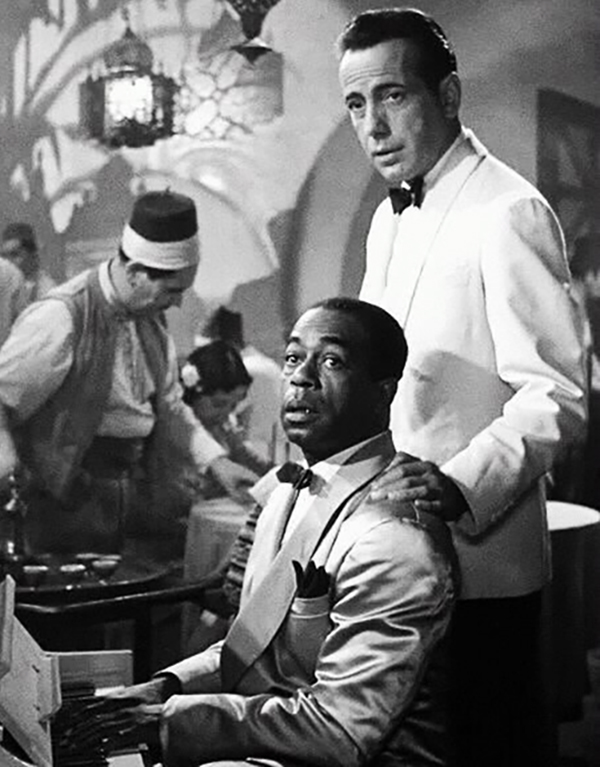
Dooley Wilson as Sam, Rick’s loyal BFF.

Hal Wallis embraced this controversial new approach, reasoning that “Negroes” were fighting and dying for their country in the war, spilling the same color blood as white people, so why not treat them as equals in pictures? First up was the role of Parry played by Ernest Anderson in the Bette Davis sudser, In This Our Life (1942). Parry was the young son of a household cook (Hattie McDaniel again) who was wrongly accused of a fatal hit-and-run accident. He’s cleared by the end of the picture and off to law school—and throughout, his part isn’t played for laughs. At all. And with Casablanca, Wallis considered the same approach—taking the character seriously. Wallis considered writing Sam as a woman and casting either Hazel Scott or Lena Horne until studio story editor Irene Lee and writers the Epstein twins won Wallis over that Sam must be a male to head off any thought that Rick and his piano player might be romantically involved—which would sap the intensity of the Rick–Ilsa dynamic.

Over time, veteran Black character actor Clarence Muse was considered for the part of Sam, and Hollywood newcomer Dooley Wilson was chosen. All the while, Jack Warner played rooftop sniper and argued against letting Sam be played as Rick’s best friend and confidant because the picture might be banned in the American Deep South for showing a Black man as Rick’s equal. And Wallis kept pointing to the war effort and the changing times, stuck to his guns, and gave the world a character for the ages in Sam, a role and a performance that holds up 100 percent today, going on a century later. There isn’t one false note in Dooley Wilson’s characterization, not one cringeworthy moment of the kind that mar Hattie McDaniel’s performances—bits forced upon her to reassure white viewers they were indeed superior.

Flora Robson as Queen Elizabeth with Flynn in The Sea Hawk (1940); Robson as a Black slave with Ingrid Bergman in Saratoga Trunk (made in 1943; released in 1945).

Now we come to the big “However.” Just months after Casablanca wrapped, Wallis started work on a picture called Saratoga Trunk, from the novel by Edna Ferber. The lead role of Clio Dulaine in Saratoga Trunk was coveted, much as had been the part of Scarlett O’Hara in Gone With the Wind. I remember how badly Olivia de Havilland in particular wanted to play illegitimate, half-Black Clio returning from France to post-Civil War New Orleans to avenge her mother. But do you know who Hal Wallis chose for Clio in Saratoga Trunk? Fair-skinned Swede Ingrid Bergman, that’s who, her hair dyed black to “satisfy” the problem of race. And for the part of Clio’s Black maid Angelique, Wallis selected very white, British-born Flora Robson, who just three years earlier had portrayed Queen Elizabeth I in Flynn’s The Sea Hawk! For Saratoga Trunk she’s slathered in hideous dark-skinned makeup because, Wallis said, “the role was so large and important that it was beyond the range of many [Black] actresses of that time.” Um, OK, Hal. Sure. Ironically enough, Robson would be nominated for an Oscar for her take on Angelique, whereas today, viewers simply take one look at her, gasp, and go, “Wut up with the blackface?” So, sometimes Wallis challenged the norms and sometimes he didn’t; after all, Wallis straddled the line between artist and businessman. When he got it wrong, the result was Saratoga Trunk, a picture known only to die-hard cinephiles. When he got it right, the result was Casablanca with its many perfections, not the least of which is quiet, steadfast Sam, best friend of the white guy. (And I’ll bet you Rick’s Café Americain didn’t hold even one segregated restroom.)