Season of the Gods Robert Matzen

Tension in the Workplace

Get away from me, you psycho bastard.

It’s been a long time since I had a co-worker of the opposite sex I just couldn’t stand. As in despised. Reviled. Back when I did, it was a good thing I didn’t have to embrace and kiss that person passionately and profess my love as part of my job. So, imagine you’re an actress on an MGM soundstage working with an actor you loathed, like Eleanor Parker working with Stewart Granger.

The picture they made together, Scaramouche, is a Sabatini novel of revenge set in eighteenth-century France during the Revolution. At the turn of the 1950s, as MGM began turning out Technicolor costume adventures by the bucketful to compete with television, Scaramouche seemed a natural fit, following up on a silent version starring Ramon Novarro released back in 1923.

As usual, I’m not going to review Scaramouche except to say I find it a terrific picture in the classic sense of a vengeance swashbuckler with a couple of neat plot twists at the end. Some of you may know I’m not a fan of Mel Ferrer the movie star or the human being, but I’m the first to say he’s perfect as the antagonist in this picture, the Marquis de Maynes. Everyone’s really good in it, and the plot moves at a breakneck pace.

Headliner Stewart Granger had recently come to the States after a string of successful pictures in the UK, and his first big MGM picture in Hollywood, King Solomon’s Mines, had been a smash. So next he would star in Scaramouche opposite former Warner Bros. leading lady Eleanor Parker, whose contract had not been renewed, resulting in a move to MGM. She played the worldly wise firebrand actress Lenore, who loves and hates Andre Moreau, a self-centered aristocratic reprobate played by Granger. The onscreen relationship between Granger’s Moreau and Parker’s Lenore is tempestuous and disguises a natural animosity that existed between the players.

My pal Dick Dinman interviewed Parker in the 1990s, with Granger as one of the topics of conversation. “I can’t even say his name, I dislike him so much,” Parker began before blurting out, “I hated the man.”

Young Janet Leigh never looked better.

Then she went on to describe a pivotal moment between the actors, a confrontation that took place in a covered wagon: “I had to slap him once in a scene. Slap his face. And he said, ‘If you ever hit me while we’re doing this, if you slap me, I’m going to grab your throat and I’ll kill you.’ He said, ‘I almost killed…’ some British actress and he named her name—I can’t remember who it was now—but he said, ‘I grabbed her by the throat and I almost choked her to death.’ I said, ‘Oh, how nice.’ And he said, ‘If you dare to slap me and hurt me at all, I’m going to do it to you.’ He said, ‘I mean it.’ Oh, he was so mean. My mouth dropped open and I wanted to hit him right then. So the scene came up and we were doing his close-up or whatever and you had to see him get slapped…and I went [she grunts faintly] and my hand went up and back. I just couldn’t hit him; he’s looking at me and I couldn’t hit him. He looked proper because he couldn’t glower at me with his face to the camera. So I didn’t want to hit him.

“The director [George Sidney] said, ‘Cut! Eleanor, what’s the matter with you?’

“I said, ‘I want to talk to you for a minute.’”

Him: “You fancy me.” Her: “No, I hate you.”

They went off by themselves and she told him, “He threatened me. He’s going to grab me by the throat and kill me if I…slap his face, and I don’t know what to do.”

George Sidney said, “He’s a coward. Never mind him. Hit him as hard as you can. Don’t worry. All the crew—everybody, we’re right here to grab that man and kill him if we have to. You just hit him as hard as you can.”

They played the scene and she gave him a stage slap as instructed.

“When they said ‘cut,’ he looked at me, turned around, and he never spoke to me for the rest of the movie. He didn’t do anything, but he never spoke to me. If I walked up and he happened to be in a group, he would turn around and leave or he would stop talking and just stand there until I left. It was most embarrassing. And that’s all I was doing, what the director told me, and I had to do it because it’s written in there [in the script].”

Hearing this story from Parker years ago soured me on Granger, and nothing I’ve heard since really counters the impression she gave of the man. He did indeed have a reputation as a cold narcissist, and what strikes me now watching him is a naked attempt to copy the style and mannerisms of Errol Flynn, which he couldn’t do because he didn’t have Flynn’s charm. Parker had co-starred with Flynn twice and, despite Errol’s bad-boy reputation, said he was a pro on the set and always respectful—never the malevolent presence she described in Stewart Granger. She summed it up saying of Granger, “He was so awful, the rudest, nastiest guy; I just hated him. Everybody did.”

To Dick Dinman’s great credit, when he interviewed Stewart Granger, he asked him about the alleged difficulties with Eleanor Parker on the set of Scaramouche. “I don’t know what it was,” said Granger, “but she had great pleasure in smacking me, really belting me as hard as she could. I mean, she didn’t pull her punches. Normally we actors and actresses pull our punches; we slap it away. One scene where I’m sitting on a basket and I’m joking with her and being difficult and she says, ‘Oh, you!’ and she goes and knocked me out. She hit me so hard that for two seconds I can’t think where I am.”

Well, yes, Mr. Granger. You threatened her and the director urged her to let you have it, with 30 or 40 crewmen as backup.

But his next comment revealed the kind of misogynist that ruled in Hollywood at the time: “There were problems with Eleanor Parker. She was a darling, but she was—I guess I was a bit of a naughty fellow, you know. [I] wouldn’t play ball in the way she—I don’t know what it was, but she seemed…you know, a lot of women like to slap men really hard, especially if they fancy you. And I think maybe she fancied me in those tights.”

Hats off to both Ferrer and Granger for a commitment to excellence making this swordfight sizzle.

Um, sure, Stewart. She must have fancied you because you were irresistible in tights. Never mind the threats of murder.

Given that I’m not a fan of Mel Ferrer and I’m not a fan of Stewart Granger, Scaramouche remains for me a hoot. It’s one of those pictures that’s been sort of lost to the ages and definitely one where you need to suspend your disbelief. But, boy, the furious chases on horseback, the lush Technicolor with Janet Leigh in her prime and Parker’s flaming red hair, and the six-and-a-half-minute climactic swordfight in a theater that’s equal parts athletic and deadly, make this for me the best of the 1950s. And knowing of the tension between the leading man and his co-star makes for interesting sport as you watch them work together, especially in that scene in the wagon.

But you know what’s funny? That one female co-worker I just couldn’t stand back in the day is one I now look back on with fondness, understanding in hindsight that I generated a lot of the conflict by being young and full of myself. It doesn’t seem that any such self-reflection ever made it into the mind of the late Stewart Granger.

The Big ‘However’

It’s baffling to me to think that in my lifetime, there was a thing called segregation. In my lifetime! I wasn’t old enough to actually see a restroom or swimming pool for “colored people,” so when I’m reminded that even in the 1960s things were that way, I’m stunned. All of which points out to me the twentieth century trailblazers who wouldn’t settle for the two-tier system in America, such as Warner Bros. executive producer Hal Wallis. As detailed in my book Season of the Gods, Wallis despised studio boss Jack Warner, whose narcissism clashed with Wallis’s own fearsome ego. One of the things they clashed over was Black talent.

Hal Wallis (right) with Casablanca director Michael Curtiz and Ingrid Bergman.

Years ago, while combing the U.S.C. Warner Bros. Archives, I came across a summer 1941 Jack Warner memo indicating he wanted some “colored people” for comic relief in the Custer biopic then in development starring Errol Flynn. Warner was an advocate of comic turns in all the WB pictures—they called them “bits of business” back in the day—always done by white character actors like George Tobias or Alan Hale, or by Black actors like Clarence Muse. In the case of the Custer picture, the Jack Warner memo resulted in the appearance of a “boy” tending Custer’s hounds at the beginning of the picture, and new scenes for housekeeper “Callie” played by Hattie McDaniel, then not far past her Academy Award win for Gone With the Wind. McDaniel’s Oscar, richly deserved for a nuanced performance as Mammy, had sent shock waves through the continent—America wasn’t ready to recognize 1) a Black character as wiser or more grounded than the white characters in the piece, or 2) a Black performer as talented as Caucasian counterparts.

Hattie McDaniel with the teacup ‘bit of business’ in They Died with Their Boots On (1941).

I don’t know about you, but McDaniel’s bits of business in the Custer picture They Died with Their Boots On have made me uncomfortable for decades—the bit about the fortune telling with the teacup and rabbit’s foot and the thing in the garden with the owl. Yikes. But that was Jack Warner for you, always ready to beat people over the head with painful humor delivered in person through notoriously horrendous jokes or through his pictures of the 1930s and 40s, none of which I find funny. Whether it’s Boy Meets Girl or Arsenic and Old Lace, the humor is loud, desperate, and, to me at least, painful.

But back to the Hal Wallis–Jack Warner enmity. Wallis acquiesced to Warner in the case of Custer, but times were changing. At the turn of 1942, with America newly launched into world war, Wallis bought a stage play called “Everybody Comes to Rick’s” and jammed it into the production schedule, renaming it Casablanca. A key member of the cast was a gay “Negro” piano player called Sam the Rabbit, who was written as a stereotype of the times. However, in developing the characters and screenplay of Casablanca in February and March 1942, Wallis was seeing headlines like this one in Daily Variety: BETTER BREAKS FOR NEGROES IN HOLLYWOOD. Dated March 24, the article began, “Negroes are to be given an increasingly prominent part in pictures,” according to Walter White, head of the NAACP. White stated that “Darryl Zanuck and other production chiefs had promised a more honest portrayal of the Negro henceforth, using them not only as red-caps, porters and in other menial roles, but in all the parts they play in the nation’s everyday life.”

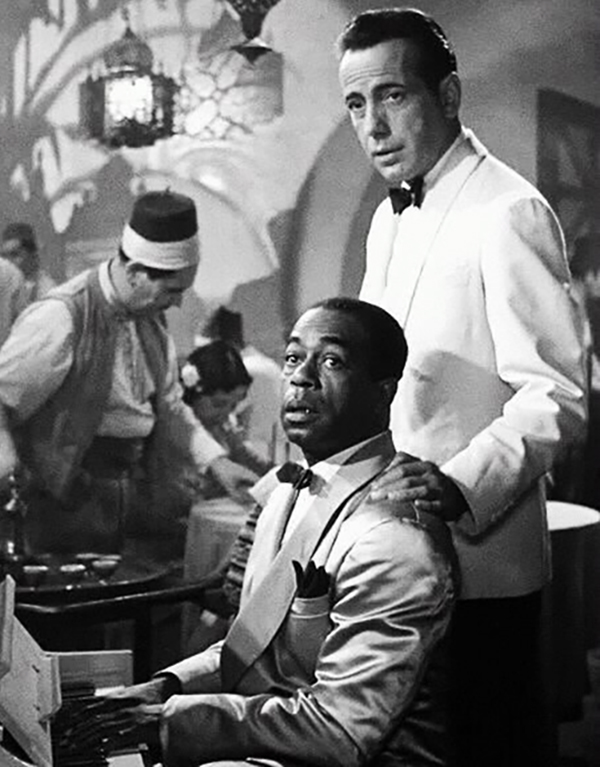
Dooley Wilson as Sam, Rick’s loyal BFF.

Hal Wallis embraced this controversial new approach, reasoning that “Negroes” were fighting and dying for their country in the war, spilling the same color blood as white people, so why not treat them as equals in pictures? First up was the role of Parry played by Ernest Anderson in the Bette Davis sudser, In This Our Life (1942). Parry was the young son of a household cook (Hattie McDaniel again) who was wrongly accused of a fatal hit-and-run accident. He’s cleared by the end of the picture and off to law school—and throughout, his part isn’t played for laughs. At all. And with Casablanca, Wallis considered the same approach—taking the character seriously. Wallis considered writing Sam as a woman and casting either Hazel Scott or Lena Horne until studio story editor Irene Lee and writers the Epstein twins won Wallis over that Sam must be a male to head off any thought that Rick and his piano player might be romantically involved—which would sap the intensity of the Rick–Ilsa dynamic.

Over time, veteran Black character actor Clarence Muse was considered for the part of Sam, and Hollywood newcomer Dooley Wilson was chosen. All the while, Jack Warner played rooftop sniper and argued against letting Sam be played as Rick’s best friend and confidant because the picture might be banned in the American Deep South for showing a Black man as Rick’s equal. And Wallis kept pointing to the war effort and the changing times, stuck to his guns, and gave the world a character for the ages in Sam, a role and a performance that holds up 100 percent today, going on a century later. There isn’t one false note in Dooley Wilson’s characterization, not one cringeworthy moment of the kind that mar Hattie McDaniel’s performances—bits forced upon her to reassure white viewers they were indeed superior.

Flora Robson as Queen Elizabeth with Flynn in The Sea Hawk (1940); Robson as a Black slave with Ingrid Bergman in Saratoga Trunk (made in 1943; released in 1945).

Now we come to the big “However.” Just months after Casablanca wrapped, Wallis started work on a picture called Saratoga Trunk, from the novel by Edna Ferber. The lead role of Clio Dulaine in Saratoga Trunk was coveted, much as had been the part of Scarlett O’Hara in Gone With the Wind. I remember how badly Olivia de Havilland in particular wanted to play illegitimate, half-Black Clio returning from France to post-Civil War New Orleans to avenge her mother. But do you know who Hal Wallis chose for Clio in Saratoga Trunk? Fair-skinned Swede Ingrid Bergman, that’s who, her hair dyed black to “satisfy” the problem of race. And for the part of Clio’s Black maid Angelique, Wallis selected very white, British-born Flora Robson, who just three years earlier had portrayed Queen Elizabeth I in Flynn’s The Sea Hawk! For Saratoga Trunk she’s slathered in hideous dark-skinned makeup because, Wallis said, “the role was so large and important that it was beyond the range of many [Black] actresses of that time.” Um, OK, Hal. Sure. Ironically enough, Robson would be nominated for an Oscar for her take on Angelique, whereas today, viewers simply take one look at her, gasp, and go, “Wut up with the blackface?” So, sometimes Wallis challenged the norms and sometimes he didn’t; after all, Wallis straddled the line between artist and businessman. When he got it wrong, the result was Saratoga Trunk, a picture known only to die-hard cinephiles. When he got it right, the result was Casablanca with its many perfections, not the least of which is quiet, steadfast Sam, best friend of the white guy. (And I’ll bet you Rick’s Café Americain didn’t hold even one segregated restroom.)

Givin’ It All Away*

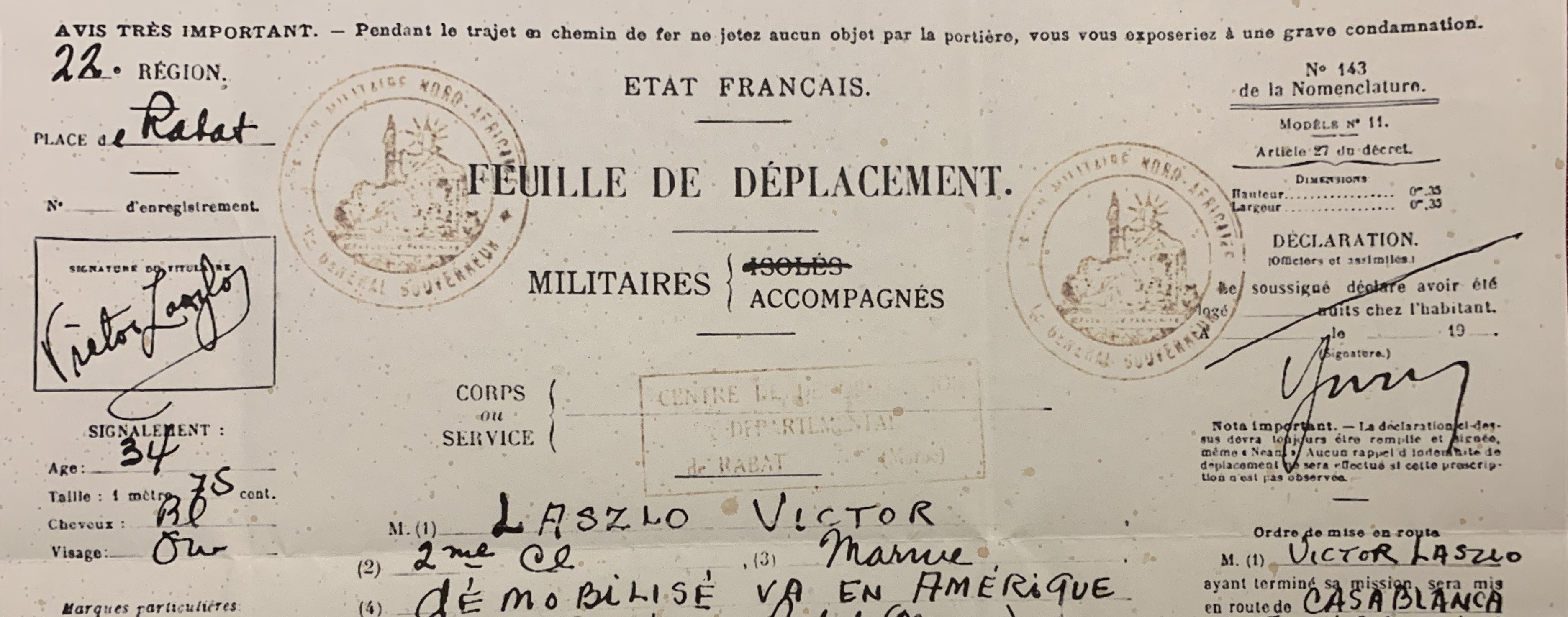
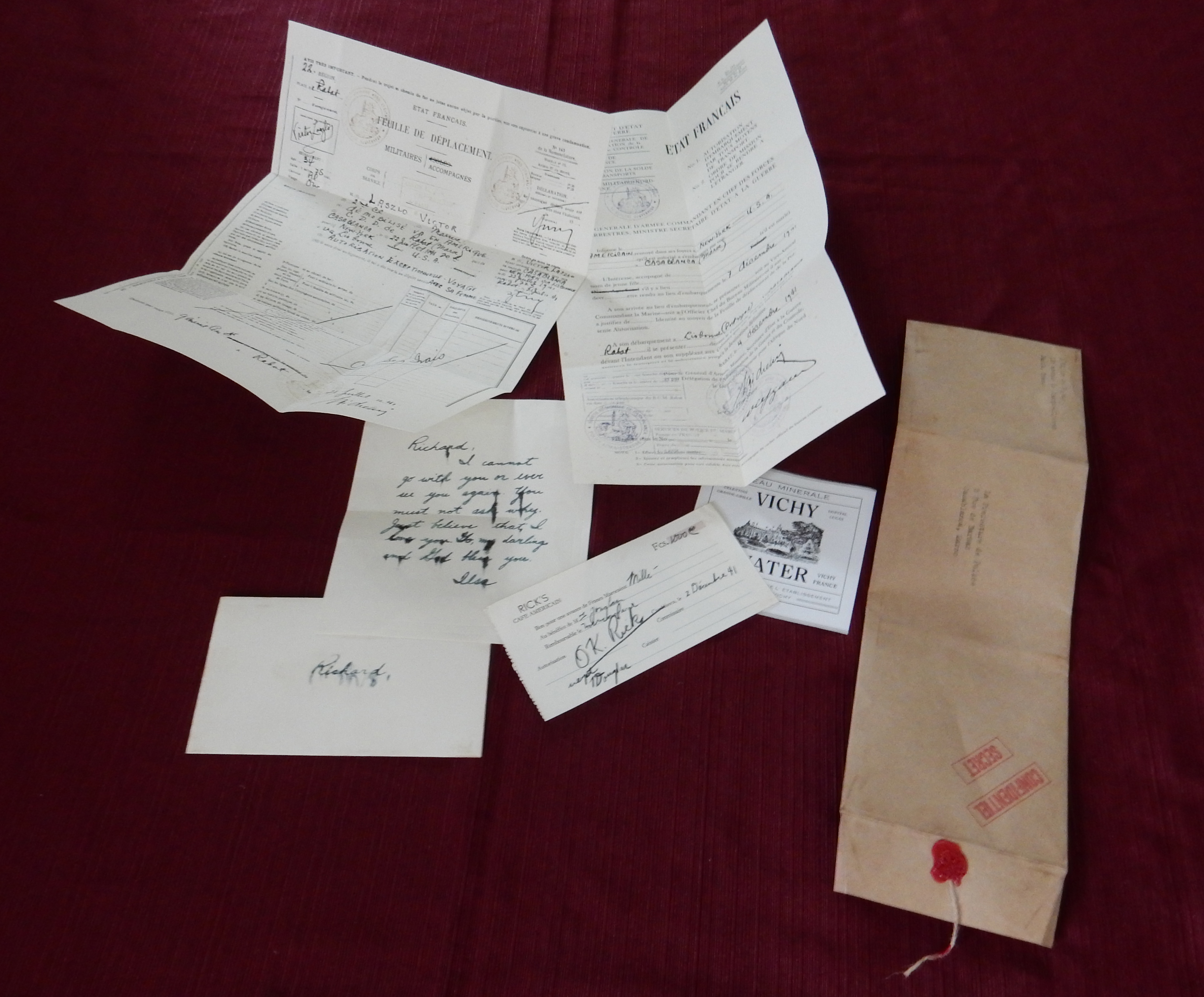
So you say you haven’t yet read Season of the Gods—the novel about how Casablanca came to be? Would it pique your interest if you learned that a major Hollywood production company is now attached to this story and enthusiastic about its possibilities as a feature motion picture? Would it poke you in the ribs if you learned of a sweepstakes underway on Red Carpet Crash that includes five finalist prize packs and one grand prize winner of a set of replica letters of transit and other key documents from Casablanca? I kid you not—the grand prize is the letters of transit (see photo above for a glimpse), and also Ilsa’s rain-smeared letter to Rick and other Casablanca papers.

A photo of the #Casablancalettersoftransit and other documents critical to the film.
The grand prize set of Casablanca documents.

Here’s the finalist prize pack:

  • Signed copy of Season of the Gods
  • Casablanca Blu-ray loaded with special features
  • Casablanca t-shirt
  • Rick’s Café Americain matchbook
  • Season of the Gods bookmark

And the grand prize winner gets all that PLUS the set of replica Casablanca documents, including the letters of transit.

To enter, visit Red Carpet Crash today—the sweepstakes ends Friday, February 2.

Just as a quick reminder, Season of the Gods is 100 percent fact-based and tells the story of Irene Lee, Warner Bros. story editor (the only female executive in the company) who finds an orphan stage play and engineers its purchase by the studio’s executive producer, Hal Wallis. Irene’s a plucky one, five-foot-nothing and holding her own in misogynistic Hollywood. She serves as a de facto producer of Casablanca even though Hal Wallis won’t give Irene, a mere female, that title. She works with the crazy brother screenwriting team of Phil and Julie Epstein to craft the story and then with other writers brought in—Howard Koch and Casey Robinson. And she finds love along the way, or rather doubts she has found love when she considers her “junkyard of a love life.” I have such great fondness for the characters in the book, not only empathic Phil Epstein and his edgy brother Julie, but also Dooley Wilson, Hollywood novice in a white man’s world and dreaming of buying his wife a house; Claude Rains the easy-going roué; Conrad Veidt the elegant German expat eager to play Nazis and expose their evil; dark and cynical morphine addict Peter Lorre; gentle giant Sydney Greenstreet; Aaron Diamond, the New York carpet buyer who’s crazy about Irene; and Joy Page, Jack Warner’s stepdaughter who sees a role in Casablanca as a potential escape route from her difficult life at the Warner mansion, dubbed “1801” for its street address on Angelo Drive in Beverly Hills. And the backdrop. Oh, that backdrop. The dark months after Pearl Harbor when U.S. coastlines braced for invasion and defeat after defeat of Allied forces blasted across the headlines.

Plucky, little-documented Irene Lee, the real hero of Casablanca.

I guess you can tell … I like this book. And I’m not alone. Season of the Gods has gotten some great ink, from Publishers Weekly BookLife (an Editor’s Pick), from Kirkus Reviews (which called it “EPIC”), and most recently from Annette Bochenek’s website, Hometowns to Hollywood. The Historical Novel Society interviewed me about the book, as did Grace Collins for her True Stories of Tinseltown podcast. I always felt that I wasn’t going to take the world of fiction by storm and that this would be a marathon; not a sprint. Fiction is a place bulging with seasoned talent and passionate readers who know what they want and what they like, and who am I but a nonfiction author daring to cross over with an idea that came from who knows where?

The fact that Hollywood likes the book is a potential game changer. No kidding, they signed me up as soon as they received and devoured the copies sent over. That said, this company-that-must-not-be-named now controls the film rights and it’s up them to announce the deal or not, and to make a movie or not. We shall see what we shall see, but all I can say to these great people is: Thank you for believing in this story.

To order Season of the Gods, visit Amazon, Barnes & Noble, or if you favor the independent booksellers (and want a discount), Bookshop.org.

As always, thank you for checking in. See you at the movies—the golden age movies, that is. And please let all your friends know about the sweepstakes!

__________

*Givin’ It All Away was the greatest song by a solid 1970s band called Bachman Turner Overdrive. When I typed this for the title, I thought OMG, remember that song? I’ve got to go listen to that song, which I hadn’t heard in ages. And, wow, what a blast from the past. “You took my heart/And you went away/We said goodbye/And we’re givin’ it all away.” Still a great song—all the fury of love gone wrong. (Just so you don’t think I’m a Johnny One Note who only writes about wartime Hollywood. Rock on, my friends.)

Playing It Safe

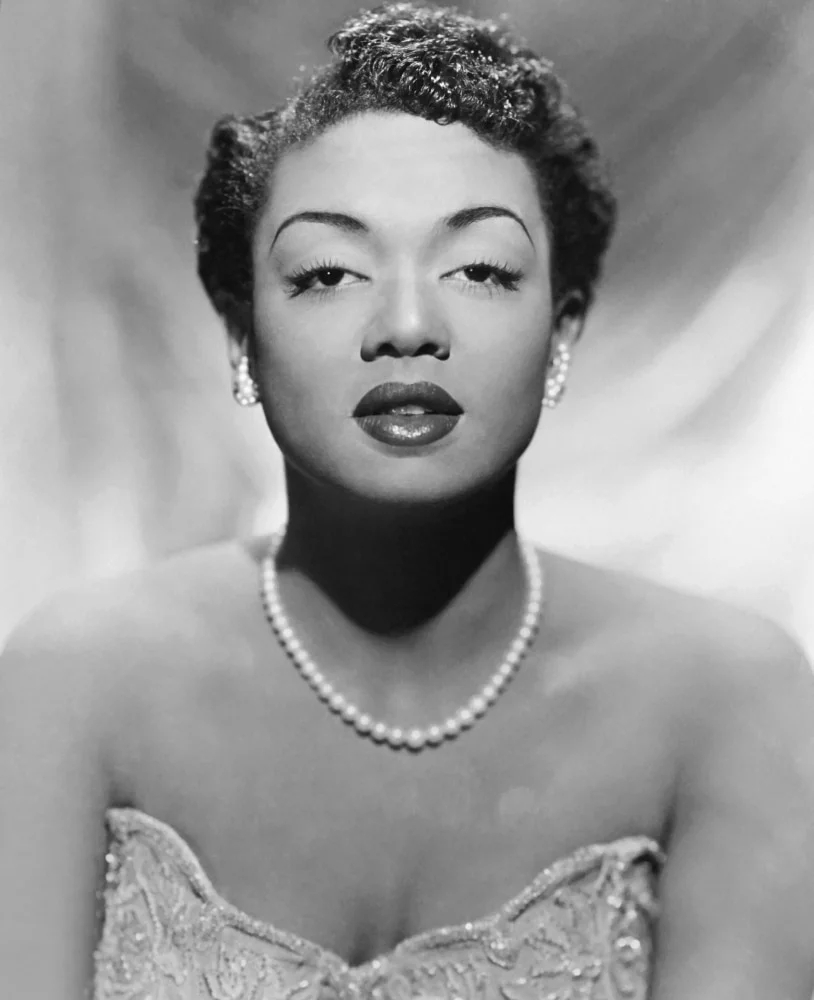
The first choice of Hal Wallis: Hazel Scott.

I was watching Turner Classic Movies (U.S.) yesterday and heard Dave Karger’s introduction of Show Boat, MGM’s 1951 adaptation of a Broadway musical based on a 1926 bestselling novel by Edna Ferber. The plot of Show Boat concerns a traveling troupe of entertainers on the Mississippi River, one of whom is singer Julie LaVerne, part Caucasian and part Black. Karger explained that Lena Horne was originally penciled in as Julie because she had performed a number from Show Boat in the 1946 MGM musical, Till the Clouds Roll By. But MGM executives worried about putting a Black actress in such a pivotal role in a theatrical release and opted instead to cast Ava Gardner, all white, in the role. And at that moment I exclaimed to Dave Karger on the TV, “Why, those chicken shits!”

It’s difficult today to comprehend a United States in 1951 where Black people couldn’t be seen as equals in Hollywood productions. U.S. culture of the time still had white restrooms and “Colored” restrooms, white swimming pools and Colored swimming pools. It was the time of the Green Book and would stay that way for another generation!

But, to me, Louis B. Mayer and his MGM brethren were chickenshits because Hal Wallis, executive producer at Warner Bros., had already stormed this beach, had already claimed this ground, had already planted the flag of equal rights by daring to show a Black character as equal to white when Wallis had said “Screw it” and cast Dooley Wilson as Rick Blaine’s best friend in Casablanca a whopping nine years before Show Boat entered production.

Wallis then deferred to up-and-coming Lena Horne.

As detailed in Season of the Gods, Wallis and his team had bought the stage play “Everybody Comes to Rick’s,” which featured “Sam the Rabbit” as a key character, a flamboyant Black entertainer at Rick’s nightclub in Casablanca, French Morocco. Originally, Wallis’s inclination was to play up the flamboyant part by switching the Sam character to a Black female and his two choices for Sam were Hazel Scott, gorgeous multi-talented 20-year-old sensation then taking New York by storm, or the aforementioned Lena Horne, then beginning her career in Sunset Strip venues.

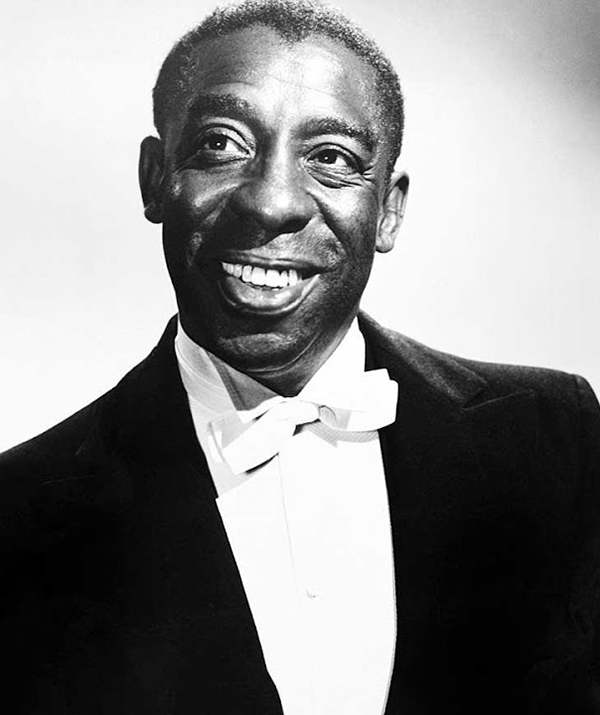
I’ll rely on you to read the debates in Season of the Gods and move on to the next plan, which was to cast Clarence Muse, dependable Colored stereotype, as Rick’s more-or-less second banana, this when early script drafts of Casablanca by Phil and Julie Epstein relied more on humor and less on romance. But Muse didn’t fit the evolving storyline, and Muse had been seen and seen and seen in this one type of role. Overseen. Wallis wanted more out of what was rapidly becoming a Very Important Picture as the world unraveled and Northern Africa hit the headlines. In the opinion of Hal Wallis, if young Black men were willing to go and die fighting the Axis powers in the name of freedom, then Black people could be seen as equals in Warner Bros. pictures.

Sam #3, the safe choice: character man Clarence Muse.

Cue more debates in Season of the Gods, as Wallis was warned he could “lose the South,” a critical market for box office returns, if he dared cast a Black man as equal to whites. Southern audience members could get up and walk out, demand their money back, and tell all their friends to stay away. This was the same American South that protested the working title of a George M. Cohan biopic then in production at Warner Bros., Yankee Doodle Dandy, because it dared to include the word “yankee” in the title! This, my friends, was the screwed up world of 1942: Americans were fighting racist authoritarianism overseas while ignoring their own racism at home.

Wallis saw it, and Wallis made a stand. He eschewed the stereotyped Clarence Muse and cast a well-worn, globetrotting entertainer named Dooley Wilson as Sam. I attempted to try to see the world of that time through Dooley’s eyes in the narrative of Season of the Gods and that in itself proved a surprising experience. Dooley just wanted to get by, so he looked away from the racism, figuratively and also literally, as he avoided eye contact with the people he met at Paramount and Warner Bros. But oh, the surprise in store for Dooley when he began production of Casablanca. You want me to WHAT? Underplay? He couldn’t believe it as his first couple of roles in Hollywood had been as a porter and a butler, doing the usual wide-eyed comic takes.

Casablanca holds up so well today because of the truth it presents. The people crammed into the lifeboat called Rick’s Café Americain—whether terrified Jews fleeing Hitler, a world-weary Black piano player, or a Czech freedom fighter and his wife—are just people trying to survive, trying to find peace. Wallis had gambled and won; his picture became everything envisioned and much, much more. I don’t know how many people walked out in the South, but that number was offset many times over by box office in New York and Chicago and Los Angeles. Casablanca scored big on release in 1943, then again in 1949 and 1956 reissues, then endured on television.

The real Sam: new-to-Hollywood Dooley Wilson.

Yes, Show Boat “played it safe” in 1951 by casting Ava Gardner in a leading role instead of Lena Horne. And yes, groundbreaking Warner Bros. (minus Hal Wallis, who had moved on) would also play it safe in 1957 when time came to cast for Band of Angels, an antebellum story set in Louisiana. In the role of half-Black heroine Amantha Starr, Warner Bros. cast Yvonne De Carlo instead of, say, Dorothy Dandridge in the part because the world wasn’t ready for Clark Gable to be kissing Dorothy Dandridge. What if they walked out in the South?! (I will acknowledge progress made by 1957 in casting Sidney Poitier in a key role.)

So, sure, the world has changed, and yet the world hasn’t changed. There’s still hate because of the color of your skin or your ethnic heritage or the god you worship. And there’s still a burning need for courage like that displayed by Hal Wallis, who dared to do the right thing back in 1942.

Season of the Gods: A Novel is now available from Amazon.com, Barnesandnoble.com, Bookshop.org, and other booksellers.

Taking it to a higher plane

A good friend and colleague of mine picked up a sign on the WGA picket line in Hollywood the other day. That sign read on one side: AI WILL NEVER GIVE YOU and on the other side: CASABLANCA. He sent me a video showing the two sides of the poster because he knows how much I’ve been into Casablanca lately due to my new novel, Season of the Gods—which he had read in draft form months ago, offering key feedback for improvement.

Only through a historical novel could I get as close as I needed to get to the story of how Casablanca came to be. I wanted to understand its writers, Julie and Phil Epstein—that’s where this project started. Who were these guys who have already been lost to history except for a few well-worn anecdotes that have been spun into implausibility over the decades? Once, the Epsteins—“the boys” as everyone on the Warner Bros. lot knew them—were young, vital, ambitious, and living by their own code—and I needed to travel back there and walk around Hollywood with these guys to grasp the evolution of a masterpiece day by day.

Read the September 23 article in Air Mail.

Why can’t AI ever give you Casablanca? You’ll find all the reasons in Season of the Gods. A high school teacher named Murray Burnett wrote the stage play on which the film was based. On Broadway it didn’t need to contend with Hollywood’s morality code, and Warner Bros. story editor Irene Lee, nicknamed “Renie,” looked past the code when she purchased the play, figuring her writers would simply adapt key parts of the story and junk the rest.

Cue the hand-wringing.

Two veteran studio writers were assigned to the project and hit a brick wall because of the illicit sex that formed the foundation of the story. But the Epstein brothers, twins then age 32 and ready to conquer the world, all but begged production boss Hal Wallis for the assignment when the first two writers failed. Wallis granted the Epsteins’ wish and then they too got stuck. A third writer, political idealist Howard Koch, came aboard for new angles, and then a fourth writer, studio Cadillac Casey Robinson, stepped in and offered critique on the work of the other three. And still these four highly skilled craftsmen couldn’t figure it out.

Julius and Philip Epstein, who appear in Season of the Gods, a novel about Casablanca by Robert Matzen
Julius Epstein (left) and his twin brother, Phil, ready to take on the world.

Cue the ticking time bomb.

Irene Lee had sold Hal Wallis on the timeliness of a story set in North Africa, where Montgomery was battling Rommel. Wallis wedged the property he had retitled Casablanca into an already crammed production schedule. He couldn’t find actors—they were already booked on the other productions. He couldn’t build much in the way of sets or use real airplanes—wartime restrictions. All he knew was he had to make a movie and get it cut and release it, and the goddamn writers were holding him up! He gritted his teeth and started shooting a movie based on a partial script and kept a gun to the backs of his writers to figure out the ending!

Irene Lee, who appears in Season of the Gods, a novel about Casablanca by Robert Matzen
Warner Bros. Story Editor Irene Lee, who championed development of Casablanca.

Imagine you’re a fly on the wall of those story conferences, particularly the last one when Renie and her four writers had literally reached the end of the runway and would shoot something in the morning to represent the end of the story. They had filmed everything but the airport climax, and it had to make sense for the German to die, the freedom fighter to escape, the freedom fighter’s wife to leave the hero, and the hero to walk away free and clear.

As my WGA screenwriter friend said yesterday, “One of the things I find so interesting about your book is that it really is a celebration of the writing process—Casablanca, with its myriad contributors, seems like an early, unintentional example of the value of the writers’ room that is so much at issue.”

Could AI have reasoned out the ending to Casablanca? Could AI have written all the great lines the Epsteins created, lines that everyday people around the world have repeated on the job or at the dinner table for 80 years and counting? These zingers charm your pants off because you can’t see them coming. They’re human, revealing, self-deprecating, and ironic.

Season of the Gods, a novel about Casablanca by Robert Matzen
Ludwig Stössel, Ilka Grüning, and S.Z. Sakall, three famous European actors who had been driven to America by the Nazi regime. All were taken into the production at the urging of director Michael Curtiz.

Season of the Gods takes you inside studio walls, inside the writers’ room, inside the soundstage. You will meet the Epsteins, Renie, Wallis, Koch, Robinson, Bogart, Bergman, Lorre, and a dozen others who made this masterpiece come together despite the odds. You’ll walk a mile in the shoes of Dooley Wilson, watch refugees from Europe join the cast and weigh it down with loss and sadness, and learn how the Epsteins’ secretary saved the day at the very last moment. You will relive fateful months at the beginning of World War II, and you will understand for the first time exactly why we all love Casablanca so much—because of those who rose to a higher plane and brought it to the world.

Season of the Gods: A Novel, from GoodKnight Books.

Glendale Forever

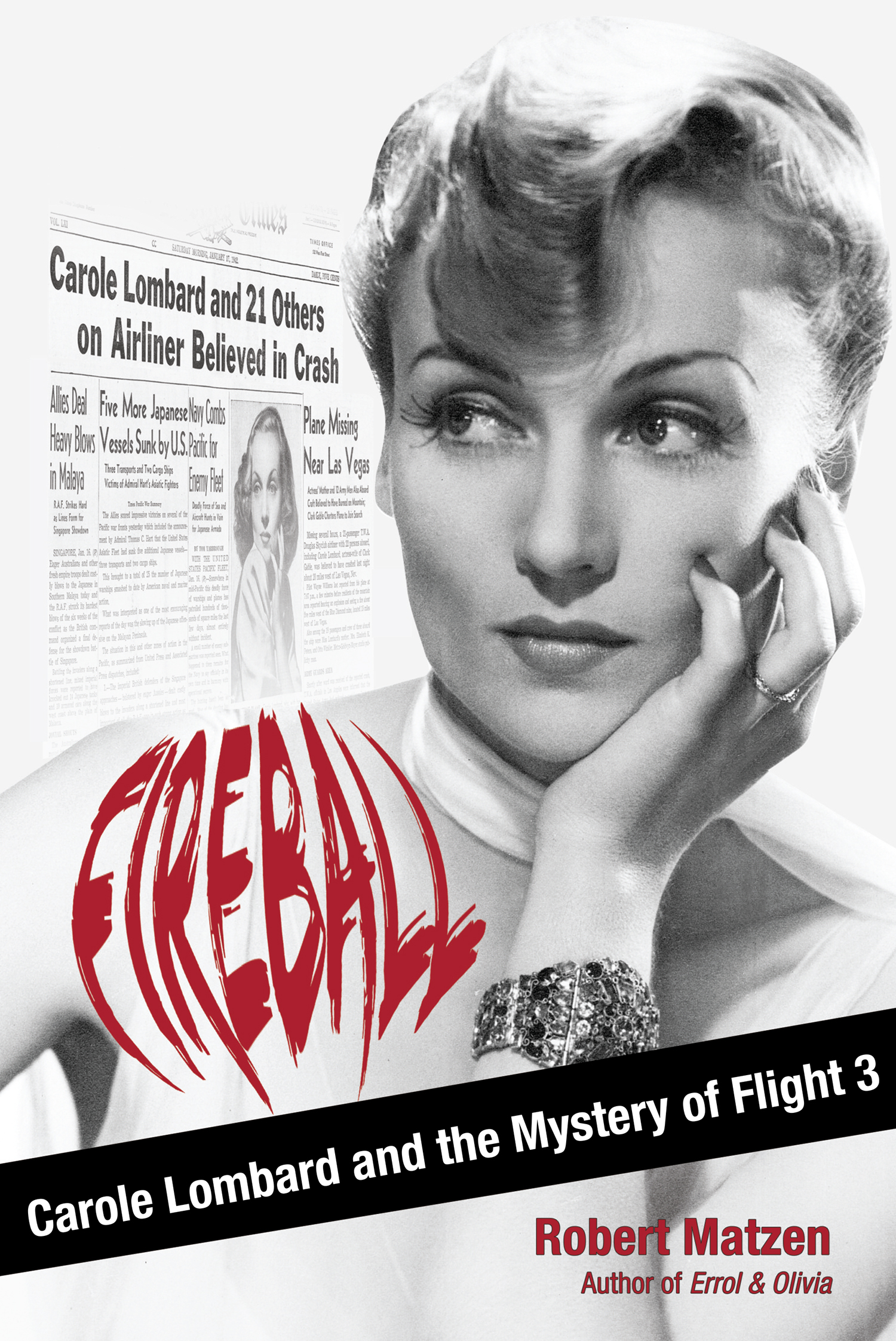
Fireball: Carole Lombard and the Mystery of Flight 3 by Robert Matzen

I once wrote a book called Fireball about an actress named Carole Lombard. Just to give you an idea of the theme, America’s preeminent Hollywood historian Leonard Maltin, as much as he loves Carole Lombard, never could crack Fireball open because it’s about, in part, her grisly death in a plane crash. Don’t get me wrong—Fireball is indeed part forensics study as recovery teams tried to clean up a crash scene where 23 people died and also understand how that crash happened. But more than anything, Fireball is a love story.

The experience of Fireball came back to me kaleidoscopically the other day as I watched the 1932 Paramount pre-Code picture No Man of Her Own, which starred a hot newcomer to the screen, Clark Gable, then age 31, and Paramount’s slowly rising star, Carole Lombard, then not quite 24. Given the fact this picture is now 91 years old, I understand if you don’t know who either of these people were but suffice to say Gable had burst on the scene in 1930, first portraying a convict in a stage play and then a love ’em and leave ’em tough guy in a number of movies made at MGM. Carole Lombard, meanwhile, had managed to land a contract at Paramount Pictures and was at this time struggling to find her footing. I think it’s fair to say early on she possessed mediocre talent balanced with buckets of natural charm.

MGM loaned Gable to Paramount so he could appear with Lombard and give her a career boost in one of those ridiculously plotted melodramas of the period; he plays a card sharp who goes on the lam from New York City and in the rural town of Glendale meets librarian Lombard. Lickety-split she falls in love with him and they wed on a bet, after which for 70 plodding moments we think how can this stupid thing ever work itself out, because by the nature of this kind of star vehicle, they have to live happily ever after.

Fireball: Carole Lombard and the Mystery of Flight 3 by Robert Matzen
Being a pre-Code, there’s some gratuitous footage of Lombard in the shower and parading in skimpy lingerie and Gable also in the shower. And the publicity stills are naughty.

Don’t worry—I don’t write movie reviews. The points I want to make are spooky points because there are spooky aspects about No Man of Her Own given that the love story in Fireball concerns these very same people, Clark Gable and Carole Lombard. When they made this picture 91 years ago, they didn’t know each other, and both were on their best behavior. Gable was married by convenience to a much older society matron, and Lombard was one year into a miserable marriage with a much older actor. Sparks between Clark and Carole didn’t fly in real life any more than they flew onscreen. Once in a while, you can see a glimmer of chemistry between them as the film lumbers along, but mostly they seem to be workers punching a timeclock.

In the picture she is the mature, stable, down-to-earth woman who, when she learns that her husband is a scoundrel who fleeces people in card games, doesn’t leave him. She chooses to stay and become his moral compass, which is exactly what Carole Lombard became for Clark Gable when they married seven years later and she discovered he was a scoundrel who had sex with every willing woman in Hollywood—and women threw themselves at Clark Gable every day because he was then considered “King of the Movies” and the most desirable man in the continent if not the world.

As described in Fireball, Lombard knew what she had gotten when marrying Gable: he was in demand and something of a scoundrel, but just like her character in the movie, she saw good points as well and determined to steer him on a navigable course. But real life wasn’t as clean and simple as a 1932 romantic melodrama, Carole learned when her husband began seeing a sexy starlet named Lana Turner who was just past her teens but already worldly. Suddenly, the bargain Carole had made took a Faustian turn that led directly to her death in flames on the mountain, as you will read in Fireball.

It struck me while watching No Man of Her Own how much the art of 1932 mirrored real life in 1941 as the dutiful wife stuck by her man through thick and thin until a particular other woman came along. It’s no stretch of the imagination to believe that a conversation like the one at a pivotal point in the movie played out at various points in real life.

Fireball: Carole Lombard and the Mystery of Flight 3 by Robert Matzen

Her: Don’t you know this had to happen sooner or later?

Him: What had to happen?

Her: Me finding out you’re a cheat.

Him: Don’t say that to me!

Her: I’ve been fighting the thought for weeks.

Him: My affairs are my own. Don’t butt into them!

Her: I thought we were married, and your affairs were mine.

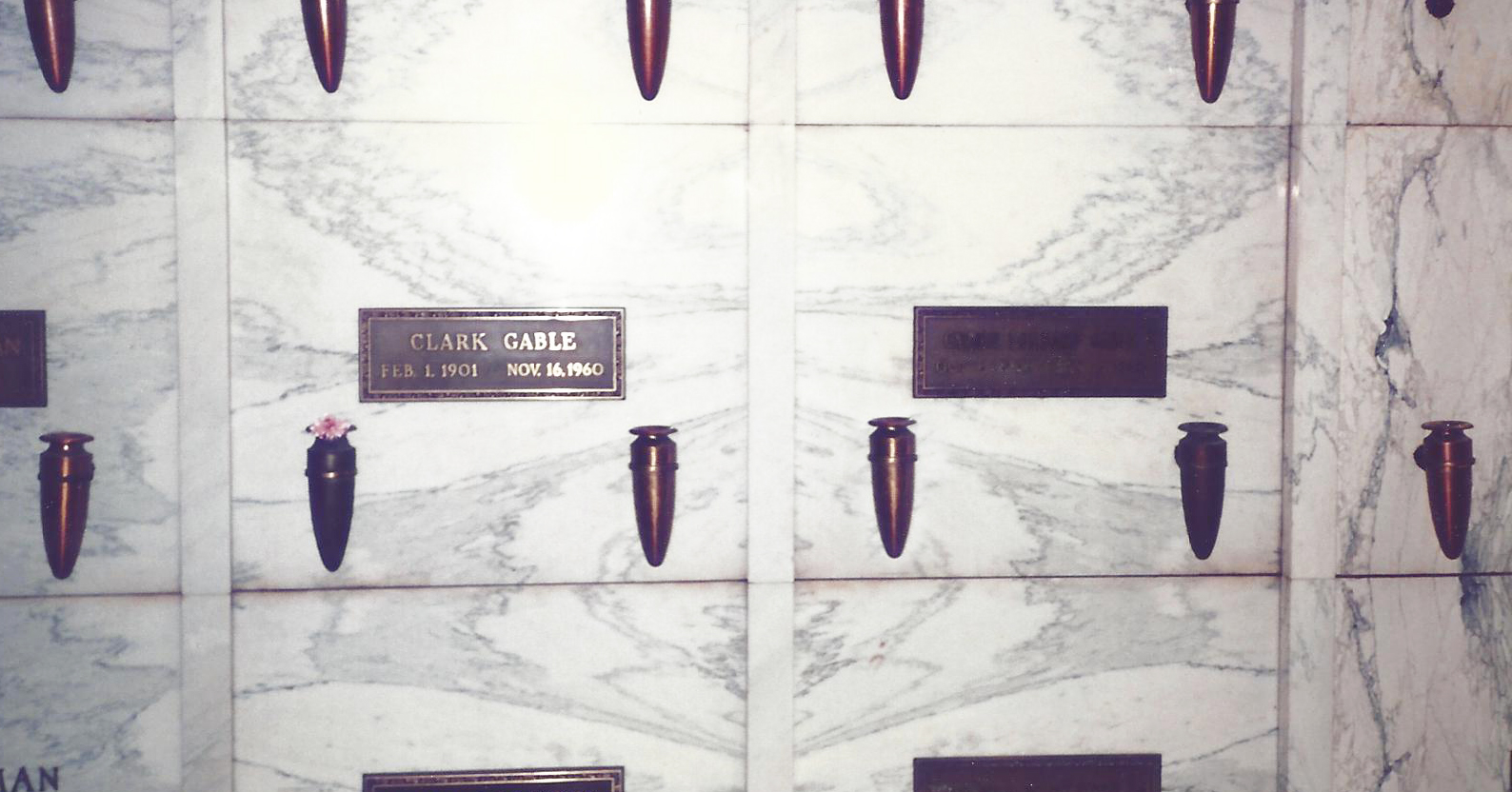
This exchange written for actors in 1932 captures the dark side of the Gable-Lombard relationship. Other dialogue is downright chilling, as when they talk about settling down in Glendale, which in the movie is a fictional town somewhere in the east, maybe but probably not Glendale in the Queens borough of New York. In real life, a town by the name of Glendale is exactly where these two actors reside today, side by side in Glendale, California, in the Great Mausoleum at Forest Lawn Cemetery.

Fireball: Carole Lombard and the Mystery of Flight 3 by Robert Matzen
The crypt of Clark Gable and beside it, nameplate tarnished, that of Carole Lombard Gable.

Fun fact: Carole Lombard comes back to life for an appearance in my new book, Season of the Gods, which will be released on October 3, 2023.

Almost Ilsa

Have I mentioned that I’ve written a historical novel? Season of the Gods follows real people and actual events from 1941 and ’42, taking you inside the heads of key players at Warner Bros. studio during the golden age of Hollywood. The rough draft hit around 180,000 words and about 40,000 words got cut along the way, meaning entire story threads were lost. One of those storylines involved Michèle Morgan, an actress who gained a reputation in France working with international sensation Jean Gabin; Morgan came to the United States in 1941, after the Nazi occupation of France and before U.S. entry in WWII.

You probably have no idea how close Casablanca came to seeing Michèle Morgan as Ilsa Lund, with the only hang-up her asking price—RKO, which owned her contract, demanded $55,000 and wouldn’t budge; Ingrid Bergman, under contract to David O. Selznick, would cost only $25,000. Casablanca producer Hal Wallis had seen Morgan and Paul Henreid in the RKO wartime drama Joan of Paris during a screening at the Warner studio, where he was taken with both leading players. Morgan was a petite 21-year-old with topaz blue eyes who played well beyond her chronological age. In fact, when Paul Henreid first heard he would be working with Morgan in Joan of Paris, his mouth watered just thinking of the French sexpot. But meeting her in person he thought, My God, she’s just a young girl!

Morgan’s story fascinates me. RKO, the studio that had teamed Astaire and Rogers, imported Michèle because of her uniqueness, and then, once she arrived in Hollywood, her handlers worked tirelessly to obliterate that uniqueness. Change how you talk, how you walk, how you think, to become the French-girl stereotype that Americans expect. And she went through it alone, completely alone, a stranger in a strange land.

I believe Michéle Morgan would have been a dynamite Ilsa, whether walking into Rick’s Café Americain to knock Rick right off his pins, or hold a gun on him, or walk out of his life to board the plane for Lisbon. She would have been more vulnerable than the physically imposing Bergman, and edgier because of nerves that plagued Michèle’s career in the United States.

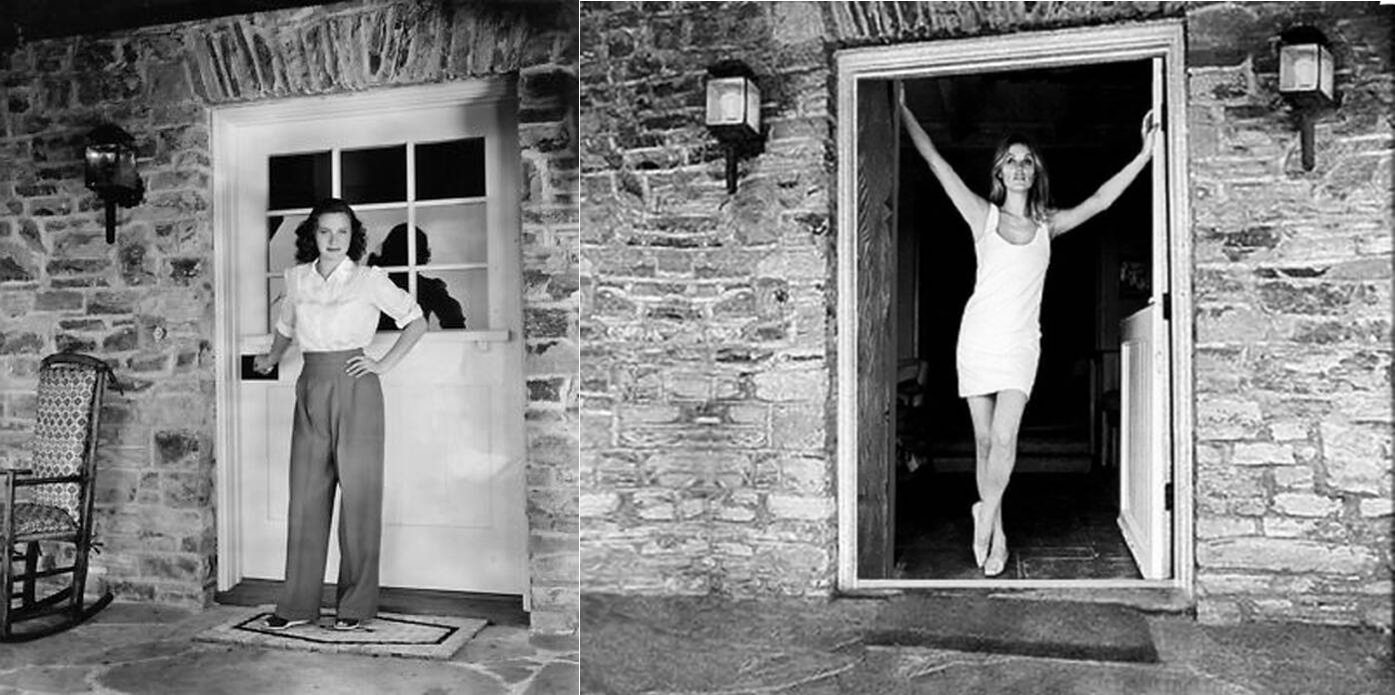
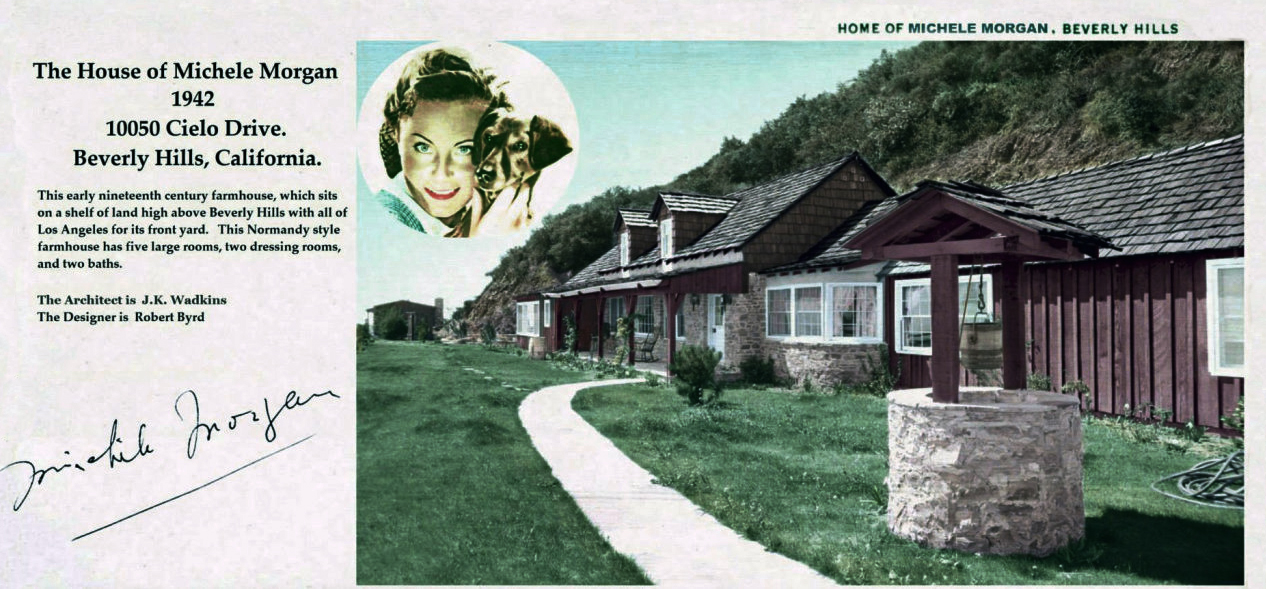
At left, Morgan at the front door of her new home in 1942; at right, Sharon Tate there 26 years later.

But the fact Michèle Morgan tested for and almost landed the role of Ilsa is only half the reason she worked her way into the storyline of Season of the Gods. The other involves the paranormal, and unspeakable evil, in the modest farmhouse Michèle built in November of 1941. The address was 10050 Cielo Drive in Beverly Hills, just off Benedict Canyon. In her autobiography, published in France, Morgan tells how her agent had advised she place her a new house on available cliff-side land at the end of a quiet street because its dramatic location would make good publicity, and indeed, many movie star magazines depicted every angle of the interior and exterior. However, in 1941, the spot was also remote. Very remote. She said, “This wild hill above Beverly Hills was quite isolated. I faced the former estate of Rudolf Valentino [Falcon Lair]. At the bend in the canyon was Ray Milland’s home, closer to Harold Lloyd’s. Still, I would have had time to scream for an hour and die 20 times before anyone heard me.”

Michèle poses in just about the spot Sharon would be found.

Despite the fact that the home was new construction and smelled of fresh-cut lumber, things went bump in the night immediately after move-in. She said, “In vain I reason with myself, tell myself that a new house, barely completed, cannot be haunted, but I am afraid.” It seemed logical there were prowlers—but no one was ever seen. She bought a guard dog, a Great Dane that took over the house but turned out to be as frightened as she was. Finally, her pal Madeleine LeBeau, another young French actress of only 18, moved in with Michèle so both could experience what they finally determined were ghosts. And, at that time, LeBeau was working on Casablanca as Rick’s friend with benefits, making another interesting storyline—LeBeau was cast in Casablanca while her friend Michèle was not—that I ultimately had to cut because of the length of the narrative.

Please note that the dog pictured is not the Great Dane that would sequester himself in her bedroom and bare fangs when she tried to reclaim her bed. As a result, she slept on the couch–the better to hear bumps in the night.

After Michèle Morgan married and sold the house, many Hollywood celebrities lived there as renters, including Lillian Gish, Cary Grant and his bride Dyan Cannon, and later, record producer Terry Melcher and his girlfriend Candice Bergen. It was during this time that a young musician named Charles Manson first stopped by the place, and aficionados of true crime know 10050 Cielo Drive all too well: on August 8, 1969, the Manson family would strike here and kill Sharon Tate and her friends Jay Sebring, Abigail Folger, and Wojciech Frykowski, along with random visitor Steven Parent.

Michèle Morgan returned to France after the war and enjoyed a long and decorated cinematic career. In 1969, when she heard where Sharon Tate had been murdered, Michèle was shocked but not surprised. In her book she asked, “How could a house without a past, which I had built, be haunted by its future?” An intriguing question, Michèle. I wonder that myself.

Season of the Gods will be released by GoodKnight Books on October 3, 2023.