World War II was big. It’s not something you can, say, take this arm and wrap around this way, and that arm and wrap around that way, so that your fingers entwine and suddenly you’ve wrapped your arms around World War II. This was way bigger than that. This was The Great War. As awful and staggering as World War I was in terms of human suffering and human stupidity, well, World War II raised the stakes and won the pot.
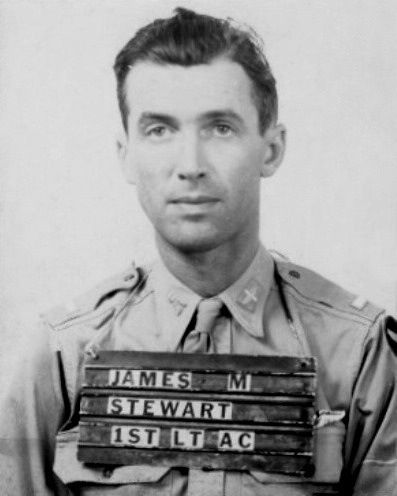
Jim Stewart rises to the rank of 1st lt. in the Army Air Corps, July 1942.
I haven’t been around much lately and I apologize, but I’ve been learning a whole lot about WWII and the men who fought it. I know that women fought it as well, but I’ve interviewed only men, 90-plus in chronology. In particular, I’ve been working with three guys who a) were in Jimmy Stewart’s squadron of the 445th Bomb Group and with him from Boise, Idaho on; b) were shipped to UK with him; c) flew missions with him; d) were shot down over Germany; e) survived German prison camps as POWs; and f) likewise survived the Führer’s order to execute all POWs as Germany was about to lose the war. These guys live on today after enduring all that, with Jimmy Stewart (who wasn’t shot down and never parachuted out of a burning plane only to be roughed up by Germans on the ground) gone 18 years.
I think my next book could be called, How to Survive to a Ripe Old Age, and I could base it on these three fit and active, terrific guys who are full of wisdom after getting out of World War II in one piece and thriving for 70 years beyond.
I was just thinking today about the exercise of writing Fireball versus what it’s like to write the new one, which is called Mission: Jimmy Stewart and the Eighth Air Force. To me it feels like Fireball was a suit of clothes that I could wear in comfort—most of the time, except for the gut-wrenching parts. But the new one is confining and I can’t breathe because there’s so much to learn. There are the Nazi aggressions; there’s the Battle of Britain; there’s Pearl Harbor; there’s the war in the Pacific; there’s the air war over France and Germany; there’s the ground war in Africa, Italy, and Europe; there’s the Holocaust; there’s the ground war in the Pacific; there’s the battle for Berlin; and there’s the battle for Japan. How do you boil that down into one book, even when most of it’s background?
For the past week or so I’ve been writing the manuscript furiously and also looking around for topics for my blog. I toyed with the idea of republishing something from my old Errol & Olivia blog, but I couldn’t find anything suitable. I looked around for something from TCM to catch my eye and comment on. Again, nothing.
I’m stuck in 1944, people! You’ve gotta get me out of here! Actually, I have to get myself out of this one. I’m in the middle of rubble, starvation, heroism, and sacrifice on a global scale, and it brings me to tears sometimes. I don’t know how as a species we got where we got in 1944, but evidence says that, yes, humanity reached a low point, and a high point, right about then.
The interesting thing is, Jim Stewart and his colleagues of the Eighth Air Force fought a war to keep the U.S.A. safe and to liberate Europe. They fought the most righteous war ever, but the fact was, when you’re dropping bombs through cloud cover and your industrial target sits in the middle of a city, you’ll miss it often. Did you know that 70 years after the end of WWII, there are still people in Germany who call the Allies “terrorists” for the way they bombed German cities and civilians?
The goal of the British nighttime bombing was to exact revenge for the bombing of England in 1940. The goal of the American daytime bombing was to destroy German manufacturing, and also to break the will of the German people and cause the masses to turn on their government. This simply didn’t happen. In response to a terror campaign, the people in Germany in 1944 did the same thing the people in the United States did in 2001: They dug in their heels and said, You will not break us!
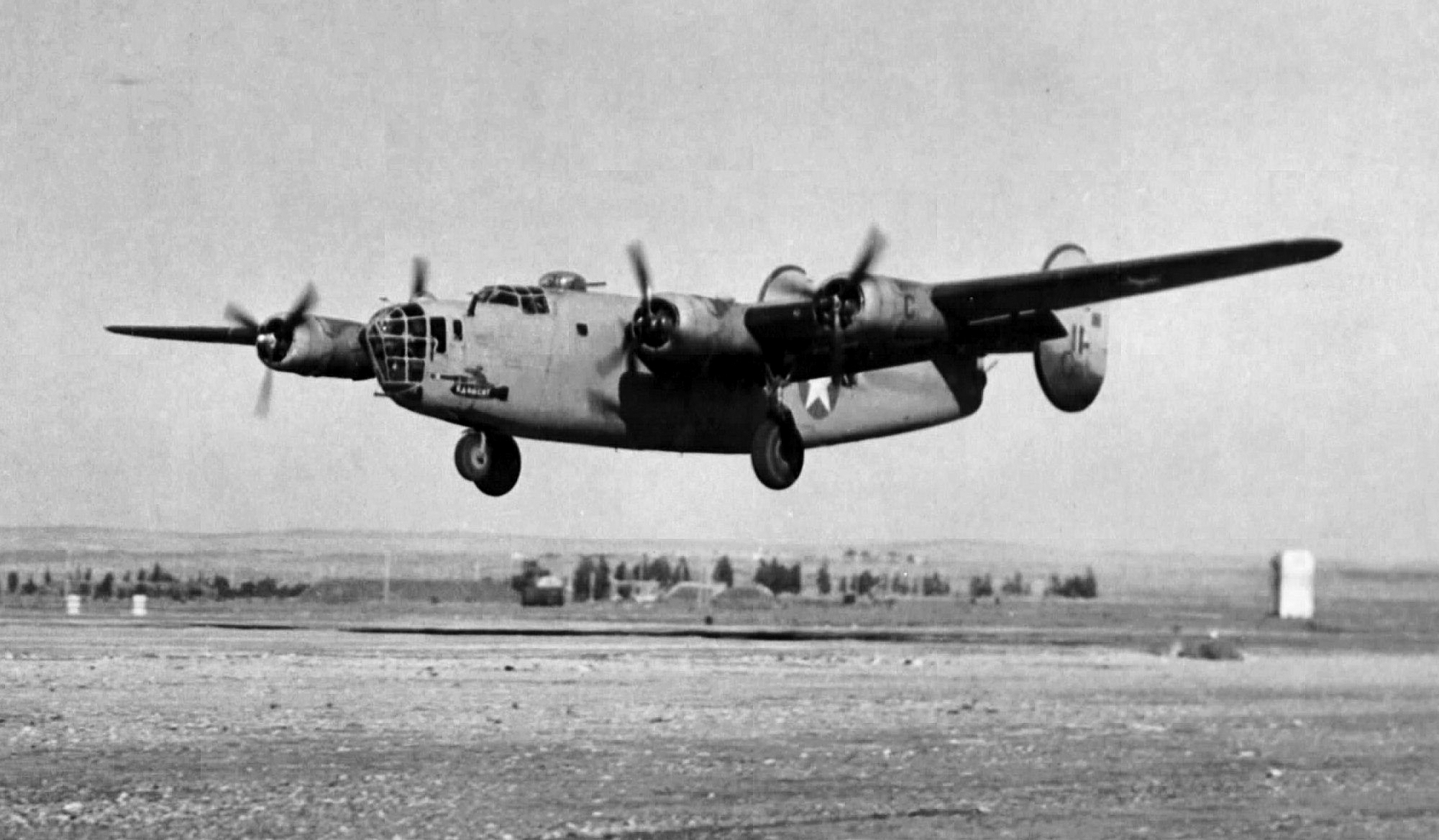
The B-24 Liberator, Jim’s ship in the Air Corps, described to me the other night by a pilot in Stewart’s squadron as “that goddamn airplane” and a “widow maker” because it was so difficult to fly.
I find the story of Jimmy Stewart in the Eighth Air Force so human, because he believed in what he was doing, and what he was doing was right. Hitler had to be stopped. And there were a whole lot of humans under his bombs who had done nothing wrong, and who didn’t believe in Hitler, and were trying to survive, but the bombs fell on them and all memory of their existence was erased when they were blown to dust.
How fragile we humans are, and how cavalier we once were with human life. That’s what I struggle with now on a daily basis—on the one hand, here are these great guys, heroes in every respect, going up to 20,000 feet at 40 below zero against a brutal enemy, facing fighters and flak to hit a target, and on the ground at the target, mixed in with Gestapo men and German infantry and devoted Nazis running factories are people who don’t support Hitler and never did, old men and women and children who dare not speak out against the government on penalty of death, along with forced laborers from conquered nations, and Jews in hiding, many living without running water and scavenging for food.
Bombs away.
It’s no wonder I have dreams and nightmares about this book I’m writing.


 Robert Matzen