Month: February 2019

Death for Wacky Donald

Dutch Girl: Audrey Hepburn and World War II by Robert Matzen

Clem Leone, age 18, graduates gunnery school.

My friend Walt Powell reminded me that 75 years ago today—today, mind you—the most amazing thing happened that I’ve ever been even remotely connected to. On February 24, 1944, my friend Clement Leone escaped out the top hatch of a burning B-24 Liberator named Wacky Donald 20,000 feet above the frozen Netherlands. The formation of B-24s in which Clem was flying had been jumped by German fighters and an FW-190 hit Wacky Donald aft with incendiary rockets. The fire blazed forward toward wing tanks still nearly full as Clem clutched the barrels of the top turret machine gun in a 200-mile-per hour slipstream. Then his impossible situation was resolved in a flash; the wing tanks caught and the ship exploded.

The blast knocked Technical Sgt. Leone out cold and blew him clear of the ship to begin a free-fall to earth. He fell maybe 10,000 feet while unconscious, and it’s a miracle he didn’t just keep on going to hit the earth at terminal velocity. Not feisty Clem. Clem came to with a face wet from blood and managed to keep his wits, locate an orange metal ring on his chest, and give it a yank. His parachute opened and he managed a controlled descent that ended with fractured ribs on impact.

You’d think that was enough adventure for a lifetime let alone one February morning, but it was just the beginning. Dutch people ran to him from the surrounding countryside, and he drew his .45 thinking they were Germans and would kill him. Instead they fed him and helped dress his wounded face and ribs. Then a member of the Nazi Green Police tried to arrest Clem, the Dutch intervened, and he took off into woodlands under the protection of the Dutch Resistance.

For historical context, Sgt. Leone was a participant in Operation Argument, which the flyboys dubbed “Big Week.” From February 20–26, 1944, the Eighth Air Force concentrated on bombing aviation-related targets in Germany. They had to take out the German Air Force before D-Day could be staged. That February week, spectacular aerial battles took place across Dutch and German skies, the Luftwaffe launching maximum effort to repel the American maximum effort bomber stream. I’ll let you read Mission: Jimmy Stewart and the Fight for Europe to find out what happened next to Clem, but it just kept getting more incredible. The man was simply meant to survive and make it home to marry his sweetheart, raise four children, become a major in the Maryland National Guard, and shape thousands of young minds as a schoolteacher.
Dutch Girl: Audrey Hepburn and World War II by Robert Matzen

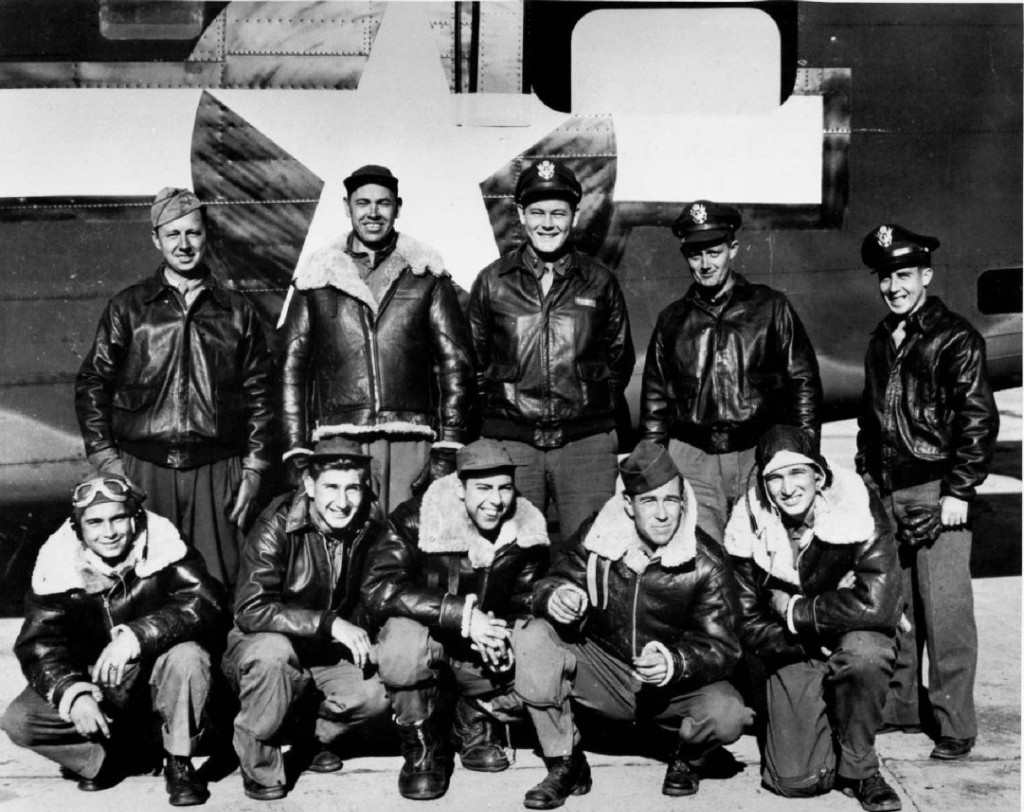
Clem (lower left) with his crew. Top center is Lt. Robert Blomberg, an up and comer with the 445th Bomb Group who died at the controls when his ship blew up. Others in the crew were also KIA. Notable in this team photo is the small man next to Blomberg, Lt. Donald Widmark, co-pilot and brother of future actor Richard Widmark. The co-pilot would grab a parachute and leave Blomberg behind 75 years ago today. Clem’s personal rule was to stay with the ship as long as the officers did, but when he saw Widmark bail out, he said, “It was time for this guy to go.”

Dutch Girl: Audrey Hepburn and World War II by Robert Matzen

The ring on his parachute became a wall decoration for Clem.

I met Clem in 2014 when he was a spring chicken of 90 and spent many hours on the phone and in his living room learning about the air war, B-24s, combat missions in the European Theater, his time with Jimmy Stewart in the 445th Bomb Group, and his adventures with the Dutch and Germans. In November 2016, Clem and I played a double bill in his hometown of Gettysburg, PA—before a packed house I lectured about Stewart and introduced Clem, who with humor and humility told his story. Afterward, we sat and autographed books side by side for an hour and a half, and I doubt either of us ever had a better time.

So let’s take a moment to thank Clement Francis Leone for his service, and marvel at an incredible life that barrels full steam ahead toward birthday number 95. Another wacky thing: B-24s were always catching fire, and Clem had bailed out of another one on a training mission in England and broken his leg. It hadn’t even healed before he was bailing out again, this time over Holland. So 70 years later his daughters decided it would be fun to buy their dad a ride in a vintage B-24 that was touring in an air show. When he heard about it, he said, “I had to bail out of two of the damn things when they were new! I’m sure as hell not getting into one that’s 70 years old!”

That, my friends, is the working mind of a survivor.

And oh, by the way, without Clem Leone, there would be no Dutch Girl: Audrey Hepburn and World War II, because it was while following Clem’s trail south from the Dutch town of Gramsbergen that I made a stop in Arnhem, and the rest is history. So, thank you for the gift of Dutch Girl, Clem. If I ever grow up, I want to be just like you.

Dutch Girl: Audrey Hepburn and World War II by Robert Matzen

We each signed more than a book a minute for 90 minutes as Gettysburg paid tribute to its hero.

The Vision

Dutch Girl: Audrey Hepburn and World War II by Robert Matzen

When the director of La La Land, Damien Chazelle, was asked why he put a dream ballet at the end of the picture, he responded, “Why wouldn’t you put a dream ballet at the end of the picture?” La La Land tells the story of lovers Mia and Sebastian—she’s an aspiring actress and he’s a struggling musician—from the inception of their relationship to its unraveling. When they spot each other five years after breakup, the dream ballet takes them to an alternate universe where each makes different decisions that result in a thriving long-term bond, all set to music and dance.

I took great satisfaction from his answer about the dream ballet because he delivered it with equal parts incredulity and disdain; it felt right, so he did it. He’s a creative; he followed his instincts and created. He’s also a student of film history and knew from pictures going all the way back to silents that alternate-universe endings can slay an audience.

Dutch Girl: Audrey Hepburn and World War II by Robert Matzen

Emma Stone and Ryan Gosling in the dream ballet.

I’m in awe of creativity like what Damien Chazelle did with La La Land because it’s magical and I don’t know where it comes from, in anybody. From nothing comes something, a painting, a film, a book, a song, a performance with the power to entertain or even change lives. It all begins with an inspiration, a vision of art that needs to be created.

I’ve told the story before about sitting alone in my dead-quiet office writing Fireball as a dual-track narrative that converges in the middle. I was using many points of view, including minor characters like a crash investigator and a rescuer, and putting myself into the heads of real people in a work of non-fiction. I remember saying to myself on a particular day, “Man, is anybody gonna go for this?”

I didn’t have an outline, just a vision that the story must open with a plane flying over Las Vegas in the night. To breathe life into an old headline, I went by instinct, and instinct told me to do it this way and for better or worse, I did. Over and over I saw it and heard it, that plane flying over in the blackness of a Vegas night sky, its motors droning on into the distance.

I also knew where Mission would start, with a man (it’s Jimmy Stewart but he isn’t names in the prologue) plagued by PTSD from the war standing in a town covered in fake snow in the Mojave Desert in a heat wave, about to shoot a scene where he goes around shouting “Merry Christmas!” when it was really June. To me it had to start there, in the land of make-believe—the last time Jimmy Stewart had seen snow, it was while he was risking life or death on a rough bombing mission against Nuremberg and could see the Alps off to his south. Now he was back in Hollywood, and what must that have been like for a soldier who had seen too much action?

While in the Netherlands researching Mission, I discovered the city of Arnhem and learned that Audrey Hepburn had spent the war there. So began the journey as I tried to research Audrey’s life in Arnhem and came up with surprisingly little. I looked at all the biographies and each had, at most, a chapter about the war. A chapter! About the war! It was Jimmy Stewart all over again because that’s what I had found with Jim—biographers would basically say, “So Jim went off to war.” And the next sentence would be, “When he came back…” WHAT?

Because of a number of factors—key Dutch people willing to help and key archives I could access—I decided to go for it and write a book about Audrey in the war, which became Dutch Girl: Audrey Hepburn and World War II, to be released in the U.S. on April 15. Embarking on the project, I faced the same challenge I had with Jim, who refused to go on the record about certain aspects of the war. Audrey was another very private person and there were episodes she would discuss, and many she would not. However, this time I had about 6,000 of Audrey’s own words about the war to go on, which was about 5,800 more than I had from Jim, so that was a start.

But how do you structure a narrative about Audrey in the war? All I knew was that once again I had a starting point, a scene that had to begin the book: In the spring of 1935, Audrey’s mother met Adolf Hitler in Munich. Hitler was then the name on lips worldwide, a vibrant and charismatic superstar who had brought pride and prosperity back to a Depression-plagued Germany that had recently lost the Great War. This time around, the reader begins in Hitler’s office and looks into his blue eyes and shakes his hand, all the while wondering, on page one, where in the world is this going?

Dutch Girl: Audrey Hepburn and World War II by Robert Matzen

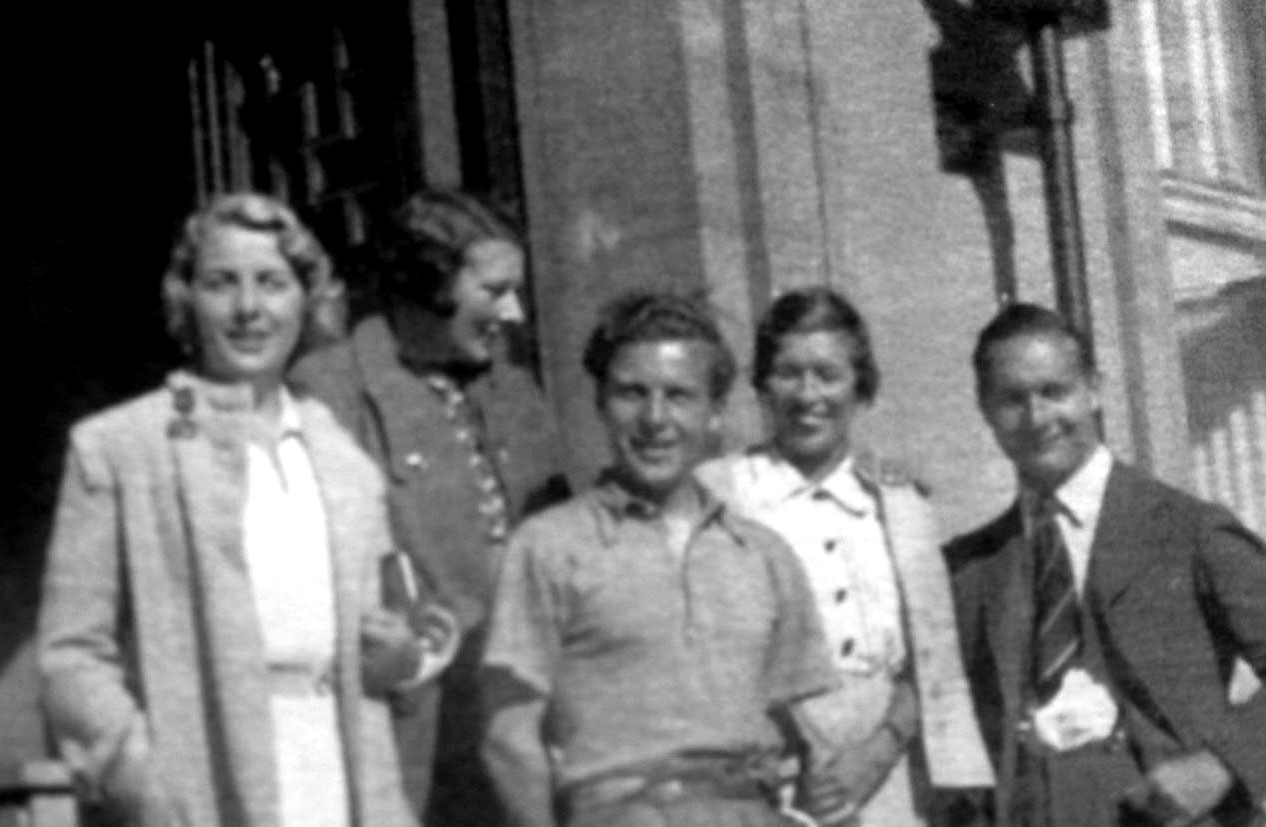
Pamela Mitford, Ella van Heemstra, Michael Burn, J.C. Hills, and Coleridge Hills stand on the steps of the Braunes Haus in Munich the day the group met Adolf Hitler, who was then a friend of Pamela’s sister Unity Mitford. It was such a memorable occasion that Ella kept this photo framed in the Arnhem apartment where Audrey spent the first two years of German occupation.

Well, I promise, not where you’d expect. There are two main characters to drive the narrative this time, Audrey, who enters adolescence under Nazi occupation in Arnhem, and Ella, Audrey’s mother, the Dutch baroness who had been enamored of Hitler. The twist is that occasionally we flash forward to see Audrey at different points of her adulthood, being who she became because of the war and living with the pain of all that had happened. There’s also a lot of history in this book, about the war, the Nazis, the Dutch Resistance—some joker on Goodreads already slammed the advance reading copy for too much history. “Cut it by a third; lose the history,” this person said.

So now I’m thinking, man, is anybody gonna go for this? I don’t know now any more than I knew when I was writing about a plane on a mountain. I’ll probably be asked in an interview, “Why did you start in Hitler’s office, for heaven’s sake?” And I will respond, hopefully with an appropriate mixture of incredulity and disdain, “Why would I not start in Hitler’s office, for heaven’s sake?”

Dutch Girl: Audrey Hepburn and World War II by Robert Matzen

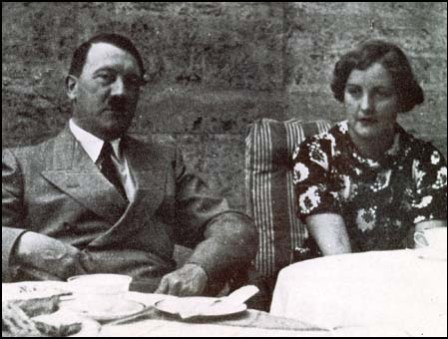
Unity Mitford sits with Hitler in Munich. A rebellious young British aristocrat, she was an avid Hitler groupie and jealous of Ella and anyone else who threatened to horn in on ‘her man.’ Supposedly a souvenir photo of Ella with Hitler was taken the day of their meeting, but it’s been lost to posterity.


But how do you structure a narrative about Audrey in the war? All I knew was I had a starting point, a scene that had to begin the book: In the spring of 1935, Audrey’s mother met Adolf Hitler in Munich. Hitler was then the name on lips worldwide, a vibrant and charismatic superstar who had brought pride and prosperity back to a Depression-plagued Germany that had recently lost the Great War. This time around, the reader begins in Hitler’s office and looks into his eyes and shakes his hand, all the while wondering, on page one, where in the world is this going?

A long shot of the Nazi Party’s Munich bastion, the Braunes Haus, which was destroyed by U.S. and British bombs during the war.