fireball carole lombard

The Crawford Touch

Fireball: Carole Lombard and the Mystery of Flight 3 by Robert Matzen

George Hurrell captured a portrait of 1942 Joan Crawford for the ‘Bride’ publicity campaign.

I had never taken the time to sit down and watch They All Kissed the Bride, the Columbia picture that Carole Lombard was supposed to make after her return from the bond tour to Indiana and the one she would never make because she didn’t return from the bond tour to Indiana. I’m not going to go into depth about They All Kissed the Bride because I want this column to be about more than movie reviews, and I’ve spent time on a number of movies already and there’s another film analysis in the queue.

What I’ll say is that They All Kissed the Bride is a picture that makes me sad to watch. Since it’s a Columbia Picture you don’t expect much going in because by 1942, Columbia was making comedies that were loud, silly, and for the most part starred down-on-their-luck actors.

Fireball: Carole Lombard and the Mystery of Flight 3 by Robert Matzen

The Joan Crawford of 1927 had already been Carole Lombard’s rival on Hollywood dance floors for two years.

It’s telling that this is a script Carole Lombard accepted. She was to play M.J. Drew, hard-as-nails boss of a powerful shipping corporation based in New York City. Hard as nails, that is, until she meets Melvyn Douglas, at which point she goes all weak in the knees and hates herself for it and can’t understand what’s happening to her. She thinks it must be her liver.

Screwball pictures often required convoluted plots to create appropriately uncomfortable situations and this one is no exception. The surprising thing for me in finally seeing Bride is: It would not have been a hit for Lombard. In fact, Joan Crawford is probably better in it than Lombard would have been, because Crawford of the square jaw and square shoulders comports herself like a cutthroat boss. She’s believable in the part.

The backstory of how she landed Bride is much more interesting than the picture itself. Soon after Lombard’s death aboard TWA Flight 3 just after World War II began for the United States, Joan Crawford was signed to take the lead in the picture then called He Kissed the Bride, and pledged to donate to four war-related charities, in Carole Lombard’s name, the entirety of her $115,000 salary. When Crawford’s agent took his usual percentage for lining up the deal on a picture made under these circumstances, Joan fired him.

These were fantastic gestures on Crawford’s part, and yet the intertwined lives of Joan Crawford and Carole Lombard had not been conducted on friendly terms going all the way back to the 1920s Coconut Grove nightclub, where they sweated against each other in dance competitions. Joan of MGM always had more clout in Hollywood than Carole of little brother Paramount. When Lombard landed Clark Gable, it was with the knowledge that Joan had been there four years earlier and sexually enchanted the big lug.

But at the dawn of 1942 Lombard and Crawford had something in common: They were both in career slides. The script for He Kissed the Bride proves it for both of them. It’s not a bad picture, but typical of the Columbia jobs, it jumps the shark halfway through and resorts to improbability, misperception, and pratfalls. You sit there thinking, “Joan’s better than this,” the same way you would have said, “Carole’s better than this.” Melvyn Douglas was better than this, too, but it was a living and the stars took these parts because it was work and hopefully better times lay ahead.

The turbulence of Carole’s career waters is confirmed if one looked ahead to what she had signed on for next. After working at Columbia she would be going back to Universal for My Girl Godfrey, a script so slight that it was finally released as a musical starring Deanna Durbin in 1943 after being retitled His Butler’s Sister. At this time Universal was making Ghost of Frankenstein and other B-level entertainment, and had Lombard lived, 1942 would probably have been seen as another mediocre year.

Yes, the most significant thing about He Kissed the Bride (which was retitled They All Kissed the Bride, a title that in context of the script makes no sense) is Joan Crawford’s gesture, which everyone in the industry greeted with, “That’s very Joan” because, despite her five-foot-two stature, Crawford did everything BIG. This is the same Joan Crawford who served as sexual surrogate for a destroyed Clark Gable in the months after Carole’s loss. She was there for him in her home anytime he needed, without strings, and provided some TLC, some physical relief, some moments reliving the days of their impetuous youth and wild sexual fling on the MGM lot.

It’s a shame that since the 1980s Crawford’s legacy has been reduced to grotesque makeup and child abuse. Joan’s better than this. In the barren chill of January 1942 it was Joan Crawford who stepped up and on those small, square shoulders helped relieve the burden of a devastated Hollywood that had just experienced the loss of its most beloved home-town girl.

Fireball: Carole Lombard and the Mystery of Flight 3 by Robert Matzen

Crawford, age 37, poses for another They All Kissed the Bride publicity still. Her career slide had been precipitous in the year prior to Lombard’s death, but Joan’s gestures to honor Carole and comfort Clark were instinctive, and heartfelt.

Jilted by Juliet

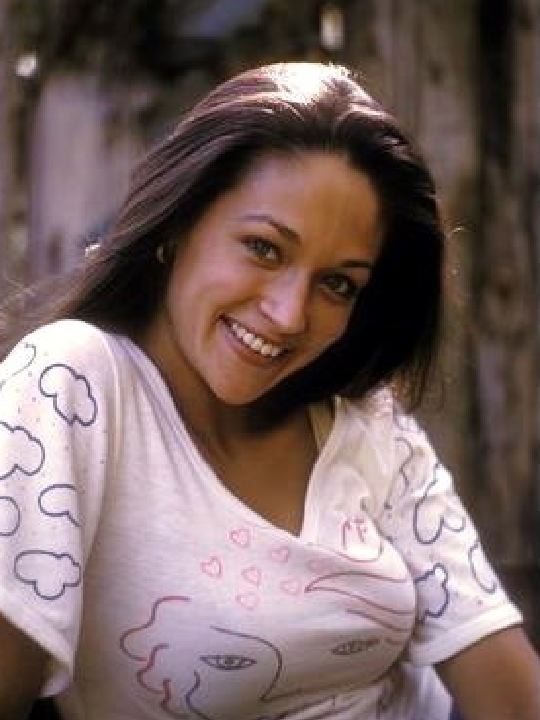
You remember when I was wringing my hands about whether to join the Twitter generation, and then it seemed like a practical business matter: If you want to be a popular author you should just try Twitter out and see what happens, especially if you’re going to be an author on tour and I’m considering some more tour dates. I’ve tweeted a few things in recent weeks, trying not to be obnoxious, and the other day I picked up a new follower: Olivia Hussey, she of the Zeffirelli version of Romeo & Juliet. How I remember being captivated by this girl, 16 when she made Romeo & Juliet, during a reissue screening of the picture when I was a mere lad. Actually I went two or three times, I think, and only because of a big-old crush on Olivia Hussey.

Olivia_Hussey2

Olivia Hussey as I imagined her, dreaming of what Robert Matzen would tweet next.

Of course she’s done much more than Juliet with her life. She was the Virgin Mary in Jesus of Nazareth on TV, and played the villainous Alicia in one of my favorite mini-series of the Bicentennial era, The Bastard. She appeared in Death on the Nile with an all-star cast and lots of other TV and motion pictures, and played Mother Teresa in a critically acclaimed biopic.

So this famous performer was now following me on Twitter, meaning I should tweet something profound—but I had nothing. I slept on it, thinking something would come to me and the next morning I learned I had another follower: Lana Wood, Bond girl, sister of Natalie, and accomplished actress in her own right. Not to be redundant, but when I saw Lana as Plenty O’Toole in Diamonds Are Forever, well, I had to go back and see the picture again. Dad was very considerate to take me back for repeat showings of these movies. Or was Dad experiencing, shall we say, the same reaction? I hear tell that the apples don’t fall far from the tree.

Fireball: Carole Lombard and the Mystery of Flight 3 by Robert Matzen

Lana Wood, Bond girl, accomplished actress, thoughtful soul, and follower of Robert Matzen.

Truth be told, Lana had just appeared at a John Wayne event in Iowa where my friend Scott Eyman was also a headliner. So she and I had Scott in common. But at any rate, now, not one but two of the big crushes of my cinematic youth were following me on Twitter, and I still had nothing. I could practically hear my tweet’s voice cracking when I shouted out to the world that I had a new column available on my blog, or said I’d be appearing on the nationally syndicated radio show, TV Confidential. But I have to be honest: Joyce Carol Oates I’m not. Joyce Carol Oates has always got eight wise things to say on Twitter and I can’t even figure half of them out, while I sit here like a frog on a rock. I’m terrible at parties, too, but that’s beside the point.

Fireball: Carole Lombard and the Mystery of Flight 3 by Robert Matzen

Oh, Olivia. Why couldn’t we work it out?

During this period of gross indecision regarding wise things to say, or witty things, or controversial things, I lost Olivia Hussey. Suddenly my Juliet was no longer following me. I was left to wonder—did she suddenly realize she was following the wrong Robert Matzen? Was she intending to follow the videographer in Cleveland? Or maybe the polar opposite Robert Matzen in Germany who’s an extrovert, loves people, and plays soccer? Whatever the motivation for the end of my personal Twitter relationship with Olivia Hussey, it was over and I was crestfallen.

Now I hang onto the fact that Lana Wood remains faithful. I cling to the faint hope that one day soon I can justify that faith by broadcasting a tweet worthy of an original Bond girl and actress who worked with John Wayne in The Searchers and nearly stole the show. The clock is ticking oh so loudly as I sit here. Jilted. And with nothing.

Rhett Butler, Take 2

Fireball: Carole Lombard and the Mystery of Flight 3 by Robert Matzen

A sign of trouble: too much to read on the movie posters in the lobby of the theater.

What an irony that Clark Gable’s last picture at MGM would be called Betrayed, because that’s exactly how Gable felt when the company that had ridden his back for two decades suddenly dumped him in 1954, the last of Hollywood’s Golden Era stars to be let go. Right about now he could have used Carole Lombard’s advice on “how to be a free agent.” As it was, Gable made several mediocre pictures in a row because now he was taking on scripts that had not been tailor-made to fit the King and his brand. He was just earning a paycheck. Then late in 1956 he considered an offer that must have made him smile the famous Gable smile, and for several reasons.

Band of Angels was a hot property at the time, a bestselling Civil War novel by Robert Penn Warren about a highborn Southern belle, Amantha Starr, who learns upon the death of her father that she is really a half-caste, born of his black mistress. As a result she’s chattel, loses everything, and is sold into slavery.

Warner Bros. owned the rights, and it was Jack Warner himself who reached out to Gable to play Hamish Bond, Southern plantation owner with a dark past. I imagine Pa heard Ma’s voice in his head squealing for him to take the part, how he’d be great in it, Rhett Butler all over again, his greatest triumph, the role everyone knew him for. Clark Gable back in the Civil War. It was a can’t-miss proposition, especially since Gone With the Wind had been reissued in 1947 and 1954 and still packed ’em in. Always packed ’em in.

Fireball: Carole Lombard and the Mystery of Flight 3 by Robert Matzen

Clark and Kay at the Encino ranch. She landed the King; he drank to numb the pain of it all.

Gable was expert at playing 50 shades of himself and never, once he became a star, enacted an out-and-out villain. Gable didn’t go taking risks like John Wayne just had with The Searchers because, as noted in Fireball, Clark was an insecure actor and sought to play it safe. Friends and directors alike noted his limited range and said there was a “Gable way” to do things. So Rhett Butler was going to resemble Gable and Hamish Bond was going to resemble Gable and any way you looked at it, with Gable’s Rhett aboard, Band of Angels couldn’t miss.

Fireball: Carole Lombard and the Mystery of Flight 3 by Robert Matzen

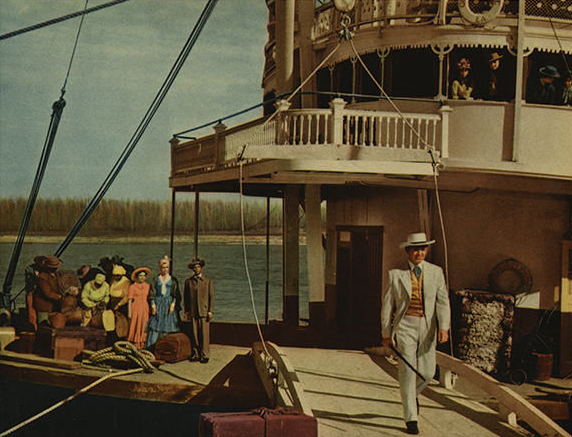
On location in Louisiana with the sternwheeler, Gordon C. Greene. This was more of the authentic Old South than even Selznick gave audiences.

Warner Bros. at the time was still a thriving studio and for the next 20 years would continue to stare down the unblinking eye of television and turn out hit pictures. Bold-as-brass Jack Warner loved the idea of luring the King to Burbank for a Civil War epic and offered him 10 percent of the net skimmed right off the top. As added incentive, all the Band of Angels exteriors would be shot on location in Louisiana, at The Cottage plantation in St. Francisville, north of Baton Rouge, and on—or in front of—the last of the old-time paddleboats, the Gordon C. Greene. The location work offered Clark and his bride of two-plus years, the former Kay Spreckels, a chance to travel together and be treated like, well, a king and his queen.

But sometimes sure things don’t work out. Sometimes planes smack into mountains for no good reason. Band of Angels was not, in the end, another Gone With the Wind. In fact, in execution and through no fault of Gable’s, it burst into flames like one of Hamish Bond’s sugar cane fields. Yes, Clark and Kay went on location, and, yes, they were treated like royalty, made the rounds, were feted, toasted, given keys to cities, and crushed by fans. Yes, Clark played Rhett Butler all over again and putting him back in sets and wardrobe depicting the antebellum South took 10 years off his appearance and son of a gun if he didn’t become Rhett Butler again. What was missing was David O. Selznick fretting and caressing and adding layer after layer of nuance, and throwing hundreds of thousands of extra dollars at the screen. Without the Selznick excesses, Band of Angels seems today almost threadbare, despite its authentic locations.

It’s hard to say when the picture’s director, “Uncle” Raoul Walsh, lost his fastball and became just another guy behind a camera. But he had lost it by The Tall Men, the 1955 picture he made with Gable, and Walsh was far more detrimental to Band of Angels. Or perhaps nothing could save a picture where the three leads are named Hamish, Amantha, and Rau-Ru. How dem dawkies love Massuh Hamish; they even sing to him in great choruses as the sternwheeler floats him on in to the dock, making this cinematic depiction of slavery problematic at best and typical of vintage Hollywood. All his slaves love Hamish Bond but one: the African child that Hamish saved from a massacre, the aforementioned Rau-Ru, who grows into firebrand Sidney Poitier in an early role. Poitier is way too sophisticated for something like Band of Angels and sticks out like a hammer-pounded thumb with all his New York, new-wave internal conflict, despising Hamish Bond and everything he stands for. Poitier, who turned 30 during production, classes up the proceedings too much. This is a picture that didn’t need class. It was bodice-ripping soap opera and needed movie stars fit to fill a frame alongside Clark Gable.

Fireball: Carole Lombard and the Mystery of Flight 3 by Robert Matzen

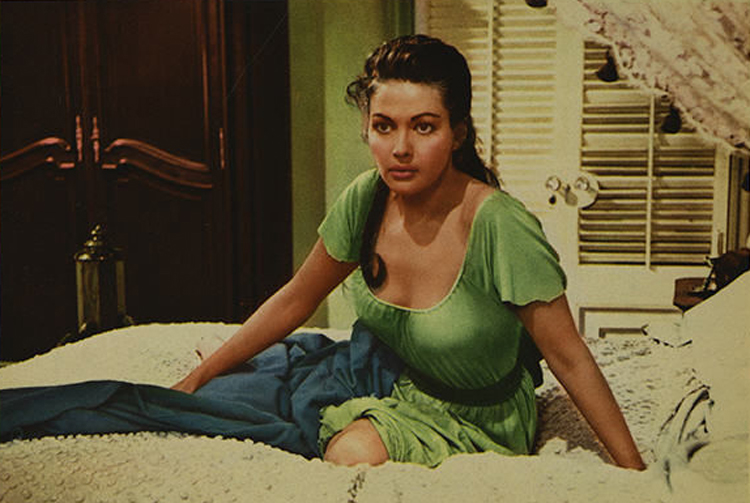
Yvonne De Carlo as Amantha Starr. Spoiler (for all of us): she survived the suicide attempt.

And speaking of what Gable didn’t have, there’s Yvonne De Carlo, a woman of so little warmth and sex appeal that when she fetches a rope and hangs herself in reel two rather than succumb to the advances of a slave trader, I cheered—and I don’t think I was supposed to.

Amantha was saved at the last minute and kept planting herself in front of the camera through the rest of the picture, giving Gable about as much to play off of as a dressmaker’s dummy. This role screamed Ava Gardner in all her sultry darkness, but posterity played a cruel joke and gave us the equivalent of Ava Gardner’s stand-in. I don’t mean to be unkind, and timing and circumstances come into play when casting pictures, but in this case DeCarlo just couldn’t infuse sympathy into this character, and sympathy was crucial.

Gable biographer Lyn Tornabene labeled Band of Angels “the nadir of Gable’s career” but I don’t see it that way. Even considering the liability of the leading lady, Band of Angels turned a slight $92,000 profit according to John McElwee of the Greenbriar Picture Shows BlogSpot. This was stout box office considering the $2.8 million cost of its production. People did flock to see Gable in another tale of the Old South, and word of mouth must have been OK or better for returns so good.

I feel for Gable as the years piled up and he coasted on reputation. He was a man of simple pleasures and little joy, lugging around guilt and grief over lost love Lombard as if bearing a lead-filled backpack. He does some nice acting in the scene where Hamish reveals to Amantha, who is now in love with him, that once he had been a villain who kidnapped Africans into enslavement. He delivers a monologue, staring off and reliving a particular dark event, and it’s effective. The moment, however, lacks a payoff because DeCarlo hasn’t established emotional parameters for us to care how she feels about the revelation. The script doesn’t help her and feels at times like a Classics Illustrated version of Band of Angels; Raoul Walsh’s lack of close-ups also saps power from this critical plot point, so much so that his decision seems to be the director’s way around Gable’s aging. The man turned 56 the second week of shooting and all the drinking, cigarettes, guilt, and grief had rendered Rhett Butler’s face into something different than audiences saw in 1939, and in more recent GWTW reissues. With the lighting and angles just right, with the sets and wardrobe and use of medium shots, the illusion works, but in a scene like the one where Hamish comes clean, dramatic tension suffers because of a lack of close-ups.

Gable made some solid pictures after this one. He was by no means out of gas and seemed to delight in poking fun at himself ever more as time went on. No, Band of Angels isn’t the picture he figured it would be, but it’s still a kick seeing self-serving, cynical Rhett Butler loose amidst the magnolias one more time.

Fireball: Carole Lombard and the Mystery of Flight 3 by Robert Matzen

Wait a minute. He’s Rhett, but she’s not Scarlett. This carefully photographed still represents the Clark Gable that Warner Bros. wanted theater patrons to see.

Note: My next column covers the 1938 Carole Lombard picture, Fools for Scandal, which TCM U.S. is airing on Thursday morning July 10 at 4:15 A.M. Eastern time.

Meanwhile, in an Alternate Reality…

For Immediate Release

MOVIE AND TV COMEDY STAR CAROLE LOMBARD TO PEN MEMOIR

Actress vows to ‘come clean’ in Putnam hardcover

HOLLYWOOD, May 1, 1961/AP —G.P. Putnam’s Sons announced today that the publisher will release the autobiography of motion picture and television actress Carole Lombard. The would-be author had stated previously that her book would be entitled, “Just One of the Guys.” Last week, Miss Lombard, who will turn 50 in October, made a public appearance after months of seclusion following the November, 1960 death of her ex-husband, Clark Gable. It is speculated that her memoir will discuss life with the one-time “king of the movies,” as well as their 1946 divorce, continued close friendship, and recent reuniting as co-stars of the romantic comedies, “Teacher’s Pet” and “But Not for Me.”

Miss Lombard’s career began in silent pictures for the Fox and Sennett studios and then continued in the sound era at Paramount. But it was the 1934 Columbia Picture “Twentieth Century” that shot her to the top. She solidified her status as “queen of screwball” two years later with an Academy Award-nominated performance in “My Man Godfrey.”

Miss Lombard and Mr. Gable began their association in 1936 and once comprised the most famous couple in Hollywood. They were married during production of the highest grossing motion picture of all time, “Gone With the Wind.” They enjoyed status as the most prolific and profitable stars of the World War II years, and, despite rumors of marital turmoil, their separation at war’s end caught Hollywood by surprise.

Miss Lombard said she has been working on the manuscript for more than two years. In describing its title, she said, “It was the men who ruled the Hollywood roost, and I had to make room for myself in the ‘boys’ club.’ Then I had to do it again when I decided to produce some pictures, and especially when I wanted to direct features and then serve as executive producer of my TV series.”

That series, “Carole of the Belle,” features Miss Lombard as Carole Simpson, a divorced newspaper reporter raising her daughter on a Seattle houseboat called the “Puget Belle.” Now in its 11th season on the National Broadcasting Network, “Carole of the Belle” was second in popularity in the last decade only to the CBS smash hit “I Love Lucy,” which starred Miss Lombard’s friend of more than 20 years, Lucille Ball.

In addition to her groundbreaking work in motion pictures and television, among the topics to be remembered by Miss Lombard are a car crash that nearly ended her career in 1925; her marriage to suave leading man William Powell; the strange death of Russ Columbo, a 1930s singer with whom she was romantically linked; a long-time friendship with tennis star Alice Marble; a brush with death when an airliner on which she had been traveling crashed in Nevada after she had disembarked; and her battles with HUAC and unwillingness to “name names.”

Famous for her salty vocabulary and known as one of the most down-to-earth of Hollywood’s elite, Miss Lombard said she would “pull no punches” in her book, although she was coy when asked if she would discuss her post-Gable romances with actor/director Orson Welles, and then her most controversial relationship of all, with actor Paul Newman, a man 15 years her junior.

Putnam anticipates an autumn 1962 release for “Just One of the Guys.”

###


How this came about…

A colleague of mine, Wendy, is reading Fireball and said to me yesterday, “The whole thing is such a tragedy because if anyone should have lived a long life and produced a great memoir, it’s Carole Lombard.” Wendy paused and said, “She’d have made a great old lady.”

Which got me to thinking. Suppose she hadn’t died on that mountaintop. Suppose she had lived a normal lifetime and worked the length of a normal career. What would have happened? Of course it’s pure fantasy, but when you have spent as much time in someone’s head as I have in hers, you get to a point where you can draw conclusions. Here they’re laid out. Somehow or other, the marriage would have ended, but Lombard didn’t hold grudges and after a time she and Gable would have been friendly. Without the tragedy of her death hanging over his head, three things would have changed: 1) Gable’s ambition wouldn’t have been snuffed out and his brand would have thrived; 2) the public would have been spared seeing Clark Gable as a mortal and he wouldn’t have aged prematurely, and 3) at age 41 and then 42 and 43, he wouldn’t have gone to war; he would have made very popular pictures from 1943 through 45, during the biggest boom in Hollywood history.

In the meantime, Lombard would have made He Kissed the Bride (retitled They All Kissed the Bride) and My Girl Godfrey, and from there, she would have been off to the races as an independent, enjoying good roles with her contemporaries until 1950. I could see her producing and directing by, say, 1948, and not comedies either. I think Lombard would have gone for gritty film noir as a form of artistic expression. She had wanted to succeed at drama but never broke through, so it’s clear she wanted the challenge of meaty work. She would have been out front with Ida Lupino as a woman director and by this time she would have amassed fortune enough to finance A-pictures as an independent.

Imagine Carole Lombard called to testify before the House Un-American Activities Committee. Always a liberal Democrat, Carole would not be the one to rat out a colleague and it was likely she’d lean into the microphone on Capitol Hill and state clearly for newsreel cameras, “Senator, with all due respect, you can kiss my ass.”

In 1954, when MGM severed with Gable, Lombard would have been there as his biggest supporter and sooner or later she would have made pictures with him to give her ex a boost—returning a favor done for her by William Powell in 1936. I picked Teacher’s Pet because I could see Lombard in the Doris Day role, and But Not for Me where she would have been perfect in the cynical ex-wife part played by Lili Palmer.

Carole would not have spoken about Clark during his lifetime, but because she was indeed a “ham” and because she loved to tell stories (never letting the truth get in her way), I could see Miss Lombard following the trail blazed by Errol Flynn and publishing a scorcher of a memoir.

Romantically, she may well have slipped into a romance with Robert Stack, a premiere Hollywood stud and nice guy who was in love with her. The problem was that Bob didn’t need rescuing, and Carole was a rescuer/nurturer who went for powerful men. Always powerful men. Who fit the bill at this time? Obviously, Orson Welles, who would have been available after his divorce from Rita Hayworth. I asked Carole Sampeck to play along and it was she who labeled Welles a likely candidate, and also young Paul Newman, the next big thing in the late 1950s at a time when Carole would have just been turning 50 but, knowing her, still mindful to play the field.

And finally, I believe Lombard would have turned to television, the rival medium. In a White 1950s America dominated by traditional family values, the formula was for aging female movie stars to play wives and mothers, but not Lombard. Carole would have scratched and clawed to play a woman with guts, a divorcee and career-minded mother. A woman making her own way and suffering romantic misadventures week in and week out, making jokes at her own expense and guiding an onscreen child in lieu of the one she could never produce in life.

Notice that the press release gets Lombard’s age wrong by three years. She had already shaved a year off by 33 and sleight of hand would have killed another couple by the early 1960s. Nobody enjoyed pulling a fast one more than Carole Lombard.

So this is my version of the alternate reality wherein Lombard lived out her lifetime–what’s yours?

Who Did She Have to Screw?

Fireball: Carole Lombard and the Mystery of Flight 3 by Robert Matzen

The ultra-rare one sheet movie poster for Supernatural; rarity caused by its rapid run through American theaters and a resulting lack of need for a lot of advertising material.

As die-hard fans know, Carole Lombard made one horror picture in her too-short but very active career. It was the 1933 Paramount release, Supernatural, produced and directed by the Halperin brothers, Victor and Edward, who were at the time flush with cash from their 1932 independent production, White Zombie, starring Bela Lugosi.

White Zombie is the mighty little swimming sperm that erupted into generations of succeeding pictures where the zombies grew ever more creepy, lustful, menacing, intelligent, speedy, and carnivorous, right up to today’s The Walking Dead, which I choose not to watch because death is around us enough without using it as entertainment. I digress. These Halperins from Chicago were the adolescent minds that started the Zombie Invasion by creating some glassy-eyed shufflers who now seem docile and even cute by today’s comparison, and now the brothers set their sights on ghosts and possession with Supernatural.

Fireball: Carole Lombard and the Mystery of Flight 3 by Robert Matzen

Didn’t FDR promise a chicken in every pot and a 20-foot bird cage in every conservatory? Carole Lombard and Randolph Scott live the good life in Supernatural, until…

Readers of Fireball know that Carole Lombard lived and breathed filmmaking. She knew when a pan was better than a tilt, when a close up was better than a wide shot, when less light was better than more light. So imagine her vexation, after working for several top directors, when she tried to understand the vision of 37-year-old Victor Halperin, fresh off his stint working with Bela Lugosi and the undead. Most telling of all the unusual aspects of this picture as viewed today is the relentless series of brightly lit, full-on close-ups of Carole Lombard’s face. The girl who only felt comfortable when she controlled the lighting because of her scars is super-exposed in Supernatural, and truth be told, she looks great. The cheek scar is highly visible in several shots because it’s an indentation in her cheek and casts a shadow, but the blown-out lighting obliterated the other, flatter scars on her face, the one by her left eye and those near her mouth. Carole at 24 going on 25 is shown in Supernatural to be as uniquely beautiful as they came onscreen in that time period. She brims with vigor, her physical powers entering their peak. Why she worried so much about the way she was lit, I don’t know.

Supernatural is the one Carole was making when she entreated the heavens, “Who do I have to screw to get off this picture??” It’s easy to see why. Supernatural fades in to a dark and stormy night and warnings by Confucius and the Bible about the undead. The first quarter of the economical 64-minute run time concerns the pending execution of serial killer Ruth Rogen, a hot little number who manages to strangle her strapping male lovers. The inference is that she gets them drunk and then, does them in. Mad-doctor-sort-of-psychologist Dr. Houston is certain—certain, mind you—that when Ruth is put to death, her spirit will inhabit a nearby living breathing woman and so after execution is carried out, Dr. Houston claims the body, and………

He what? He claims the body? I guess these were simpler times, the 1930s, because you’d think it’d be a tough case that some guy can just claim the body of a headline-grabbing, newly executed serial killer. But next thing you know, he’s got her in his laboratory and he’s experimenting on her.

Fireball: Carole Lombard and the Mystery of Flight 3 by Robert Matzen

Is it just me, or are you fellas also suddenly feeling like murdering people? Roma is possessed by the soul of Ruth Rogen as Dr. Houston (H.B. Warner) and Grant (Randy Scott) look on.

If you were so inclined, you could spend a week questioning the plot of Supernatural, but it would be a pointless exercise. Just enjoy Carole Lombard as young, wildly rich Roma Courtney, who’s possessed by the murderous soul of Ruth Rogen and bent on putting an end to Ruth’s evil lover, Paul Bavian. I’d tell you who the actors were but you never heard of them.

What I want to know is, how did everyone in this time period, from Roma Courtney to Nick and Nora Charles, get their MONEY? Wasn’t there this thing going on called the Great Depression? DAMN these people were well off. Roma’s digs are so vast that the dolly operators have a tough time keeping up with her. Roma has a yacht, too, which I mistook for a U.S. Navy destroyer.

Fireball: Carole Lombard and the Mystery of Flight 3 by Robert Matzen

Paul Bavian stages a bogus séance related to the picture’s other story line: Roma’s twin brother has just died, and she wants to make contact with him. (I was annoyed that all pronounced it “SEE-ants.” Was that really the word as used in the 1930s?)

Randolph Scott is in Supernatural, but I’m not exactly sure why. He’s too good for this sort of thing and yet manages to make no impression as Roma’s boyfriend, a part that could have been played by any guy plucked off any street corner in Hollywood. It’s the kind of role that only becomes necessary in the last reel, and (Spoiler) only for the moment it takes to rescue Carole Lombard’s possessed character from committing a murder.

Ironically, Carole’s off-screen posse included two psychics, and these weren’t money-grubbing Long Island Mediums either. These two refused to take her money and instead hung around Carole and her mom Petey just because. They routinely raised hackles by knowing things they couldn’t know. As a result, Carole should have found some interesting concepts in Supernatural, but the chaos of its production negated any such inclinations on her part.

Fireball: Carole Lombard and the Mystery of Flight 3 by Robert Matzen

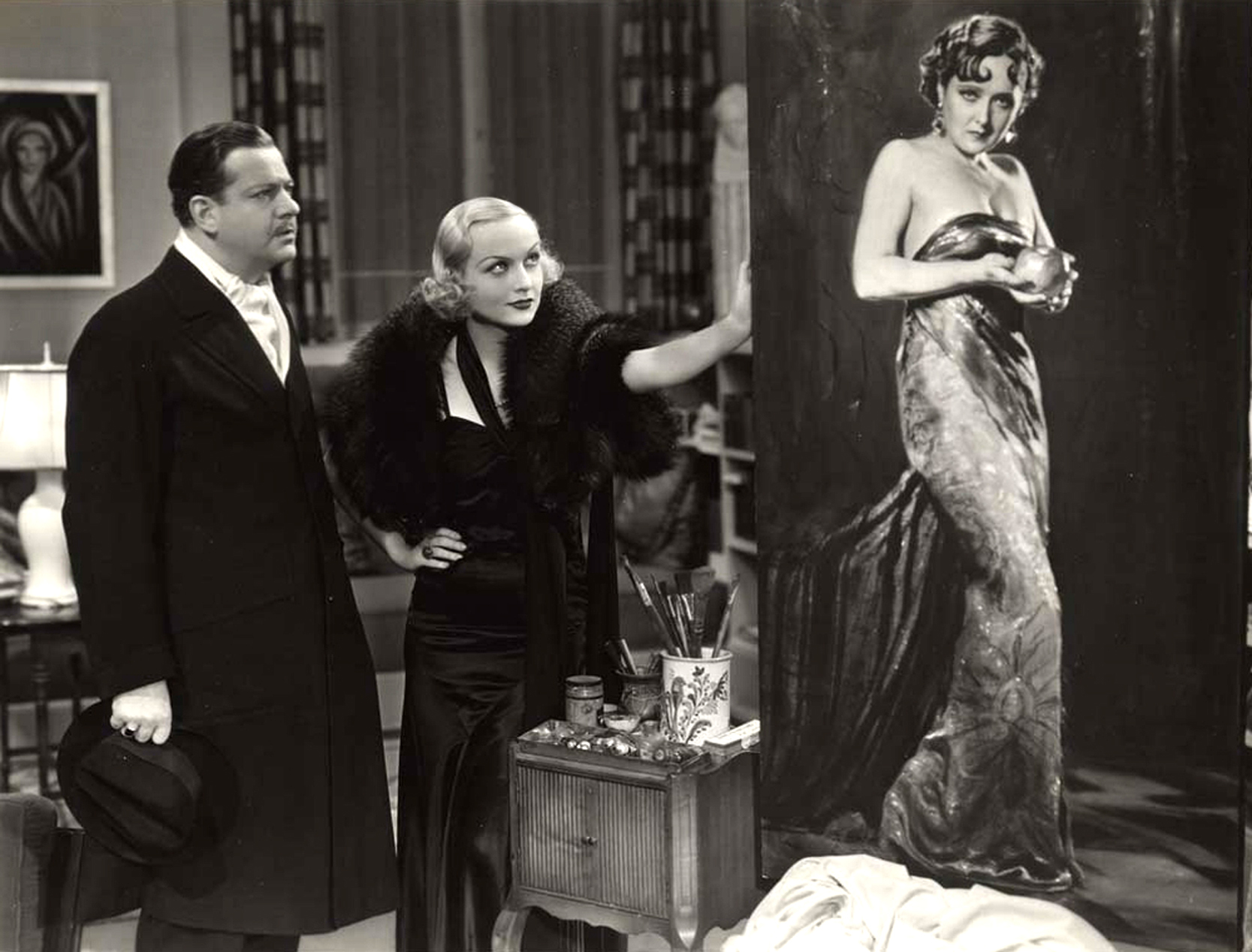
Paul Bavian (Alan Dinehart) is only a little suspicious when Roma takes him to his late lover Ruth Rogen’s apartment. The full-length portrait of Ruth (Vivienne Osborne) offering up a tempting apple is emblematic of the fact that bad girls are a lot more fun. Until they strangle you, that is.

Don’t get me wrong. Supernatural is a rollercoaster ride of a picture, and if it were made today, it would be all CG and over the top and loud and entrail-strewn and in your face and no fun at all. But because of the times and the stars involved, this thing is a hoot, with enough genuine creepiness to keep an audience onboard for an hour of mayhem thought up by genuine adolescent brains.

This is one of those “pre-Code” pictures they’re always talking about—you know, before the Hollywood Production Code went into effect and pinch-faced censors took over. This doesn’t mean Lombard’s bouncing around naked in Supernatural (unfortunately), but it’s clear that actual sex breaks out in this universe, and that booze is fun, and murder rewarding. Ruth Rogen doesn’t get her comeuppance for being a killer, which the Production Code would soon require. Sure, she’s executed, but then her soul floats free to continue the mayhem, and it’s implied at fade out that she’ll possess again after being driven from Roma’s body. For all I know, Ruth Rogen is still out there somewhere, strangling away.

Fireball: Carole Lombard and the Mystery of Flight 3 by Robert Matzen

Will Grant arrive in time to save Roma from a murder wrap for strangling evil Paul Bavian?

I hope Turner Classic Movies runs Supernatural soon. If it doesn’t, seek out a bootleg copy and emulate Paul Bavian by pouring a triple shot of hard liquor. It worked for me. Then sit back and enjoy the picture that drove Carole Lombard crazy, the one she didn’t talk about, the one horror picture she ever made; the one that collectors today revere for its rarity. Whatever else you can say about Supernatural, it is hands-down the wildest, most unusual picture to which Lombard’s name is attached. And, oops, I think she just turned over in her grave.

Feathering the Nest

Notes: Check out the latest bestseller list for Movie Biographies. Fireball peaked at #2 on the list last Sunday and is still going strong. Also, please consider clicking the Follow button on this blog to get an alert when a new column appears, and if you’re a Twitter person, you could follow me (@RobertMatzen) to receive important updates on book lectures or other Fireball news.

Think how profoundly we all have been impacted by the cellular telephone. A generation is growing up that knows nothing about the “phone booth” or telephones in your house that used to be tethered to walls. What? It’s all part of the march of technology, and as I sat and watched Errol Flynn’s 1952 pirate picture, Against All Flags, last night, I thought most of all about technology and how it brought about pictures like this one.

Fireball: Carole Lombard and the Mystery of Flight 3 by Robert Matzen

What red-blooded lad could resist this art announcing another pirate picture hitting port soon? Many a dad also felt the call of this particular brotherhood of buccaneers

There’s a lot to like about Against All Flags, which has the look and feel of a big-budget picture the way Universal International made them at the time, and they made them that way at that time because of the impact of television. Movies had to keep being bigger and better to lure people out of their homes because in 1952, families could suddenly sit at home while metal antennas pulled broadcast signals out of thin air and allowed people to watch grainy black-and-white images on television for free. You didn’t have to get dressed up and haul the brood to a theater with all its related expenses at the concession stand. You could lounge at home and be entertained.

In Against All Flags, Errol Flynn is a British naval officer who goes undercover to bust up a band of pirates. How could any kid not find this to be a disagreeable plot since Hollywood pirates were always attractive, well-costumed rule-breakers—every boy’s dream of the way life should play out. Anyway, here’s Flynn undercover and since he is Errol Flynn the script tosses out a lot of innuendo, playing on his bad-boy reputation with the ladies, lines that came oh-so-close to being snagged by the censors but never quite crossed the line.

The key gag in the picture is that a virginal Indian princess, age about 16, falls for Flynn on first sight and after an innocent Flynn kiss to quiet her, she spends the second half the picture puckering up and exclaiming with youthful enthusiasm, “Again!” She’s young and willing as portrayed by 19-year-old brunette Alice Kelley, and the tailoring of the subplot says something about how Flynn swashbucklers were constructed at this time. They traded on his reputation as a swordsman in more ways than one and offered sexual morsels in vivid Technicolor that television couldn’t begin to rival.

Fireball: Carole Lombard and the Mystery of Flight 3 by Robert Matzen

What you couldn’t see on TV in 1952: flesh-baring, under-aged girls throwing themselves at Errol Flynn, in Technicolor yet. Or does Spitfire want the wench for herself? Alice Kelley broadcasts raw sexual desire for the bad boy as Maureen O’Hara and Mildred Natwick look on.

There’s a big-three starring here, including Flynn, Maureen O’Hara, and Anthony Quinn, who cuts a fine figure as “Captain Roc” in his black headscarf. And how many of these pictures did Maureen O’Hara make? Here she plays buccaneer Spitfire Stevens in a man’s clothes and fetching leather hip boots and does so with credibility. Am I the only one who sees a hint or two of masculinity in everything about her? How else could she carry and wield a sword as if she could hold her own in a duel and actually hurt somebody? Plus the androgynous nature of her character gives a kinky undertone to dialogue about ownership and uses of a slave girl—television certainly wasn’t offering such suggestive fare.

Maureen O’Hara was smart enough to follow the money wherever it led, including many a swashbuckler, and feathered her nest in these sweet Universal International profit participation deals. It was a setup that Carole Lombard had dreamed up for herself in 1941 with To Be or Not to Be; had she lived past 1942, she would have blazed this trail as an independent for the remainder of the decade.

Fireball: Carole Lombard and the Mystery of Flight 3 by Robert Matzen

Hmmm, who to root for…Flynn the undercover do-gooder or Quinn the minding-his-own-business pirate?

In the early 1950s, Universal International managed to thrive on this setup in the ongoing war between the studios and upstart television. UI turned out lush Technicolor offerings that drew top stars like Errol Flynn and Maureen O’Hara specifically because they knew that black ink was likely and they would be getting a cut.

It doesn’t matter that Against All Flags frays long before the last reel and becomes just another loud and mindless pirate picture. I admire the pluck of the studio, the writers, and the stars for managing to turn out product more than 60 years ago that maintains enough sass for a Friday night primetime broadcast run on Turner Classic Movies/U.S. In this case, the dreaded medium, television, is taking a moment to salute a one-time enemy that only went down after one hell of a fight.

On the Street Where I (Didn’t) Live

I was a kid out of college the day in 1987 that my then-wife Debra and I visited Robert Stack at his home in Bel Air, California. Mr. Stack’s longtime next-door neighbor was Ronald Reagan, so I knew as we wound along the lush and winding roads, with the landscape abloom, that I was about to be in good company. My second book, under contract to Greenwood Press, would be an academic volume about Carole Lombard with a 30-page biography included. I queried all the old stars still alive at the time seeking in-person interviews. I didn’t know protocol and had no track record as a biographer, so Ralph Bellamy sent quotes in a letter and so did Cesar Romero. Jimmy Stewart, operating out of his Beverly Hills office, was downright gruff. I was in contact with many others, but the correspondence is buried somewhere. Then there was Robert Stack. I wrote him a letter with the basics—book about Carole Lombard, may I speak with you, etc.—and he shot back a note in the minimum number of days for mail to go from Pennsylvania to California to Pennsylvania. It included his phone number and he said, basically, love to talk about Carole, give me a call and stop by any time.

Robert Stack had met Carole Lombard in 1933 when he was 14. She befriended him in Tahoe as she took up Nevada residence in anticipation of divorce from William Powell. Carole had the ability to make a guy feel special; she was beautiful, accessible, and genuine, and made electric eye contact. Grown men fell in love with her almost daily, so what chance did an adolescent boy have of avoiding a head-over-heels tumble?

Lombard knew the effect she had on men, so she must have known Bobby Stack’s feelings, and she must have pulled her punches with this poor mop-topped kid.

Ironically, Stack’s first picture after migrating to Hollywood six years later would be called First Love, and he would portray new sensation Deanna Durbin’s onscreen boyfriend. A couple of years and five pictures later, Carole Lombard asked for Stack to portray a younger man smitten with her in To Be or Not to Be, a move that was typecasting for Stack—but didn’t make Carole’s husband, insecure Mr. Clark Gable, any too happy.

Fireball: Carole Lombard and the Mystery of Flight 3 by Robert Matzen

Robert and Rosemarie Stack right around the time I met both of them at their home in Bel Air.

Forty-five years later we pulled into Robert Stack’s driveway and were ushered past the pool and into his den by the housekeeper. We waited only a moment on an overstuffed leather couch before Bob breezed into the room, hair longer and blonder than I would have guessed, dressed in lounging pajamas, that big friendly movie star smile lighting up from ear to ear and his handshake firm. If he was surprised to be looking at a couple of wet-behind-the-ears kids, he didn’t let on.

He talked first about the film version of The Untouchables and this was bitter Robert Stack, grumbling that he hadn’t been involved in the production, then nearing completion, and he seemed to want to be on the record voicing his displeasure to anyone with an audio recorder.

Then he seemed to recall why I was there, and brightened, and a light clicked on in his eyes. Carole Lombard. Ah yes. He launched into stories of those early Tahoe days, laying eyes on and getting to know 24-year-old Carole, teaching her to shoot skeet, this boy teaching this woman, and Stack confessed that his mother, to whom he was very close, didn’t much care for Lombard’s loud personality and penchant for swearing. “Mother didn’t think I should be hanging around her,” said Stack with a smile that showed the perspective of decades.

He sat on an adjacent couch, cross-legged as he talked. But then at powerful memories of Lombard he would stand and pace, often ending up leaning against a giant fieldstone fireplace with a dark wood mantel. This was a man’s room, trophies, guns, and now I know that Stack had had Gable’s den in mind when he created his own. He talked a lot about Gable, about admiring the King and worrying for him after Carole’s death, when “He would race up and down Laurel Canyon on his motorcycle, not caring if he lived or died.”

We talked about the making of To Be or Not to Be and the lengths to which Carole went to keep a very nervous “Bobby” loose on the set. He told a story that showed up in his memoirs, how Carole would gently take him by the elbow and ease him back into his key light when he drifted out of it. She was, he said with awe, the only fellow performer ever to do that for him, but he learned from her to do it for other newcomers over the years.

Fireball: Carole Lombard and the Mystery of Flight 3 by Robert Matzen

Carole Lombard keeps an ill-at-ease Robert Stack loose on the set of To Be or Not to Be.

I asked him where he was when he learned of the plane crash and his response was telling. He didn’t hem and haw, and look far off and reach for the memory. “I was walking out of the Hollywood Palladium,” he boomed at once in that Unsolved Mysteries voice, reflexively. “I was with my date; we had been dancing. I heard a newspaper crier on the street corner. It was the Los Angeles Times, and he was calling out, “Carole Lombard in Plane Crash!”

I get goosebumps now thinking about that moment in Bob Stack’s den, seeing this friendly, sincere man tearing up. “I saw it in a newspaper headline,” he said, regarding me through the mist. “I couldn’t believe it.”

Unfortunately for me, one can only live life straight ahead, with no do-overs. There was so much more I could have and should have asked him. About her, about Gable, about his career—The High and the Mighty, Written on the Wind, his TV series

—about Flynn for crying out loud, since he haunted Flynn’s Mulholland tennis court for years. I need to give myself a break, though. I was just a kid starting out.

Finally I ran out of questions and he led us back outside by the pool, where I met his wife Rosemarie, who was just as gracious as her husband, and their friendly white poodle Hollywood, regarded by both as a beloved child and the heart of the household.

This was my first celebrity interview, and therefore the most memorable. I wish I had taken pictures that day but I didn’t. I just lived it, a kid out of college on the street where the president lived.

I Love a Parade

In this case it’s a parade of good news about Fireball: Carole Lombard and the Mystery of Flight 3. I learned yesterday that the ebook version of Fireball has been chosen by Amazon as part of its June Big Deal program. This means it’s discounted from $10.99 to $1.99 from June 13 – 28, potentially opening the book up to a legion of summer beach readers who might not take the plunge at Amazon’s regular price. Please spread the word as far and wide as you can about this opportunity to get Fireball at deep discount.

Now that the book has been out there for several months, fewer reviews are appearing, but here’s one from the most recent Vegas Seven magazine, which is distributed free all around Las Vegas and represents a terrific way to expose Fireball to an international audience.

Fireball: Carole Lombard and the Mystery of Flight 3 by Robert Matzen

My PR rep, Sarah Miniaci, with a copy of Fireball at Book Expo America.

Fireball also got nice exposure at Book Expo America thanks to the team at Smith Publicity, which featured Fireball in its display. My PR rep, Sarah Miniaci, spread the word at BEA, which is the largest annual gathering of book industry professionals and this year was held at the Javits Center in New York City. I have to take a moment and thank Sarah for months of hard work and expertise, which got the book in front of millions of people via broadcast television and radio, print articles and reviews, and vast internet exposure.

The last bit of good news for today is about my latest lecture and signing, which took place at Cinevent, the annual film convention held in Columbus, Ohio each Memorial Day weekend. The lecture drew the largest crowd yet and we sold a record number of books over three days. I want to thank Cinevent manager Steve Haynes for making time for me in the packed program and also for an outstanding level of support that pretty much guaranteed success.

The lectures always result in meeting great people. This time it was Bob King, publisher of Classic Images magazine. Bob invited me to do a Fireball-related article, which I’m getting started on today. I also met David L. Smith, author of the 2006 book, Hoosiers in Hollywood as well as the article “Carole Lombard: Profane Angel,” which appeared in the Summer 2001 issue of Films of the Golden Age magazine. Dave sent me a copy of the 2001 broadcast documentary, Carole Lombard: Hollywood’s Profane Angel, in which he appeared as an on-camera expert with, among others, Robert Stack, Robert Osborne, A.C. Lyles, Eddie Bracken, and William Wellman, Jr. Watching this 2001 documentary gave me an idea for my next column, so stay tuned for what I hope to be a good one.

Fireball: Carole Lombard the the Mystery of Flight 3 by Robert Matzen

Preaching to the choir of Hollywood film lovers at Cinevent.

You Can’t Win ‘Em All

I bet you never saw Olivia de Havilland’s last theatrical picture. I bet you didn’t know it was a swashbuckler set around the time of Captain Blood. I bet you didn’t know she played a queen and the key to solving the plot of the film. Do you want to know why you don’t know?

After her Academy Award run of the late 1940s, Livvie tried everything to remain relevant. Screen, stage—nothing went according to plan. Into the 1960s she sought to reinvent herself with the shocker, Lady in a Cage and then she took over Joan Crawford’s role in the follow up to What Ever Happened to Baby Jane, this one called Hush, Hush, Sweet Charlotte. Like all actresses from the Golden Era, she had an ever more difficult time finding good parts in decent pictures, which is what led Miss Bette Davis to make everything from Baby Jane to Return from Witch Mountain—it was a living.

Fireball: Carole Lombard and the Mystery of Flight 3 by Robert Matzen

Her biographer, Tony Thomas, would never quite forgive Olivia for showing so much skin in 1970’s The Adventurers.

OdeH lay low from 1964 until the 1970 Harold Robbins Eurotrash feature, The Adventurers. There she became the best thing about the picture, playing a 40-something cougar to young Bosnia/Herzegovina leading man Bekim Fehmiu. If you think about a Bosnia/Herzegovina leading man in a Hollywood picture, the problems with The Adventurers become pretty obvious pretty fast, and speak to the dearth of parts for Miss deH and the questionable judgment she brought to bear when something did come her way. She even showed some flesh this time around, much to the mortification of some of her admirers.

If you weren’t yet born in 1970, you missed a hell of a brouhaha when Airport hit big screens, and by 1972 turnstiles were spinning madly as The Poseidon Adventure capsized its way to box office history. Suddenly, the all-star disaster epic was in vogue. Olivia saw aging Helen Hayes claim an Oscar for Airport and Shelley Winters nearly follow that path for Poseidon. From there, Livvie watched Earthquake shine the spotlight on aging sexpot Ava Gardner and MGM ingénue Monica Lewis, and The Towering Inferno do likewise for Selznick discovery (and wife) Jennifer Jones.

Lots of water--too much water--and not enough substance plagued her appearance in Airport '77.

Lots of water–too much water–and not enough substance plagued her appearance in Airport ’77.

Meanwhile, on a separate track, swashbucklers came back in vogue with Richard Lester’s irreverent version of The Three Musketeers, shot in 1973 and released in 1974. Of all people, Raquel Welch scored biggest this time, winning a Golden Globe for her wacky Constance. Livvie had to get in on this gravy train and gain back some relevance. After all, she was then in her youthful 50s with a lot yet to offer the motion picture world. Then she got what seemed to be her break with a role in Airport ’77, sequel to the huge Airport 1975. Yes, work was work, but what a thankless part, with endless reaction shots in her passenger seat aboard an airliner that sinks to the bottom of the ocean, and then a less-than-flattering dunking during the ocean rescue. I’m on your side, Livvie, but, it’s hard to look good with a couple tons of water smacking you in the face.

Fireball: Carole Lombard and the Mystery of Flight 3 by Robert Matzen

Oscar nods do not result from death by bees.

Airport ’77 did well, not as well as the previous two, but well enough. By this time Hollywood was groping for disasters with which to imperil all-star casts, and somebody at Livvie’s old studio, Warner Bros., decided that bees hadn’t been done and bees are scary and why don’t we do bees? Hence, The Swarm. This time Olivia shared screen time with Ben Johnson and Fred MacMurray, but fans of the great dual Oscar winner had a hard time watching her get stung to death, her face eaten, as the bees rampaged. Never mind that these days killer bees have since been proven to exist, and they really are scary. Way scarier than those depicted by Warners of Burbank. And how strange must it have been for Olivia de Havilland to return to the studio she so desperately sought to sever herself from 35 years earlier? Oh the ghosts she must have brushed past during production since so many of her colleagues had by then passed, including Errol Flynn.

Which brings us to the little-known swashbuckler that became Livvie’s swan song in feature pictures. It must have looked like a godsend in 1976 when the idea first came up. Behind the Iron Mask, based on Alexandre Dumas’ Man in the Iron Mask, would be lensed in Austria by Director of Photography Jack Cardiff and directed by Ken Annakin, veteran of Disney pictures and some all-star hits, including Those Magnificent Men in Their Flying Machines.

Behind the Iron Mask would feature 60-year-old former fencing champion and veteran Hollywood heartthrob Cornel Wilde as D’Artagnan, Oscar winner for his Cyrano (a brilliant swordsman) Jose Ferrer as Athos, and Alan Hale Jr. as Porthos. In a 1952 Howard Hughes picture for RKO named Sons of the Musketeers, Cornel Wilde had portrayed the son of D’Artagnan and Alan Hale Jr. had played the son of Porthos. That in itself was a kick because his dad, Alan Hale, had portrayed Porthos in the 1939 version of Man in the Iron Mask.

Fireball: Carole Lombard and the Mystery of Flight 3 by Robert Matzen

Sons of the Musketeers was renamed At Sword’s Point for its 1952 release. Here a very young Alan Hale Jr. portrays the son of musketeer Porthos. Next to him is Cornel Wilde as the son of D’Artagnan. The “twist” is offered by Maureen O’Hara as the daughter of Athos. As modest as this RKO B picture was, it feels like Citizen Kane next to The Fifth Musketeer.

So here was Alan Hale Jr. back in a role that had been in the family for 40 years. And into this cast was invited Olivia de Havilland—Alan Hale’s co-star on so many Warner Bros. hits—to portray Anne of Austria, wife of Louis XIII and mother to wastrel Louis XIV and his good-hearted twin brother, Philippe.

Fireball: Carole Lombard and the Mystery of Flight 3 by Robert Matzen

This was not your father’s Man in the Iron Mask. Although I’m pretty sure Dad would have approved–of the European version at least.

How freakin’ great is this? Olivia must have thought, to cavort with a veteran cast that also included Rex Harrison and old Warner Bros. contract player Helmut Dantine. But a funny thing happened on the way to swashbuckling glory. Actually, a series of funny things. The script stank. The key role, that of Louis/Philippe, was given to Beau Bridges, an actor with zero romantic appeal. The director couldn’t figure out how to approach the material. The audio was bad, even by European standards. The producers decided to shoot a European version featuring nudity for the two leading ladies in the picture, Sylvia Kristel of Emmanuelle fame and Ursula Andress, who was ready and willing to show off her still formidable 43-year-old body. Unfortunately, some of the plot was embedded in the nude scenes and so when they were cut for U.S. audiences and a PG rating, the picture didn’t quite make sense. And finally, those same infallible producers changed the name of the picture to cash in on the success of The Three Musketeers and its sequel The Four Musketeers. The picture that was shot in 1977 as Behind the Iron Mask now carried the U.S. title The Fifth Musketeer, which made no sense, and Fifth was launched in limited U.S. release in 1979 after sitting around a good while and sank so far and so fast that if you blinked, you missed it. The run on cable TV was similarly short, and if I hadn’t happened upon a late-night run of Ursula Andress pictures on Turner Classic Movies this past week and DVRed Fifth in its pre-dawn run, I would never have thought of The Fifth Musketeer again.

Fireball: Carole Lombard and the Mystery of Flight 3 by Robert Matzen

One more, just because. Sylvia Kristel in the European version of Olivia de Havilland’s last feature picture, The Fifth Musketeer.

I told myself that it couldn’t possibly be as bad as I remember. But, oh, my friends, it is. In 1979 I was appalled that the swords were made of obvious plastic, as if from the Marx toy factory, and for the especially dangerous scenes, and I kid you not, the swords were made of rubber so, I guess, to keep the advancing-in-age musketeers from hurting themselves or skewering an Austrian extra. The dubbing sounds just as horrendous today as it did back then, and the musical score is an offense to musicians everywhere.

Livvie shows up in three scenes for a total of about six minutes of screen time, in a nun’s habit. You should probably be aware you’re in for a rough time as an actress when the script calls for you to be amidst a 30-year vow of silence. But she does pipe up to vouch for her son Philippe at the climax of the picture, one of too-few lines for the actress who launched Errol Flynn, became the Maid Marian of all time, brought Jack Warner to his knees, and earned two Oscars in four years and should have claimed a third for her most daring picture of all, The Snake Pit.

So there you have it. Olivia de Havilland ended her screen career in a costume picture, which is how she started it. But it’s a picture with maybe five great moments that remind us how talented these actors were in their prime, and how much they still had to offer in the right hands and the right vehicle, which this most certainly was not.

Fireball: Carole Lombard and the Mystery of Flight 3 by Robert Matzen

Plastic swords and costumes that must have been scrounged from Barry Lyndon.

Note: Portions of the European version of Behind the Iron Mask are available on Youtube. Although they are dubbed in French, these segments allow a glimpse into this picture that should have been one for the ages.

Joan Jett Wisdom

Fireball: Carole Lombard and the Mystery of Flight 3 by Robert Matzen

The crazy kids back when life made sense.

Who was the first one to sing, “You don’t know what you got till it’s gone?” I remember the Joan Jett version, You don’t know what you got till it’s gaw-aw-aw-aw-onnnn. Joan wasn’t just whistling Dixie, my friends. You lose things, and it hurts. You lose living things, and in an instant the world stops spinning and everything goes flying in all directions, and usually only then do you realize what you had and don’t have anymore; how blessed you were when the parts of your life all fit together so nicely day by day, routine by routine. Then suddenly, there’s a big hole in your existence. Things go all out of whack and you’re stumbling about all fuzzy-headed because your days are numb and your nights are sleepless.

Do you ever wonder how Clark Gable survived January 16, 1942? He was ripped from the ranch to fly up to Vegas in dead of night, then driven this way and that, sequestered at the El Rancho, forced his way to the mountain, tried to climb it, got stopped partway up by news that his wife was dead, was taken back to the El Rancho, sweated out victim retrieval, was given a piece of her jewelry that had been pried from her body, and had to pick out caskets. If ever a man appeared to be shell-shocked, it was the Gable seen in those photos at the El Rancho, hiding behind sunglasses as he walked across the parking lot and climbed inside a car.

Today we know “shell shock” or “combat fatigue” as Post-Traumatic Stress Disorder or PTSD. I suspect I am tasting a bit of that over a recent trauma, where memories stab into your brain with no warning, memories that are too horrible to process, and startle and hurt as much the fifteenth time as they did the first. Or they wound even more because you’re still trying to come to grips. Soldiers and law-enforcement professionals suffer such trauma and it can endure years, decades, lifetimes. Those first responders to the crash of Flight 3 tasted it, like the one rescuer who told of stuffing body parts in mail bags said, “I still see it in my dreams sometimes.” He said it 50 years later.

Fireball: Carole Lombard and the Mystery of Flight 3 by Robert Matzen

Gable at the El Rancho.

Gable showed all the signs of PTSD, not just that weekend but for the rest of his life. I wonder which moments produced the flashbacks. You have to know he never went back to the El Rancho. I haven’t investigated to learn if he ever stepped on another Western Air DC-3 like the one chartered to rush him to Vegas. I bet he lived that moment on the mountain, “I’m sorry, Mr. Gable,” over and over. And that moment when he was asked if he wanted to spend time with Lombard’s body, which was in the next room. And that first bad memory, when MGM VP Eddie Mannix and PR man Ralph Wheelright barged in the front door of the Encino ranch to interrupt prep for a dinner party, two bundles of nerves to announce that the plane was down. It was the instant his royal, carefully crafted, highly insulated, pampered and preened, forever-adolescent movie-star life stopped making sense. Clark Gable liked being an actor because he could portray successful, secure, confident people quite unlike himself, but on that Friday evening his bill of 10 years was due, and the world got to see the other Clark Gable, the real-life one.

And then, oh, the grief. Inhuman, what he endured, what any husband or wife endures when the spouse exits suddenly. And this spouse, with her shtick, her sayings, her constant carrying on, talking a mile a minute, high-high energy every instant she wasn’t asleep. She would buy outlandish hats just because he disliked outlandish hats. She dared kid the king, and how he loved her for the audacity. The hunting trips wherever, the premieres where they dressed to the nines, the ranch with its orchards and horses and tractor and constant carrying on. Santa Anita, aaaaaaaand they’re Off! The shouting matches and jealous brawls and how they hated each other and loved each other. Driving at 80 with the top down and laughing their heads off. All that………….removed. In its place, silence. In its place, stillness.

It was no longer his life. He could make no sense of life.

The most telling and recurring theme: His friends didn’t want to be around him anymore. He was that different. His hands shook; his hands always shook after that weekend. He had been laid bare for the world and what good was a hero so vulnerable under the shining armor? He never got to enjoy a giant, classic movie hit again. Some of his pictures made a lot of money, but he became the King of Hollywood in name only.

You don’t know what you got till it’s gaw-aw-aw-aw-onnnn. Whoever or whatever you hold dear, go give it a big hug. Look at it and appreciate and imagine what your life would be like without it. I’m feeling a personal loss right now because I dared take for granted and maybe you can profit from my misfortune. Give him or her or it a kiss. Look him or her or it square in the eye and say, “I love you” like maybe it’s the last time, because you never know when it will be.