Jimmy Stewart World War II

Rendering in 3D

I sat at the barber shop yesterday staring at a poster of the late Roberto Clemente framed on the wall. The shop is decorated with framed art of Pittsburgh sports heroes. The Clemente print showed various views of the one-time Pirates baseball star and I thought back to my youth sitting in the first row of the right-field bleachers watching Clemente up close. I know I’ve mentioned before that my sister would take me and Roberto knew her by name. Between innings when it was quiet he would talk to us in the stands and I remember this guy in brilliant, full-color 3D when he was more than a memory and a poster on a wall. Sitting there thinking about how long ago that was now made me both sad and nostalgic–we’re here on this earth for what really amounts to such a short time; it’s important to make each day count.

Mission: Jimmy Stewart and the Fight for Europe by Robert Matzen

The poster on the barber shop wall.

Right now I’m busy trying to turn Capt. Jim Stewart back into a 3D human who flew in combat in World War II. The manuscript for Mission: Jimmy Stewart and the Fight for Europe is now in final editing and I’m doing things like chapter notes, photo captions, and acknowledgments. I’m very happy with the book and think it will answer a lot of questions about Stewart’s service during the war. You want to talk about action and adventure; be sure to wear your safety harness and take your Dramamine because you’re in for quite a ride at 20,000 feet. Mission cleanup is why I’ve been so quiet this past month, because there’s a lot going on and not enough time. (Commercial plug: Look for the 400-page hardcover Mission, including 16 pages of rare photos, on Amazon and at a bookstore near you beginning October 24!)

For now I’d like to point you to an interesting Journeys in Classic Film think piece on Errol Flynn’s 1939 super-western, Dodge City. I also read this article at the barber shop (it was a long wait). I just loved being able to enjoy a fresh and thoughtful interpretation of this 77-year-old near masterpiece; it’s one of collections of words that makes me say, I wish I had written that. Actually, I wish I were smart enough to write that.

Enjoy, and I’ll be back soon with fresh material.

Mission: Jimmy Stewart and the Fight for Europe by Robert Matzen

Errol and some of the boys.

Everything’s Relative

Mission: Jimmy Stewart and the Fight for Europe by Robert Matzen

GoodKnight Books first look at the cover design for Mission, release date October 24, 2016.

As you may know, it snowed here in the Northeast. Actually it’s still snowing, so I got up this morning and decided to shovel the driveway. This is always something of an exercise because the driveway is very wide here at the top by the two-car garage and then narrows for the 216-foot descent to the road. Usually I just shovel the wide part near the house and a couple of tracks down the driveway, but this morning was different. Why? Because I’ve reached the stage on my new book where I’m confronting every word by reading it aloud (more on that later). So I went out to shovel the driveway at 7:30 this morning knowing that afterward, I had to come in here and confront. I kept shoveling, and shoveling, and then I decided, in a bizarre sort of work avoidance, to shovel the whole 216 feet because it was less strenuous than sitting here doing all that confronting. In 35 years of living here I had never shoveled the whole thing, you know, the whole width of the driveway from top to bottom; about three-fourths of the way through it, the sweat was in my eyes and the hair was frozen on my head since it was still snowing and it was accumulating up above my brain.

This was a very old-school experience, with a shovel, not a snow blower or a plow. I’m pretty sure the neighbors think I’m a lunatic but I wouldn’t know because I don’t know my neighbors (me being me). So anyway, I pretty much wrote this column in my head as I was shoveling all the way down the driveway to the road, eight inches of snow (and counting), thinking what I was doing was a lot easier than plowing through Mission: Jimmy Stewart and the Fight for Europe aloud.

OK, why read Mission aloud, you ask? Well, back when I was writing Fireball, at a certain point I learned it would be an audiobook and I started thinking about how my good friend Tavia Gilbert, a nationally known, award-winning audiobook performer, would read it, which forced me to read Fireball aloud myself to hear what it would sound like as an audiobook. It was a highly worthwhile experience because confronting every word helped to iron out problems and strengthen the narrative. I heard the clinkers, realized what words I’d used too often, got reminded of things I forgot to include, and enjoyed one final opportunity to cut sections that didn’t hold up. This is the time to make a book sing. I highly recommend this step for anyone who writes anything about anything. Fiction, nonfiction, a letter to a client—whatever. Read it aloud to hear how it sounds.

Angelique when she's really into a chapter.

Angelique when she’s really into a chapter.

I’m up to chapter 36 on Mission and am pleased to report that I’ve given myself goosebumps in many places and made myself cry twice. There’s been only one chapter so far where I went, “This doesn’t sparkle.” Oddly, it was a chapter about one of Stewart’s missions over Germany, but it didn’t sparkle and still doesn’t, and I was alerted to this fact when I read it aloud. Actually, Angelique, our little peanut of a cat, was looking at me oddly when I was reading that chapter as she lounged on her perch beside my desk half asleep. She just wasn’t feeling that one, so I knew it needed more work and I flagged it for some final reconstruction at the very end of the process.

It only took about a year and a half to write Fireball, and it’s taken about that long to write Mission. I learned a great deal from Morticia Addams, who said one time on The Addams Family, “All work and no play gets books done.” It was an episode from around 1965 when Morticia decided to be a writer and Gomez found her in the dungeon or somewhere writing away and said what was she doing. That’s when she said, “All work and no play gets books done,” and that sentiment really got to me, to the extent that for years I had it posted in front of me here in the office in 60-pt type. For the past year and a half I’ve been all work and no play to the extent I don’t watch TV, and only hear about the local sports teams on the news the next day. Day job, night job, day job, night job, that’s the routine. Most of the weekend it’s the night job. The words pile up that way (like snow during a storm), with the goal being 1,000 an evening most evenings, and they don’t have to be good words, just bulk words to be sanded and polished later. Sometimes, when I was writing the stories of the actual missions, I’d listen to music. A little Von Suppe’s Light Cavalry here, some Elmer Bernstein movie music there, a little Elgar’s Pomp and Circumstance for martial spice. You know how well Richard Wagner worked for Apocalypse Now—symphonic really works for B-24 missions over Europe, and for the German viewpoint fighting the bombers as well.

So this morning I shoveled all the way down the 216 feet of driveway, a seven-foot-wide path, and at the road had to make my way through the big pile left by the borough snow plows going past. I was terribly pleased with myself. Ha! Take that, neighbors. I had avoided work for 90 minutes or whatever it was, and I trudged back up the cleared driveway only to realize, Oh shit! It’s still snowing, and the top is covered in snow, and I HAVE TO START ALL OVER AGAIN. I had avoided my work a little too well.

There’s your little slice of life from Snowmageddon 2016 here in Pennsylvania.

Mission: Jimmy Stewart and the Fight for Europe by Robert Matzen

View from the top after I was “done,” with snow covering everything all over again. Oh well, I avoided it as long as I could–time to get to work.

Don’t Call Him “Jimmy”

Fireball: Carole Lombard and the Mystery of Flight 3 by Robert Matzen

In 1952 James Stewart played a doctor wanted for murder in The Greatest Show on Earth. Through the course of picture, he never appeared without clown makeup.

It’s happening again: I’m on the trail of an elusive subject, trying to figure him out, following clues leading to deconstruction of his personality to the elements, then examining them and reassembling the human. This time, I’m finding the exercise frustrating. Well, as frustrating as usual.

The subject is James Stewart, Hollywood leading man from 1937 to the early 1970s, not to mention war hero, political conservative, and deity to what seems to be an entire demographic of the U.S. population. One of the first things I learned: He didn’t favor the familiarity of “Jimmy.” I interviewed his movie and television co-star Julie Adams recently and picked up on the fact that she called him not “Jimmy” but “Jim.” Said Adams, “I always called him that, and so did everyone else; I don’t think he liked Jimmy.”
Fireball: Carole Lombard and the Mystery of Flight 3 by Robert Matzen

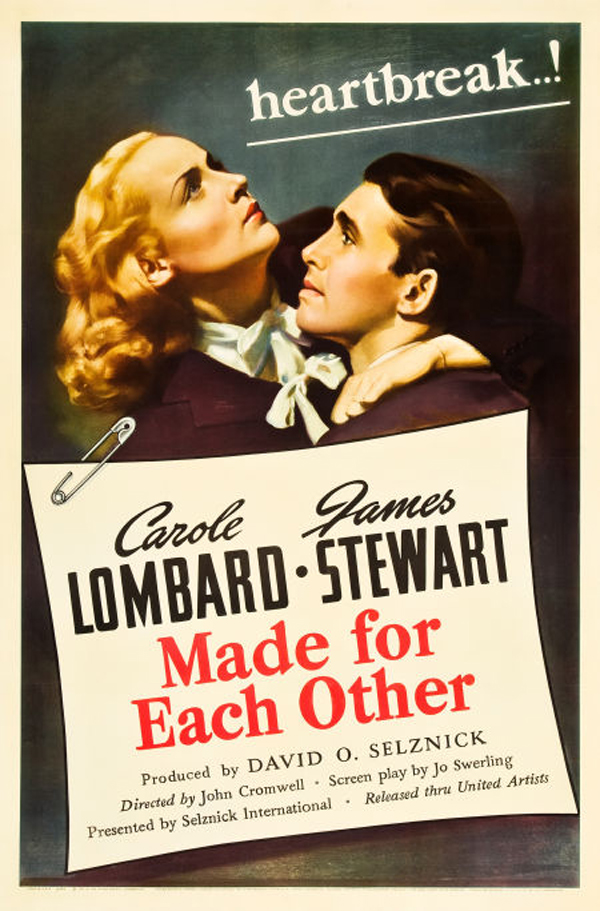
The biggest heartbreak about the only picture Carole Lombard and James Stewart made together was the amount of money this contrived melodrama lost at the box office.

This is a tough nut to crack, this chasing down of a deified figure. There are a thousand stories out there of good deeds done by James Stewart, and I’m finding nothing juicy, nothing to humanize him. It takes me back to trying to decipher the real George Washington—not the capital city, not the university, not the bridge. The man who started it all. Eventually I got at this guy, who was in youth an ambitious, hot-tempered (did you know he was a redhead?), self-educated natural athlete who dearly loved the ladies. A theme of one of my documentaries was that GW pursued the married Sally Fairfax—which earned the video a ban by a major Christian DVD distributor! George Washington loved freedom, all right—the freedom to make an untaxed fortune, and it was self-interest, not altruism, that started him down the revolutionary road. Eventually, he was willing to give up everything for the good of his fellow Americans. Everything. And believe me, he had a lot to lose. The courage of convictions that grew within him, the awareness to know what was required of a leader, and a pre-existing and unshakeable self-discipline, all combined into what became the most admired man in the world. All that said, it was interesting that he had a violent temper; it was interesting that he pursued the wife of his best friend. It was all part of the same package.

In the end, I figured out George Washington, and I admired his human failings because he fought these parts of himself on his way to immortality. So now I have to learn the failings of James Stewart. He’s practically got the Knights Templar guarding his image; to me their protection harms his legacy rather than protects it. Isn’t a subject of biography interesting precisely for what he or she overcame in life? The inner conflicts? The failings? The handicaps? The demons?

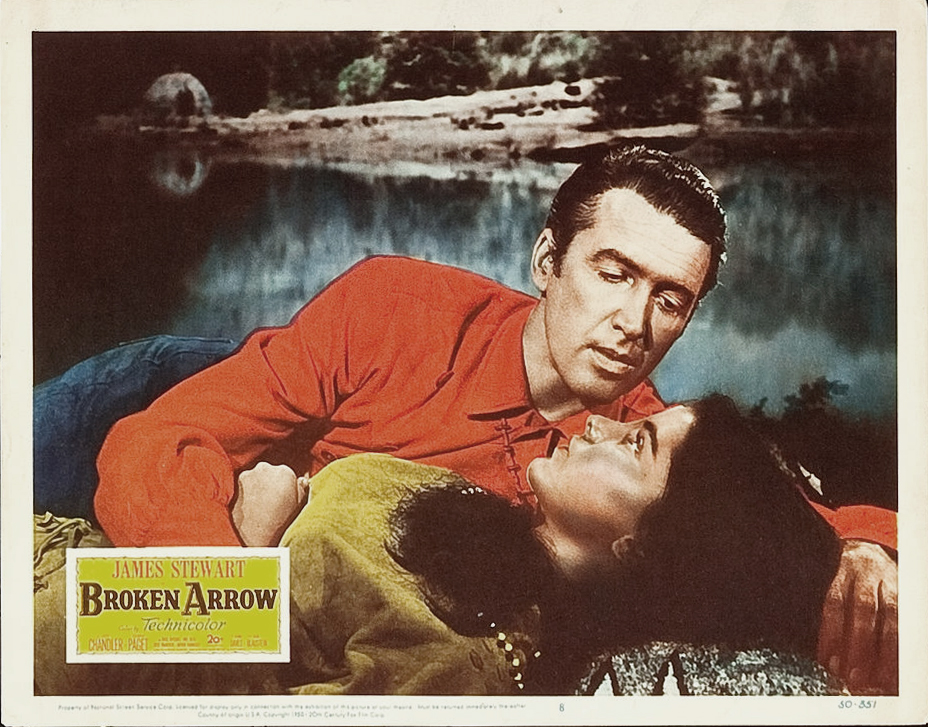
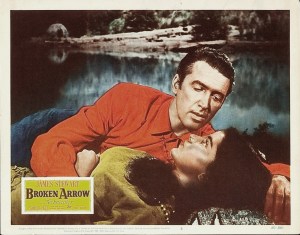
The next book will be about a lot more than James Stewart, but he’s the focal point like Carole Lombard was in Fireball. I’ve been busily watching Stewart pictures of late, most recently Broken Arrow with Jeff Chandler and, as Stewart’s love interest, 16-year-old Debra Paget, nearly unrecognizable sans trademark heavy eye makeup. Yes gang, I said Stewart had a 16-year-old love interest to his 41! Today, they call that statutory rape, and even in the context of a picture made in 1950, I grew a little fidgety looking at their clinches.
Fireball: Carole Lombard and the Mystery of Flight 3 by Robert Matzen

James Stewart with Debra Paget.

I’m blazing a trail of pictures I never gave a hoot about. Another one I caught recently was The Naked Spur co-starring Janet Leigh and Robert Ryan and before that Strategic Air Command with June Allyson. I could always take or leave James Stewart as an actor, which, really, makes me a match as a biographer because I’m starting out neutral. No image to protect. No axe to grind. Oh, sure, he’s perfect in It’s a Wonderful Life and I really liked Harvey—although I never bought him as an alcoholic in that picture. His ingenuousness and his playing against cynical Henry Fonda worked beautifully in The Cheyenne Social Club. His body of work is simply outstanding and the more you think about the variety of his pictures, the more impressive Stewart becomes. He was much more the chameleon as an actor than he appears at first blush. Like when he played a clown in the circus and on the lamb from the cops who stayed in makeup throughout the film. This wasn’t John Wayne or Errol Flynn playing 17 variations of his public persona; Stewart could be a man with a past, a killer, a voyeur, or an obsessive-compulsive. Throughout the 1950s you never knew which James Stewart you’d meet in the dark.
Fireball: Carole Lombard and the Mystery of Flight 3 by Robert Matzen

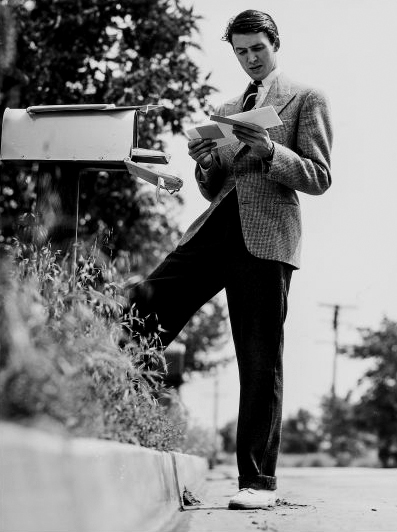
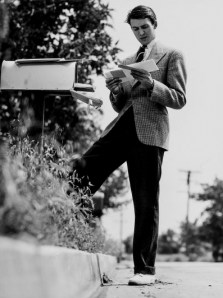
James Stewart picks up his mail at a rented Brentwood home in 1936, soon after arriving in Hollywood.

What the hell made this guy tick? He played the accordion and built model airplanes as a pastime during years most young men his age spent getting laid, or trying to. He enlisted in the Army Air Corps nine months prior to Pearl Harbor at a time when a majority of Americans were staunch isolationists trying to look the other way from an inevitable war. Instead of cashing in on celebrity and spending the war in his crisp uniform stateside, getting laid some more, he itched for combat and finally got an overseas assignment that landed him smack in the middle of hell. He sounds too good to be true, and maybe he was.

I’ve already got some great clues about the real James Stewart and how he got that way. For the record, I’m determined to confine my book to a particular theme and not encroach into the territory of a writer also developing an aspect of Stewart. I don’t feel that my book on Stewart will be competing with anybody else’s because I think one will complement the other and demand for both will be heightened.

I encourage all of you to help me write this book. What do you know about Stewart that can help me grasp his character in the way I ultimately understood others I’ve chronicled? Your opinions, insights, and clues are welcome as we embark on this grand new adventure into the past.