Mission: Jimmy Stewart and the Fight for Europe by Robert Matzen

Grandest of All

“Man is destroying the forests, poisoning the oceans, poisoning the very air we breathe. The oceans, the forests, the races of animals, [and] mankind are the roots of heaven. Poison heaven at its roots, and the tree will wither and die. The stars will go out, and heaven will be destroyed.

These words weren’t written yesterday or a year ago. They were uttered in 1958 by a character in a film based on the novel The Roots of Heaven written in 1956 by French author Romain Gary about a character named Morel who Robin Hood-like goes on a crusade with a band of not-so-merry men to stop the killing of elephants in Africa.

Moviemakers John Huston and Darryl Zanuck both fell in love with the novel and Huston bought the film rights only to be trumped by Zanuck, who at the time held Huston’s contract and so they became a production team to bring the story to the big screen.

I’m not going to sit here and tell you very much about the movie The Roots of Heaven except to say it’s a Cinemascope gem that’s turned up in 2012 on Blu-ray, according to Greenbriar’s John McElwee, although my viewing was on the Fox Movie Channel. The picture was critically panned on release, lost a fortune, and was looked upon with disdain by Huston, who directed it. “Even as I made the picture I knew it wasn’t going to be any good,” said Huston. “You kid yourself, try to buoy yourself up, but eventually you just have to face it.”

Mission: Jimmy Stewart and the Fight for Europe by Robert Matzen

The band of elephant protectors on location in Africa, including, L to R, Peer Qvist (Friedrich von Ledebur), Morel (Leslie Howard), the Baron (Olivier Hussenot), Forsythe (Errol Flynn), and Minna (Juliette Greco).

The book and film are both populated with people scarred by World War II: Morel, the former German prison camp inmate who goes mad and sees visions of elephants; Minna, the French girl forced into prostitution in a German “doll house” and then “liberated” (her term for repeatedly raped) by Russians, Brits, Americans, and Frenchmen; Forsythe, the British officer-turned-traitor for the Nazis to save his own hide; Waitari, the African nationalist out to exploit Morel; Abe Fields, the ingenuous American photojournalist who had stormed the beaches of Anzio and Normandy and now braves gun battles to follow Morel’s exploits; Peer Qvist, the aged naturalist who utters the statement heading this column (beautifully done by Austrian actor Friedrich von Ledebur); and many others.

Trevor Howard as Morel is an odd choice but the casting against type works and he’s very good. It was to be William Holden’s role, but Paramount wouldn’t let him do it. Errol Flynn agreed to let John Huston direct him and when Flynn arrived on the set, according to Huston, “It was the first meeting since that bloody night long ago at Selznick’s house.” [For more on this 1945 encounter, see my three-part series of earlier columns.]

Mission: Jimmy Stewart and the Fight for Europe by Robert Matzen

Juliette Greco. Be still, my heart.

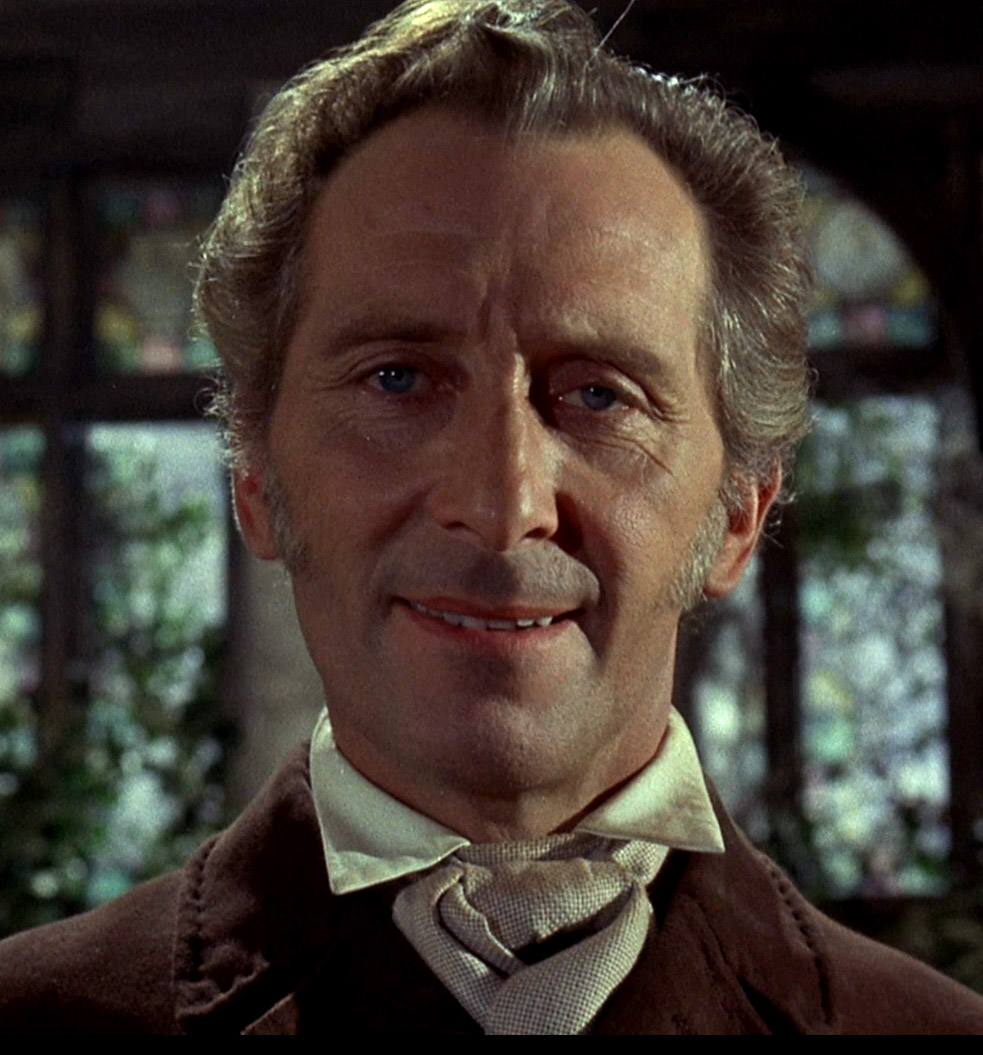
Flynn is his late-career drunken self in The Roots of Heaven but looks at some points sharp as a tack as an actor (for him) and dies a heroic death in a running gun battle with elephant hunters. Eddie Albert plays the hell out of the photojournalist, and Herbert Lom is a standard stereotypical bad guy. Paul Lukas is Saint-Denis, who is a major character in the book and much less so in the movie, but Lukas is always so smooth and world weary that he wins you over. Orson Welles shows up to play Orson Welles playing an American TV journalist with a nasal Amurrican accent. French nightclub singer Juliette Greco does in The Roots of Heaven what she always does to me—she makes me think impure boy-thoughts. She made Zanuck think them too; he insisted on having an affair with her, and since he had the power to give her top billing in this and other big Fox pictures, she didn’t say no. Huston said in his memoirs that Juliette treated DZ badly, though, and made fun of him behind his back.

The five-month African location shoot has become the stuff of legend. Cast and crew called off a record 960 days with heatstroke, malaria, dehydration, animal bites, and everything else you can imagine. Huston made it through and so did Flynn, who kept up his strict hydration regimen of a bottle of vodka a day, but they were the only two to remain upright despite days that reached 130 degrees and nights that settled in at a mere 100.

I don’t mean to bury the lead here; the headline for me is elephants. As Trevor Howard’s Morel says with such sweet sadness at one point of the hunters rampant in Africa killing his elephants, “They aim at the soft spot between the eye and the ear, just because they’re big, free, and beautiful.” Morel fought for the elephants back then, and I weep for the elephants now because they are so grand, so intelligent, and the jeopardy they faced in 1956 when Gary wrote his novel was nothing compared to their near-extinction today. Huston’s The Roots of Heaven features great thundering Cinemascope herds of majestic elephants in their native habitat, crushing everything in their path. Huston called Gary’s The Roots of Heaven “a prophetic book, anticipating the concerns of today’s environmentalists.” Which is what brought me to my recent viewing–the Greenpeace nature of Morel’s mission and the correctness of a cause that rings true today louder and clearer than ever. Full disclosure: I have never cared for hunters and hunting. It was never “sport” and only could be “sport” if the prey were armed and proficient in weaponry to make it a fair fight.
Mission: Jimmy Stewart and the Fight for Europe by Robert Matzen

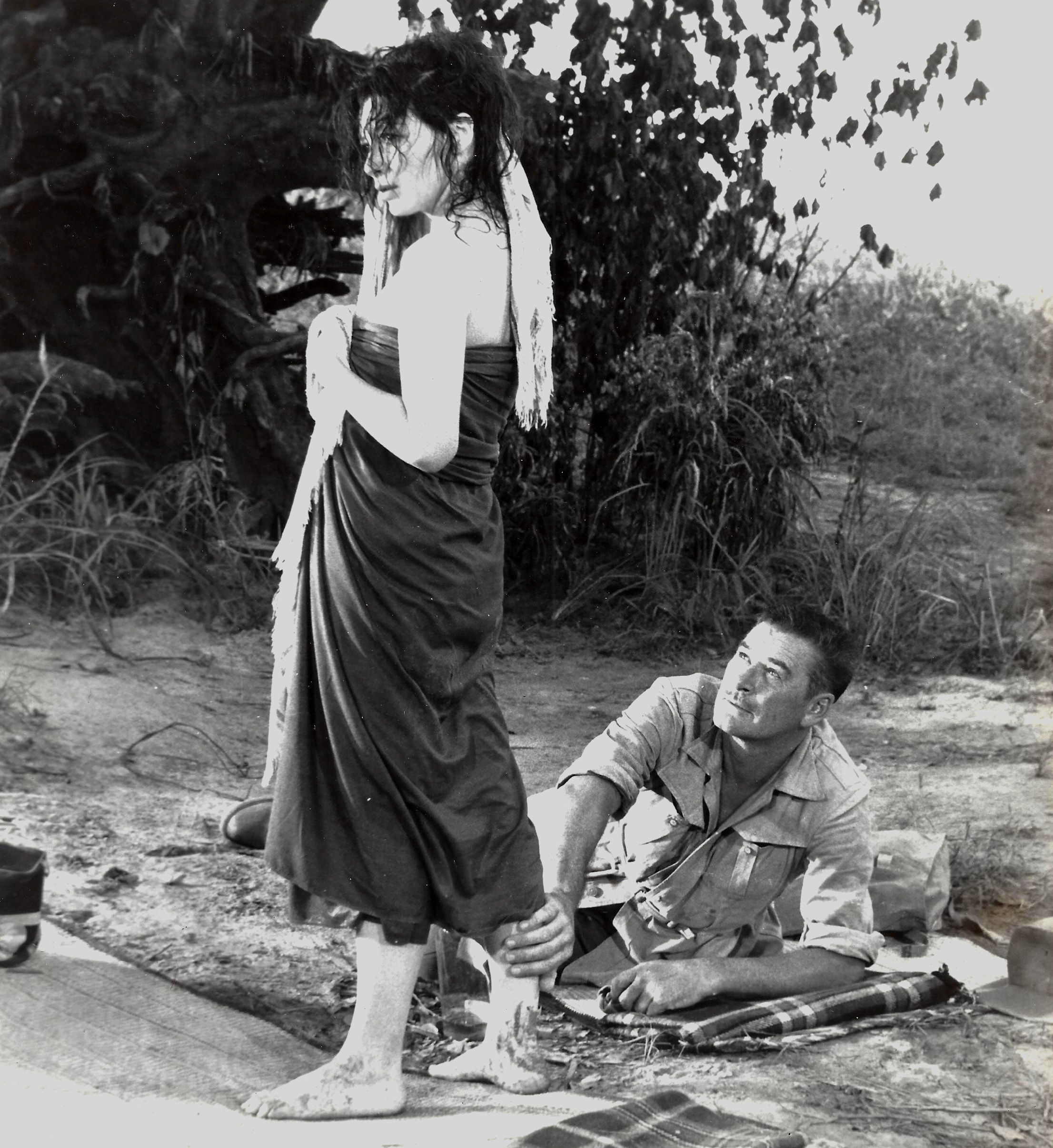
Greco as Minna emerges from the river after a bath. Flynn as Forsythe touches her ankle, as in, “Let’s do it.” She doesn’t even consider the idea, which is richly ironic since Errol Flynn was probably the most prolific lover of the 20th century (if combining on- and off-screen exploits). He was now, officially, a character actor.

Hearing Morel’s impassioned speeches for the elephants made me look up the African Wildlife Foundation, with its mission to save our grandest creatures. I have just today set up a monthly donation to help with their work—the AWF is accredited by the Better Business Bureau and states that 88 percent of donation amounts go to programs and only 3 percent to administration. Romain Gary through a 61-year-old novel and Trevor Howard through an authentic and heartfelt performance inspired me to help the noble elephant; now maybe I can inspire you to take the same small step in helping these innocent creatures that yet manage to inhabit our planet gone mad.

Mission: Jimmy Stewart and the Fight for Europe by Robert Matzen

Well worth saving.

Home Sweet Home

I finally found a place where I fit in, and it’s France, because like me, the French are impatient and unfriendly-going-on-surly. I can’t overstate this enough: I’m not a fuzzy, cuddly person, so it was this introvert’s dream come true to go to Paris and be surrounded by millions of people who didn’t ask, “How was your day?” or care how my day was or come anywhere near making eye contact. Vive la France!!

My affinity for all things French began with my love of the works of Dumas and grew over the decades as I also became interested in World War II. Somehow, however, the movie Is Paris Burning? had eluded me because all along I had the impression it had to do with radicals in the 1960s, which interested me not in the least. But no! It’s about the end of Nazi rule in Paris in 1944 and was made in the mid-’60s as the French answer to Darryl Zanuck’s formula of taking a popular military book and turning it into a blockbuster picture with an all-star cast; Zanuck had just done it with Cornelius Ryan’s The Longest Day and director René Clément would repeat the process with Is Paris Burning? by Larry Collins and Dominique Lapierre (a book I haven’t read but need to).

Mission: Jimmy Stewart and the Fight for Europe by Robert MatzenThe French have this understanding that they’re the coolest people on earth, and this theme permeates Is Paris Burning? In the last days of the occupation of the city, the Germans were besieged by various factions of Resistance fighters who squabbled amongst themselves. Into this scenario backpedaled German Gen. Dietrich von Choltitz, given Paris to administer by Hitler. Their meeting comprises the first sequence in the picture and von Choltitz instantly becomes human and not your typical robotic Nazi when one of the Fuhrer’s aides asks the general if he’s nervous to meet Hitler. “Ja,” says von Choltitz, and that simple line of dialogue as delivered by Gert Frobe (fresh off Goldfinger) sets him up as a sympathetic character for the remainder of the picture. Hitler states that he is placing von Choltitz in charge because he has always been a loyal officer and the order is clear: If it looks like Paris is about to fall, burn it.

Throughout, Paris is treated like a beautiful princess, bound and gagged, held at knifepoint by thugs, and menaced periodically. The audience is held captive alongside her, and we don’t want a pore in her face or a hair on her head to be so much as touched.

Mission: Jimmy Stewart and the Fight for Europe by Robert Matzen

Two of the cool kids, Marie Versini and Jean-Paul Belmondo of the Free French who are out to save the beautiful princess.

A parade of famous French movie stars marches through the picture: Charles Boyer, Leslie Caron, Alain Delon, Jean-Paul Belmondo, Simone Signoret, Yves Montand, Jean-Pierre Cassel, and so on. As with any all-star epic, some vignettes work and others fall flat. Frobe lugs the entire German P.O.V. on his burly shoulders for hours of run time and is more than capable of handling the assignment. We also see a fair number of American stars sprinkled in like salt and pepper to suit the tastes of U.S. audiences. First of these and a shock to see was my old friend Robert Stack. I wish I had had the foresight to ask him back in the day about Is Paris Burning? but I was woefully ignorant when I knew him. Most of the American actors in the cast play generals. Stack is General Sibert; Glenn Ford is a generic Omar Bradley; Kirk Douglas takes on Patton in name only and for a reported one-day’s work on camera. The French have this way of subtly or not-so-subtly portraying Americans as clods—even the good guys edging closer to break the German Occupation. In Paris today we Americans can be spotted at once, and we’re merely tolerated because we have money and don’t tend to carry bombs, but we’re notoriously gauche and anything we touch needs to be disinfected. That same view seeps down into the cans of film onto which Is Paris Burning? has been imprinted. I say this with great affection because the French are discerning and know gauche when they experience it, and when I interact with them I realize it’s up to me to deal with my lower status because all they want is my money and not my friendship.

The version of Is Paris Burning? I watched the other night On Demand ran about 3:20 but it went by fast and I’m reading that the original clocked in at more than four hours and a number of bits have been cut over the years, including E.G. Marshall as an American G-2 officer. I wonder if he was portrayed as just another American simpleton, rattling sabers and over-rounding the R’s in the dialogue.


Mission: Jimmy Stewart and the Fight for Europe by Robert Matzen

I imagine Leslie Caron is thinking, Orson, you look terrible.

Orson Welles shows up playing Orson Welles playing a Swedish diplomat and looking, as usual, terrible. How do you become that just a quarter century after serving as Hollywood’s latest “boy genius?” Anyway, he spends a fair amount of the picture serving as the German commandant’s conscience; in real life Nordling the diplomat may or may not have influenced von Choltitz, who ruled Paris for all of two weeks, to spare the city and not carry out Hitler’s orders.

Mission: Jimmy Stewart and the Fight for Europe by Robert Matzen

Wretched advertising poster for Is Paris Burning? I’d have taken a match to this campaign that left would-be audiences wondering what the hell this picture was about.

Director Clément supposedly was intimidated by making this picture and I can see why, starting with knowing he had a country full of critics awaiting–not just any critics but French critics–and with having at his disposal the entire city of Paris as a stage. When you see a line of German tanks in front of Notre Dame, you are looking at a line of German tanks in front of Notre Dame. The entire city center is on display with most of the action taking place on or around the Ile de France. For scenery alone this picture is magnificent, and Maurice Jarre used these stunning visuals as inspiration for a musical score that infuses scenes with romance and majesty as various French units—republican, communist, etc.—find ways to work together, contact the Allies, and systematically take back their city. Check out various clips on Youtube to get a sense of what I’m talking about, like this one where two Resistance leaders (Belmondo and French actress Marie Versini) brave snipers to get to the Hotel Matignon held by Vichy-French soldiers, walk in, and calmly take over. It’s French enough to make me cry, and do yourself a favor and watch the entire six-minute clip because after these two civilians review a line of French troops suddenly under their command (accompanied by Jarre’s scoring), just, WOW! Belmondo surveys the opulent 18th century Matignon—shot on location—and sums it up with a blasé, “Adequate.”

The downsides are there in plain sight. The title Is Paris Burning? is pretty awful as titles go and the 1966 publicity campaign reeked. It’s a black-and-white film, which of course disqualifies it for a portion of modern cinema goers. There’s no CG and nobody jumps out of a plane at 15,000 feet without a parachute and lives to tell the tale. Nor are there any zombies. Dubbing is an issue; dubbing has marred many an international picture. Here the actors spoke their native languages—French, German, English—and then were looped over depending on country of release. The result, nicht sehr gut, and I would have preferred subtitles. I’m blaming the dubbing for shortcomings in narrative flow because Gore Vidal and Francis Ford Coppola wrote the screenplay, and with that comes pedigree. All in all, even though I’m German, feel free to give me an armband and sign me up for the French Resistance.

A Jagged Edge

Mission: Jimmy Stewart and the Fight for Europe by Robert Matzen

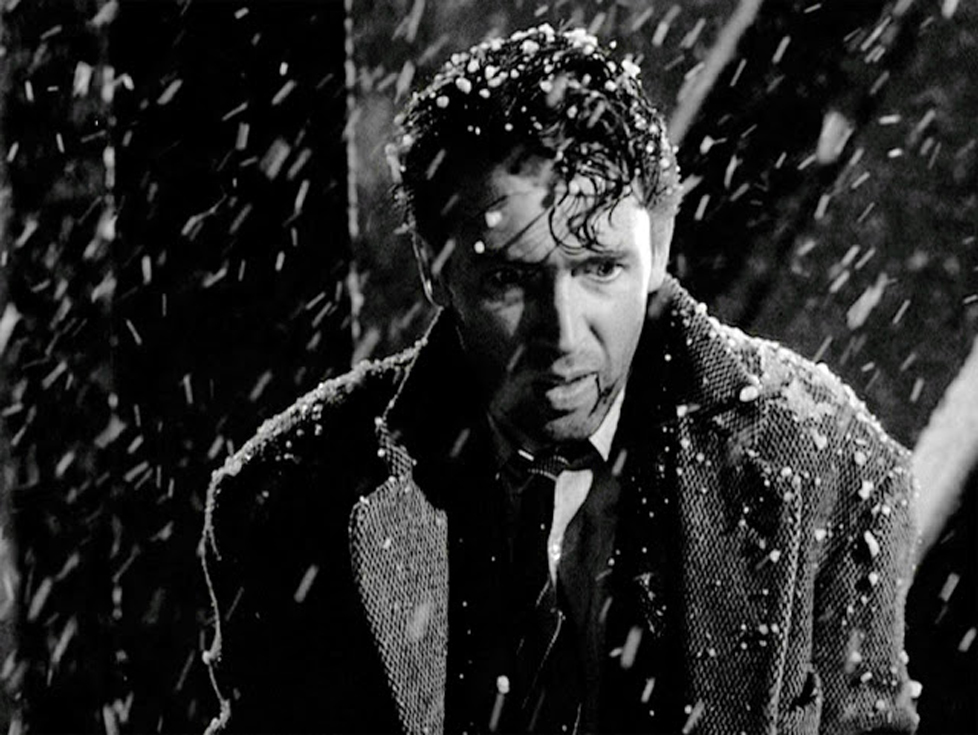
Jim Stewart as George Bailey Standing on the edge of suicide in It’s a Wonderful Life.

I’ve heard more than once on the book tour that some people are uncomfortable with It’s a Wonderful Life as a motion picture. A couple weeks ago I watched it on the big screen and sat there with this specific point of view in mind. I have to say, I understand where these people are coming from. This is a dark tale, so dark and so unusual that it’s no wonder Jim Stewart balked initially when Capra pitched it to him in autumn 1945.

A man driven to suicide? No, no, no, Jim countered, if I can find work–if any studio will have me-I just want to make a comedy.

An angel needs to earn his wings? What? Forget it, Frank, I’m out.

When you’re sitting in a balcony looking at a silver screen 30 feet high, the view is much clearer than your television system at home, even if you’ve got a 65-inch setup. As viewed this picture the way God intended, in a theatrical setting, It’s a Wonderful Life unspooled as a long picture, and grim, with a carefully crafted screenplay that drives our hero to despair in a relentless effort. Take for example the “Buffalo Gal” sequence after the dance and the terrific exchange between Stewart and Donna Reed walking along the street. It’s a dynamic sequence that builds and builds and suddenly she’s (presumably) naked in the hydrangea bush. Jim says what the audience is thinking, “This is a very interesting situation!”

Boom! The air is let out of characters and audience alike by news that George’s father has suffered a stroke. I don’t think it’s just me who reacts badly to this. We are meant as an audience to be uncomfortable with this moment because the theme of the picture is oppression, gloom, and the erosion of a person’s will by the tide of life. If not for the relentlessness of the setup, the payoff wouldn’t offer such release from the emotional bondage Capra has spent two hours creating.

Mission: Jimmy Stewart and the Fight for Europe by Robert Matzen

George at the end of his rope, praying for guidance. Jim only had one take in him, and told Capra he had nailed it and couldn’t do another.

With my newfound perspective on Jim Stewart the man and actor, knowing more than anyone in the world other than Jim himself what he had gone through in the war, I watched him onscreen as, frame by frame, It’s a Wonderful Life unspooled in the dark. In his first scene buying the suitcase he’s playing 22 when in the real world he’s 38 going on 50. He’s got a hairpiece in front, hair coloring left and right on his gray, heavy makeup, and careful lighting to help him carry an impression of youth. He bubbles over with energy in that first scene. He’s a thoroughbred just out of the gate at Churchill Downs in this moment, a stallion away for five years and now once again feeling the bit between his teeth. And man does he run. What comes across is youthful enthusiasm but make no mistake, this is a man who appreciates the opportunity he’s been given, a man who is going to work this day and not getting shot at by a deadly foe.

There is brutal hate in George Bailey, and Stewart—a desperate man at this point in his life—finds that vibe easily, as when he goes to Mary’s house and berates her for showing romantic interest in him and accuses her of trying to tie him down. What did Mary ever do but love this man, and he all but wipes his shoes on her. Jim Stewart’s George Bailey is a guy with an edge, wild-eyed in some scenes, rage-filled in others, as when he wrecks his living room and terrorizes his wife and children who see not husband and father but a monster unmasked. The America of 1946 was filled with monsters, men back from the hell of World War II and now strangers in their own homes, in some cases ticking time bombs, full of self-loathing at what they had seen and done and unleashing fury on family members, just like George did with Mary and the kids.

Indeed, the picture is populated by people riding the line of good and evil, like Nick the bartender, good in the Bailey world, evil without Bailey’s influence. Or George’s mother, a bitter soul without George around. And Gower the druggist, who so easily beats youngster George to a pulp and bloodies his ear. Capra paints this corner of America as a brutal place but for the intervention of someone extraordinary like George, a man of principle who influences impressionable, self-involved masses.

Mission: Jimmy Stewart and the Fight for Europe by Robert Matzen

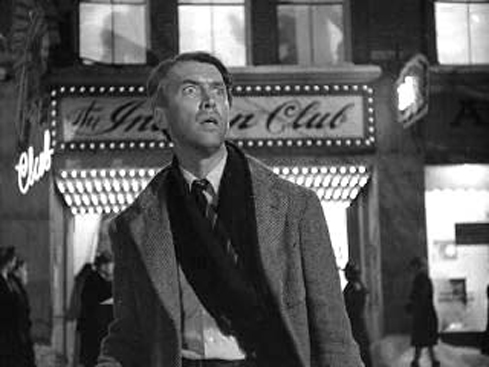
Jim wild-eyed and letting the world see something from deep inside.

There is a myth that It’s a Wonderful Life bombed at the box office on release 70 years ago this month at Christmas 1946, but that’s not accurate. This was a prestige picture and it performed like one and nearly made back its cost, but that cost had been extravagant, from construction of the main streets of Bedford Falls at the RKO Ranch in Encino to the snowstorm created in 90-degree Mojave Desert to all those expensive bridge and river shots that took weeks to complete on RKO soundstages.

What isn’t myth is that this was a picture ahead of its time, too long and dark for war-weary audiences to process in 1946. In another 10 years television would intervene and peacetime Eisenhower-era viewers would drink up and savor It’s a Wonderful Life for its themes of principles, friendship, the value of human lives lived well.

When you finish reading Mission you will understand what Stewart brought to this production and what it meant to him. You will sit there in the dark not just with Jim but with fine young army fliers like Albert Poor and Earle Metcalf who died under Jim’s command but lived on through all their skipper’s accomplishments. Jim carried with him all those boys he had lost, which is one of the reasons he wouldn’t talk about the war—it hurt too much. He didn’t talk about it but he remembered those men and their times each and every day on a journey into the second half of his career that began with It’s a Wonderful Life.

Mission: Jimmy Stewart and the Fight for Europe by Robert Matzen

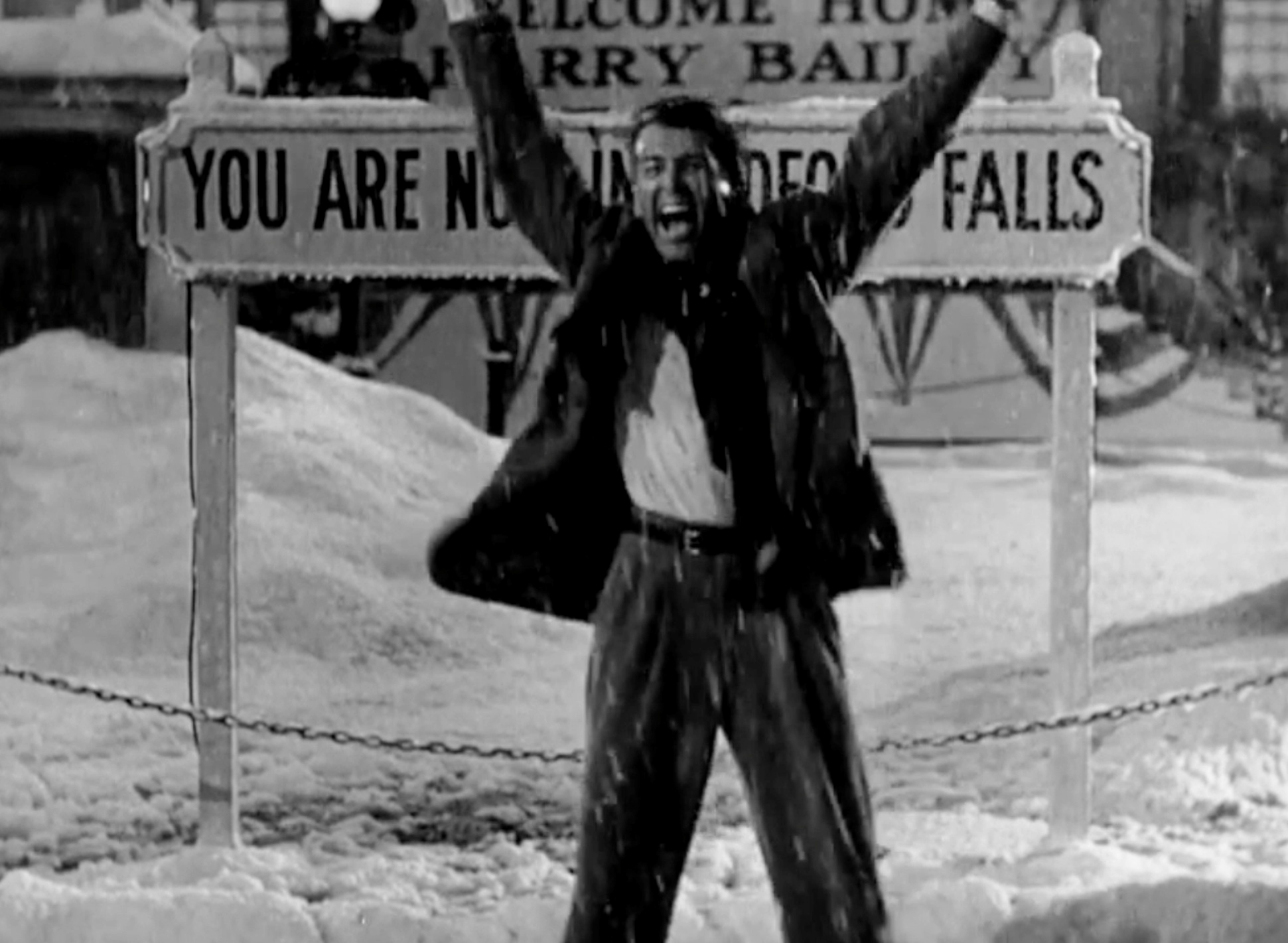
Heartfelt salutations from both Jim and George in the last reel of It’s a Wonderful Life.

Long Live the King

Sometimes there’s nothing you can do but laugh. In the past two months I’ve been interviewed dozens of times about the themes of Mission: Jimmy Stewart and the Fight for Europe, my GoodKnight Books release. It’s a story with so many angles that the media practically has a smorgasbord. But my experience of a couple days ago was one I didn’t see coming and an angle I wasn’t comfortable talking about at all.

A certain talk show host at a radio station in a major Midwestern city asked me for a 7- to 10-minute interview. It was on the schedule for 10 days. Sometimes the station calls me and sometimes I call the station. Usually, I speak first with a producer during a commercial break who patches me in so I hear the intro, and then go live. Well, this time it was me doing the calling, and there wasn’t any conversation with a producer. I automatically went into a queue where I heard the commercial break and then the talk show host, a woman, started her segment with a folksy chat about the holidays, and I thought she was segueing nicely into a mention of It’s a Wonderful Life and then here I’d come after she completed a standard welcome of Jimmy Stewart biographer Robert Matzen.

She was going on about the baking of holiday cookies, and I wondered how she was going to bring it back to Mission, but OK I’m sitting there listening waiting for the plane to circle around to my direction. Then she started talking about the “Cookie King,” Robert Merten who has written a book about holiday cookies and in a split second I realized: Wait a minute. Robert Matzen, Robert Merten. World War II book, cookie book.

Mission: Jimmy Stewart and the Fight for Europe by Robert Matzen

A book not about cookies.

It’s a horrible thing when you realize, This plane isn’t landing. This plane is about to crash. She launched into an adoring, full-fledged introduction to Cookie King Robert Merten and the deeper she got into it, and the closer I got to going live, the faster my brain operated as I tried to think of what to do. I imagined the conversation that was about to take place, the one where I hesitated and stumbled my way through an explanation of how, yeah, I like cookies just fine but I’m not the king of them and in fact my blood isn’t blue but rather, it’s as red as the next guy’s, and I’ve written this book called Mission about death in the heavens over Germany. It would be a conversation blinded on both sides by egg on faces, and there would be earwitnesses all over a major Midwestern city.

The flop-sweat started to flow as she brought the intro into what she imagined was a smooth landing with a warm, “Joining me today in a rare radio appearance is the Cookie King himself, Robert Mert—

*CLICK*

Yes, people, I strapped on my ’chute and jumped before the plane crashed in flames. I left the host to die in the cockpit and I besmirched Robert Merten’s reputation but at that moment the Cookie King was on his own and I was out of the doomed ship in one piece. I lived to fight another day.

The post-mortem with Sarah my top-notch publicist left us both baffled (and her furious on my behalf), and I don’t feel too bad because somebody at that station wasn’t paying very close attention: How do you confuse an author who’s written a book about cookies with an author who’s written a book about World War II? I mean, I can sort of imagine how this crash happened, but only sort of, and the startling lack of preparation on their end mitigates any guilt I felt about bailing out with bare seconds until impact.

For the record, the Cookie King’s book is entitled, logically enough, The Cookie King, and sports a royal crest on its cover. The subtitle is, “Delicious, sweet and savory cookies from a lifetime journey of cookie baking” and my sweet tooth thinks it must be a steal at $34.95.

So there you have it, just another day in the life of an author who is soldiering on in a major publicity campaign. And Robert Merten, the next time you realize that somebody has booked you to talk about Jimmy Stewart as a combat pilot in World War II, please bail at the last moment and leave the host to crash in flames. At that point we’ll be even.

The Mission

I stood in high Pennsylvania winds last Sunday morning on what is ground zero to the core story of Mission: Jimmy Stewart and the Fight for Europe. At my back was Gettysburg’s infamous Wheatfield, scene of some of the bloodiest fighting of the second day’s battle. A half mile at my front rose Little Round Top. And staring me in the face was a granite monument to the 11th Pennsylvania Reserves, the regiment commanded by Col. Samuel M. Jackson. In murderous fighting on July 2, 1863, the 11th Pennsylvania—part of Fisher’s Brigade of the Fifth Corps—was part of a charge down the slope of Little Round Top that checked Longstreet’s ambitious maneuver to hit the federal left flank. Afterward, a Union commanding general rode up to Jackson hat in hand and exclaimed, “Colonel Jackson, you have saved the day. Your regiment is worth its weight in gold; its weight in gold, sir!”

Thanks to men like Col. Sam Jackson, the Union was preserved.

Mission: Jimmy Stewart and the Fight for Europe by Robert Matzen

The monument of the 11th Pennsylvania Reserves, with Little Round Top in the background. This ground was carpeted with the dead and dying on July 2, 1863, but Sam Jackson remained upright. It was here that union Brig. Gen. Samuel Crawford praised Jackson for saving the day.

Why is this ground zero to Mission? Sam Jackson was Jimmy Stewart’s grandfather, his mother’s father. Jackson’s regiment had been positioned at the foot of Little Round Top and received orders to hold against the Confederate advance at all cost. This his regiment did, and advanced probably no more than 1,500 yards that day, but hard-fought and bloody real estate it was. Standing amidst the monuments to so many regiments intermingled there and representing both Union and Confederate units, this hallowed acreage, I was hit by what Jackson had done, and how much it influenced James Maitland Stewart, the laid-back star of stage and screen.

Except Stewart wasn’t laid back at all. Stewart was high-strung and possessed a compulsion to serve—his Mission of the book title—that was born of his two grandfathers, Sam Jackson and James Maitland Stewart, Jim’s father’s father and a sergeant in the Army Signal Corps. Sergeant Stewart had fought his way through many Civil War battles, the last being Appomattox, where he then witnessed the surrender of Lee to Grant that ended the war. The estimable Jackson had died just before Jim was born in 1908, but old J.M. lived into the 1930s and Jim learned about service and sacrifice from this man above all others, one who had lived through America’s bloodiest war.

Mission: Jimmy Stewart and the Fight for Europe by Robert Matzen

The Pennsylvania Memorial at Gettysburg, where S.M. Jackson gets top billing.

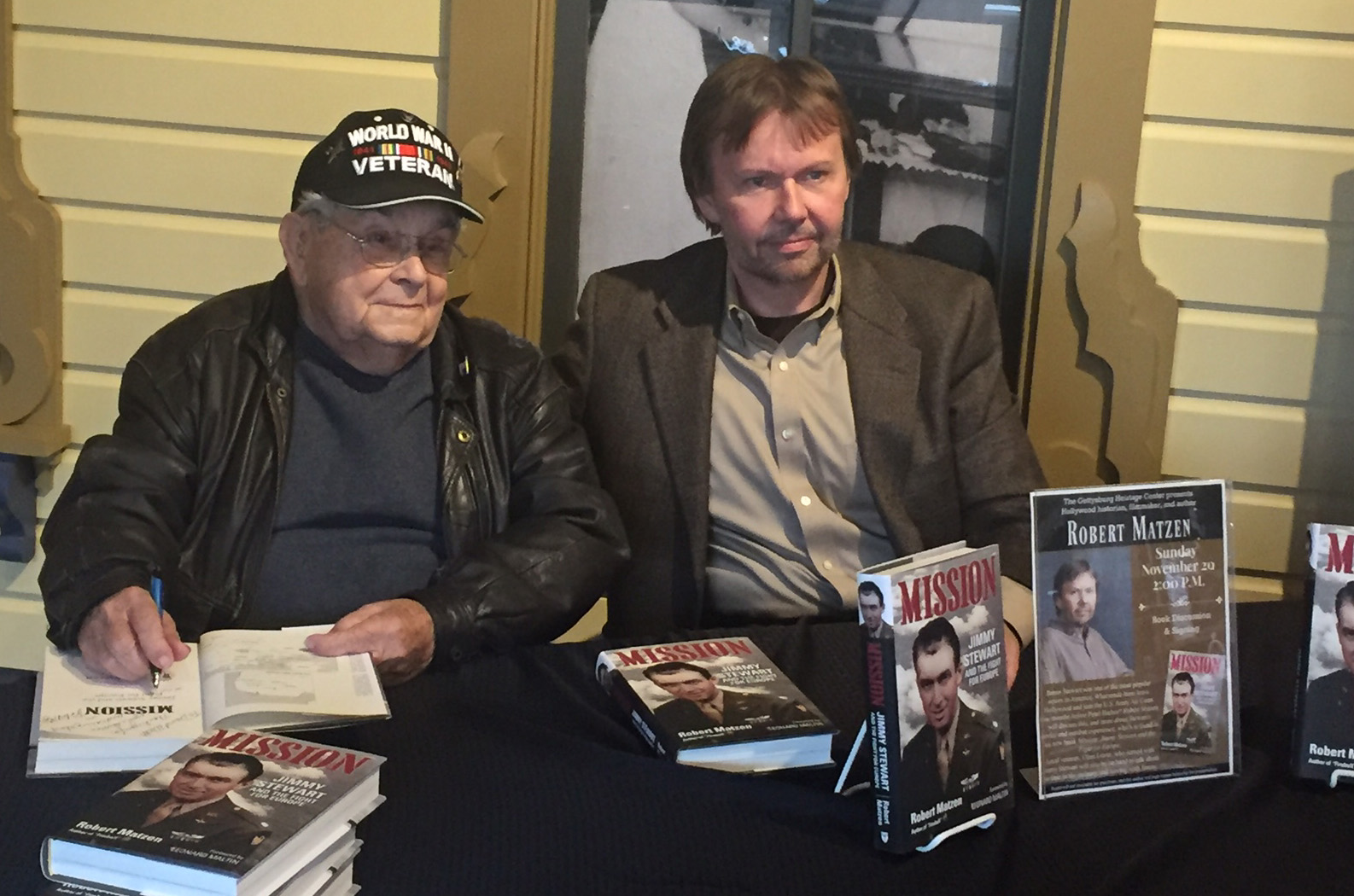
This past Sunday, November 20, I lectured at the Gettysburg Heritage Center, which includes an ambitious multi-media museum designed to entertain and educate even today’s short-attention-span learners. When I described Jackson’s advance and his connection to Jim to a packed Heritage Center house, there was a collective gasp. People just don’t realize what a giant shadow Jim’s grandfathers cast on his life. In effect, Jim was poured into a military mold and had no choice but to end up a soldier. It’s the reason he gleefully reported for induction after being drafted nine months before Pearl Harbor. With this action he turned his back on Hollywood luxury, a thriving avocation as a sexual athlete, and an Academy Award career with a giant, goofy grin and pulled an army private’s uniform onto his six-foot-four, 139-pound frame. After he was fingerprinted and sworn in before a throng of reporters and cameraman, Jim refused to talk to or work with the press for the next five years so he could concentrate on being the best soldier he could be. It’s unprecedented what he did and the way he did it.

Speaking of soldiers, I shared the microphone last Sunday with Clem Leone, 92-year-old veteran of the air war over Europe. Clem knew and flew with Stewart as described in Mission, and was shot down over Gotha, Germany, on February 24, 1944. I’ve never experienced anything quite like this stretch of two hours, sharing the stage and then sitting and signing books with my own hero who had lived history. It’s one of many things I’m thankful for this Thanksgiving 2016.

Mission: Jimmy Stewart and the Fight for Europe by Robert Matzen

With Clem Leone at the Gettysburg Heritage Center event. Amidst an outpouring of love for Clem, who is a local celebrity, 97 books sold in 90 minutes.

The Time I Was a Legend

In the ninth grade I cut my fingertip off in shop class. It’s the ring finger of my left hand, and I was planing a piece of wood on a machine called a joiner and the plastic guard was off it for some reason and I was holding the wood carelessly. Mr. Russell the shop teacher watched my fingertip fly up in the air and I’m sure imagined his career flying beside it. Such a sound it made, the blade hitting my flesh, that whenever I hear a similar sound today all these years later a chill runs from the base of my spine down my legs. I just heard a version of that sound out the open window as someone in the neighborhood fed tree branches into a wood chipper.

Blood was everywhere. Mr. Russell kept his cool and wrapped my hand up so the principal could drive me to the doctor’s office. Now, I come from a small town and we had two doctors, both alcoholics. I remember the doctor I went to that day had an old portrait of himself as a navy officer in his office, so he must have been in his 50s, although at the time I thought he was ANCIENT. Or did he just look ancient because of the booze?

Anyway, as the principal parked along the street in front of the doctor’s office I watched my mother run into view and straight inside. She wasn’t exactly a graceful woman and definitely not an athlete but she had still managed to sprint about three-quarters of a mile and beat us there even though the principal was hurrying and only had to drive three blocks. In other words, Mom cared.

When the doctor removed Mr. Russell’s wrapping, my finger was sticking up at a perfect sightline between my eyes and Mom’s, and I watched her face turn chalk white at what a high-speed circular saw can do to human flesh. It looked like ground sirloin, except purple.

My fingertip looked like this, but purple.

My fingertip looked like this, but purple.

The doctor said there was nothing to sew so he didn’t sew it. He wrapped it in gauze and then cotton bandage and sent me home. Even then at—what was I, fourteen?—I thought to myself, shouldn’t you lubricate that, because things are going to congeal and it’ll be difficult to get the bandages off down the road?

I believe seven days ensued. In that time I became a high school legend as the ninth grader who cut off his finger in shop class. My school was a junior high, a decrepit old set of buildings long since torn down, while grades ten to twelve were jailed in a shiny new school out in the country. Aside from being a mediocre baseball player on championship teams, I had never achieved notoriety of any sort until now, unless you count the time I (along with at least 100 others) colored a picture of a clown flawlessly and won two free tickets to the circus, or the time I won a drawing in the fifth grade and got to take home the week-old jack-o-lantern at Halloween.

Now? Now I hit the bigtime as the ninth grader who lost a hand in shop class. None of the upper classes laid eyes on me, but when one loses an arm, you can imagine what the poor bastard must look like in all those bandages lying in a hospital room hooked up to IVs and monitors. That was the progression, as I found out later, with my condition worsening until a week had passed and I was hanging on by a thread in ICU.

The day came for me to go back to the alcoholic ex-navy man for a follow-up, and here I am just a kid kind of shaking my head thinking… Salve? Ointment? Something was supposed to go between my flesh and those bandages.

He started unwrapping and, son of a gun, the bandages were stuck. He said, no problem, let’s soak it. I can still remember the kidney-shaped metal dish that my hand, bandages attached, soaked in. He came back after a while and gave a tug. “YEEEEOWW!” I think I’m quoting myself accurately. I think it was, “YEEEEOWW!”

My doctor sort of looked like this while sober.

My doctor sort of looked like this while sober.

No problem, let’s soak it some more. We repeated the process. Same result. Finally he said, “Here, lie back,” as he must have said to many a wounded navy man back in the South Pacific, and I did as ordered and he said—I kid you not, he said, “This might hurt.”

I reached out with my right hand and found the metal stirrups that are used when ladies are examined. Just as I did, he gave it all he had and yanked the bandage off.

I don’t remember the next moment or two because the lights went out, but for years afterward my big sister Janet would ask me to tell the story of the time the doctor removed the bandages from my finger, and she would laugh and laugh.

What happened was that he knew he was going to have to pull hard, and I guess he was trying to make it go quick for me, but with the bandage when it separated from my hand went all the ground meat, plus what was left of my fingernail, and the cuticle, which was ripped clean up to the first joint. What a scar it made, and for ten, fifteen years the slightest bump would put me through the roof.

I was reminded of this incident while cutting my nails and facing again the result of that morning in shop class. The end of my finger grew back after a fashion, although there’s no fingerprint and the nail, which did grow back against all odds, is about half the size of its right-hand mate. The coolest thing in retrospect is that if you look closely, you can see where the cuticle was ripped in a blazing trail in the direction of his yank. I was actually pretty lucky when you think about the alternative, like my brother-in-law who was a meat cutter in adolescence and apparently not a very accurate one by what’s missing today.

I know what you’re thinking, what a lawsuit this must have made because of the missing guard on the table saw, but that wasn’t the cut of my father’s jib. Dad chalked it up to inherent Matzen clumsiness and we moved on, and the grateful school district rewarded me in the only way it really could, with an A in shop class.

Maltin at the Bat

I grew up with Leonard Maltin. I don’t mean we flipped baseball cards and caught tadpoles; I mean one of my go-to books when I became interested in classic Hollywood as a teenager was the first book he wrote, Movie Comedy Teams detailing the Three Stooges, L&H, the Ritz Brothers, and my faves, the Marxes. I haven’t opened that book in years, but I still remember the narrative and every photo and caption because I read that book over and over and over.

Maltin was a child prodigy in film and began writing for Film Fan Monthly at the age of 13, then took over that periodical (at age 16) and ran it for 9 years. From there he began releasing his movie guides and became an on-air critic for Entertainment Tonight. Is there anyone among my readers who hasn’t owned at least one edition of Leonard Maltin’s Movie Guide and consulted it before watching a picture to see how many stars Leonard gave it and why? In those dark times before the internet, there was nowhere else to find a thumbnail description of even something as obscure as The Secret Mark of D’Artagnan without Maltin and his guide. Today there’s imdb and Wikipedia, but back then, there was Maltin. Period.

Mission: Jimmy Stewart and the Fight for Europe by Robert Matzen, Foreword by Leonard Maltin

Hollywood author and critic Leonard Maltin, now aboard the Mission team. (Photo by Jessie Maltin)

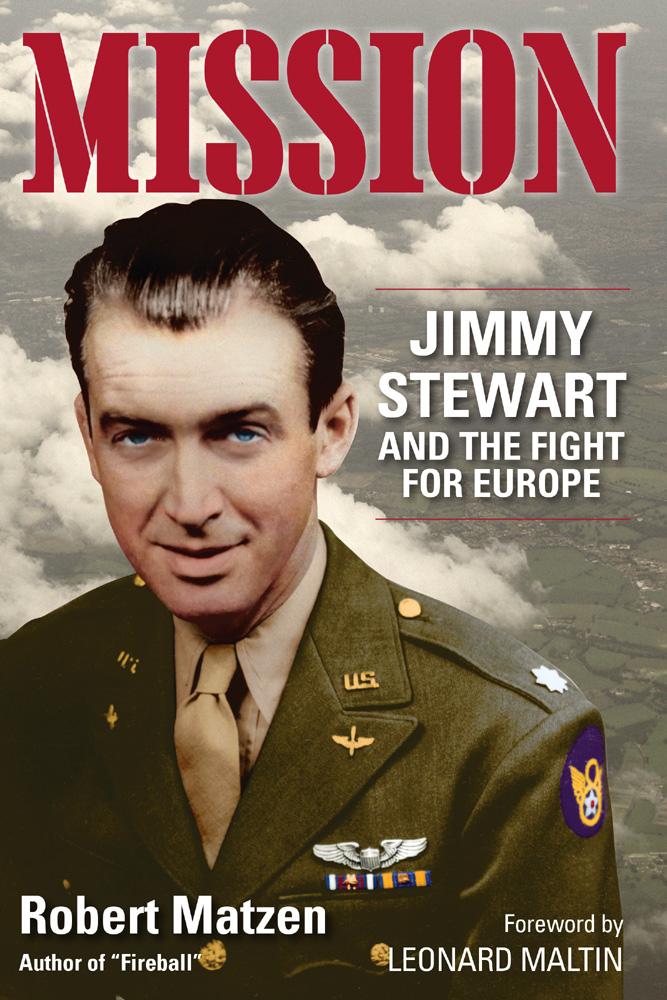
Leonard Maltin is a pop culture phenomenon, a guy who remains after all these years a big kid when it comes to movies, and I’m happy to report this particular phenom is writing the foreword for my just-completed book, Mission: Jimmy Stewart and the Fight for Europe. It occurred to me that I could really use Maltin’s insights into Stewart, the war, and subsequent effects on his career. Leonard said he might be interested in such an assignment, send along the manuscript; so I did. I guess what he read was OK, because he said yes.

I’ve been giving a final look to the narrative the past few days because soon it will go off for galleys and I want it to be right—you know, t’s crossed and i’s dotted and all that. It’s easy to get so lost in the process that I’ll be sitting there and it’ll occur to me, “Wait, did I write that? I don’t remember writing that.” It is becoming a descent into madness among 117,000 words. There are places that make me laugh, give me chills, and reduce me to tears, all of which I consider to be good signs because the same thing happened with Fireball. It’s a different kind of a book, though, a different story and a different protagonist. Lombard was sexy and vivacious, someone you wish you could have known or at least experienced once. Stewart was an aloof man who was there and not there at the same time, an introvert without much to say who kept his significant intensities on the inside, and a guy who, as he aged, hid behind the persona he had created for the Tonight Show and other public outlets. He became what people expected to see, and behind his blue eyes were 50,000 memories of the war that he kept locked away and never related to anyone. The reason Mission is necessary is specifically because he wouldn’t talk, and what I discovered was that in refusing to let Hollywood exploit his wartime service for publicity purposes, he turned out the spotlight on a terrific cast of characters surrounding him in the Second Combat Wing of the Second Bombardment Division of the Eighth Air Force. You’re about to meet some great guys in Mission, guys Stewart knew and commanded, guys who in talking about their lives in combat allow us to know what Jim Stewart did in the war, who he flew with and against, and who died beside him. He wouldn’t tell us, but others tell us. We have these guys and the combat records, and from a great number of sources, including survivors who flew with him, I was able to recreate the war as Stewart knew it. The result is an adventure more fantastic than anything he ever enacted on-screen. In fact, it’s an adventure that could only be recreated today in a CG universe, at which point you wouldn’t believe it really happened. I assure you, it did.

Into this mix of Hollywood and war is about to step Leonard Maltin to provide his thought-provoking perspective, and the coolest thing of all? I get to be the first to read it.

Mission: Jimmy Stewart and the Fight for Europe by Robert Matzen, Foreword by Leonard Maltin

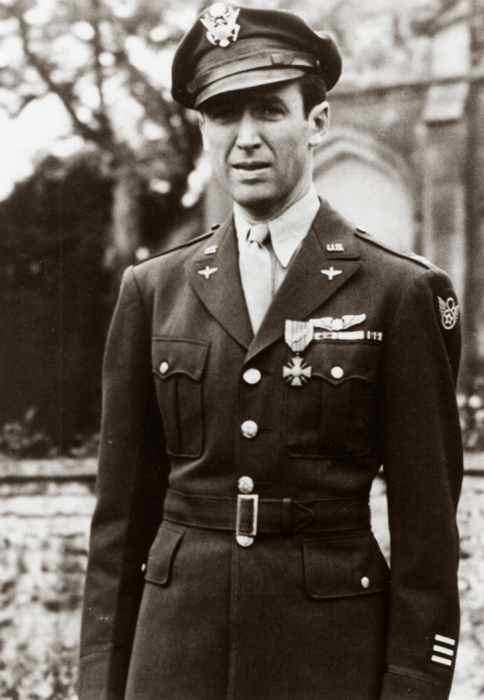
Jim sports the Croix de Guerre, a medal awarded to all Eighth Air Force combat veterans at the end of the war. (Photo courtesy of the Jay Rubin Collection)

Silent Night, Creepy Night

Mission: Jimmy Stewart and the Fight for Europe by Robert Matzen

When The Bishop’s Wife didn’t generate sufficient box office, Goldwyn and RKO altered the title to suggest shenanigans.

There’s a tremendous distinction between Christmas and the day after Christmas. Ever since I was a kid the day after Christmas was cast in black and white; a drab, depressing, downer of a day. I say this because most of you will be reading this after the Big Day and the impact will be lessened, but Christmas morning is the first chance I’ve had to sit down and contribute to my own column of late, so, here we are.

I’ve tried to get in the spirit this year, really I have, but it’s been no-go. I sampled the usual holiday pictures, those touchstones that help us orient ourselves in time-of-year. I wanted to watch It’s a Wonderful Life the other night on NBC because it’s so key to the plot of my almost-completed book, Mission: Jimmy Stewart and the Fight for Europe, but I walked in after it had begun and endured 5 minutes of commercials, at which point I bailed. I did sit through The Bishop’s Wife last evening, which is a picture I used to love but which, over the years, began to produce creepy feelings in me, and now I watch it the same way I do Silent Night, Evil Night, just to feel my skin crawl.

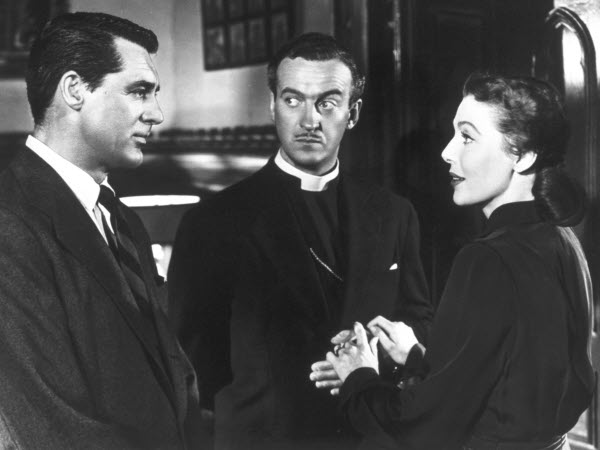
It’s been a while since you’ve been mad at me, so I think it’s time I reveal my feelings for this beloved holiday classic. For those of you who have never seen Samuel Goldwyn’s Christmas story, The Bishop’s Wife, you really owe it to yourself to spend two hours with Cary Grant as an angel sent to earth to guide the bishop, played by David Niven, his wife Loretta Young, and curmudgeon professor Monty Woolley. I now would like to go on record to describe these actors portraying these characters as creepy, creepy, creepy, and creepy.

Mission: Jimmy Stewart and the Fight for Europe by Robert Matzen

The three stars, Cary Grant, David Niven, and Loretta Young.

First the no-brainer. Monty Woolley is supposed to be playing a charming old curmudgeon but somewhere in his backstory I feel like there’s a molestation or two. Everything about him is a little too dark, from his hoarder apartment to his writer’s block to his drinking problem. But then I’m not now and never was a Monty Woolley fan. To give you a comparison, if you were to offer me the choice of an hour with Woolley or with Thomas Mitchell (see previous columns), I’ll take Mitchell every time.

Loretta Young by this point in her career had acquired a hard, stretched, unnatural look that belies her tender age of 34. I never thought about it but she screams plastic surgery in this picture and her very appearance and particularly that hideous hat she dons in reel two and forces us to endure through the end of the picture make this woman utterly unappealing to at least one heterosexual male.

David Niven as a bishop?? Come on, need I say more. Errol Flynn’s drunken pal David Niven, playing 1000-percent against type as a man of God is just too much for me. What denomination are you again, your holiness? And what is it exactly you need help from an angel for, anyway? You are trying to build a church of some sort, and there isn’t enough money…or something? That’s the murkiest part for me, trying to figure out why the angel has come to earth. Because the reverend isn’t paying enough attention to his wife? Because he’s not building his temple? Or is it just because he’s depressed at the holidays? If that’s the case, I’d think there were better candidates for angelic visitation than a guy with a job, a big house, a wife, kid, servants, and dog.

And here’s where I speak genuine heresy. I find Cary Grant as Dudley the angel to be the creepiest thing of all about The Bishop’s Wife. Let’s compare him to Clarence in It’s a Wonderful Life for just a moment. Clarence is an innocent. He’s ingenuous, earnest, and so lovable we want him to earn those wings. Dudley skulks, comes around corners to startle people, has a seductiveness about him that drives the maid wild, and all but seduces the bishop’s wife. I mean, really, when he finally propositions her it’s anti-climactic because of all that’s come before. He’s an angel who seems to me like he’d be much more comfortable in Kevin Smith’s Dogma than he is in a 1947 Goldwyn picture.

Mission: Jimmy Stewart and the Fight for Europe by Robert Matzen

Is it just me or do you prefer your angels just a little less lustful than Cary Grant’s Dudley, who seems to be eyeing up the bishop’s wife like a Thanksgiving turkey.

Now, all this is on the one hand. On the other hand, there are classic moments as well, thanks mostly to the character actors populating The Bishop’s Wife. James Gleason does his usual thing as a cab driver who is unnecessary to the plot, but character actors have to eat like everybody else. Elsa Lanchester is gently wonderful as the maid in love with Dudley. Regis Toomey should have played the bishop because he’s such a good guy by nature and that energy always shows through onscreen. Don’t you want Regis Toomey to overcome whatever obstacle he’s facing in whatever picture? There’s not a creepy bone in Regis Toomey’s body.

Mission: Jimmy Stewart and the Fight for Europe by Robert Matzen

The darkest aspect of all: that hideous hat, which I’ll be seeing in my nightmares.

Then there’s Gladys Cooper, who steals the show as Mrs. Hamilton, the bitchy old rich lady who hamstrings the bishop with demands for recognition in exchange for her money to build whatever church it is the plot centers around. The scene where Dudley unlocks the awful secret tainting Mrs. Hamilton’s heart is beautifully played by Cary Grant and Gladys Cooper, but once again I get a little uneasy because the secret involves a wild love affair between the lady and a composer who died young. She’s still carrying a torch for the guy 45 years later and never loved her rich, dead husband—although she married him anyway and did all right for herself. I’m all for love, don’t get me wrong, and torch-carrying, but there’s something oppressive about this storyline in this instance for some reason I can’t quite put my finger on.

Sex, greed, and death; yes sir, I always want these in my 1940s holiday classics. I find my own favorite Christmas movie, Die Hard, to be much less ambiguous than The Bishop’s Wife, but that’s just me. Isn’t it funny that three of our enduring holiday pictures, It’s a Wonderful Life, Miracle on 34th Street, and The Bishop’s Wife were all made within two years of the end of WWII? And it’s no coincidence that all three have their dark aspects as a result.

There, I’ve had these feelings about The Bishop’s Wife locked up inside for too long and now I feel better for having revealed them, just like Mrs. Hamilton. Now maybe I’ll be nice too. Unlikely, but possible, in which case Dudley will have saved another one. Am I the only one who feels this way about this picture? Are there other holiday classics that everyone around you loves while you just don’t get it?

For those of you who happen to wander in within the next week, Happy Holidays! I have a feeling, a very strong feeling, that 2016 will be an exciting time, and I hope it will be a grand, healthy, successful year for each and every one of you.