FLASH: AMERICA IS AT WAR.

It’s difficult to imagine a moment like that, when those words are heard. Wait, no it isn’t, not if you lived through 9/11 and the chaos, fires, and heartbreak of that day and the days that followed. But December 1941 was a more innocent time. We got our news from daily papers and radio, without benefit of TV or the internet. By 2001 we had been desensitized by all sorts of horrors over the decades brought into our homes mostly courtesy of television, but in the run-up to the holidays 1941, no one could conceive of a sneak attack by another nation on an American naval base where young men and women were stumbling out of their bunks in the utter quiet of a Hawaiian Sunday morning and wiping the sleep out of their eyes, guard down.

Pearl Harbor? Where the heck is that? We have a naval base way out there? There was so much we didn’t know that day and struggled to find out. It all unfolded so painfully slowly. First a bulletin after 2 in the afternoon on the East Coast, and phones ringing off the hook in D.C. Families told families until the news had rippled across the nation. All gathered around living room radio sets and stayed there through the evening to pick up shards of information that came through not in today’s explosion of information and misinformation but as facts crawling in one at a time, in single file.

We know now, from the hindsight of 75 years, what happened 75 years ago this morning. Hours of hell on earth. Bombs, exploding ships, blood in the water, death. We know how and why the Japanese attacked, the damage they inflicted, and the gross miscalculation of picking a fight with a “sleeping giant” and filling it with a “terrible resolve.” But on the evening of December 7, 1941, nobody in the United States enjoyed any sort of historical context. Instead, all wondered what would happen next because the Japanese hadn’t just attacked Pearl; they had swept across the South Pacific in a multi-pronged invasion that most believed would bring landing craft to Washington or Oregon or California. Air raids were feared and blackouts went into effect at once.

As ships burned at Pearl Harbor, America entered a new reality, just as we did on September 11, 2001, when buildings burned. Everyone knew nothing would be the same again and they were right. The world was plunging into a blackness that would claim tens of millions of lives. Parents would no longer sleep at night because they worried their children would be sent off to fight. Austerity became a way of life as everything of value was rationed for the common goal of defending liberty.

I’m not a big fan of war because it so rarely settles anything and only causes other problems. But 75 years ago today the United States entered a just war against terrible foes. After tremendous sacrifice over nearly four years, good defeated evil. I’m pausing this morning to think about the thousands of innocent kids who woke up at peace on the ships of Pearl Harbor on December 7, 1941, and ended the day as battle-tested warriors. And I’m especially remembering the 2,300 who fell in that attack, many of them entombed on the U.S.S. Arizona. Theirs are the first names on the honor rolls of World War II and I say to each one: Thank you. We will never forget.

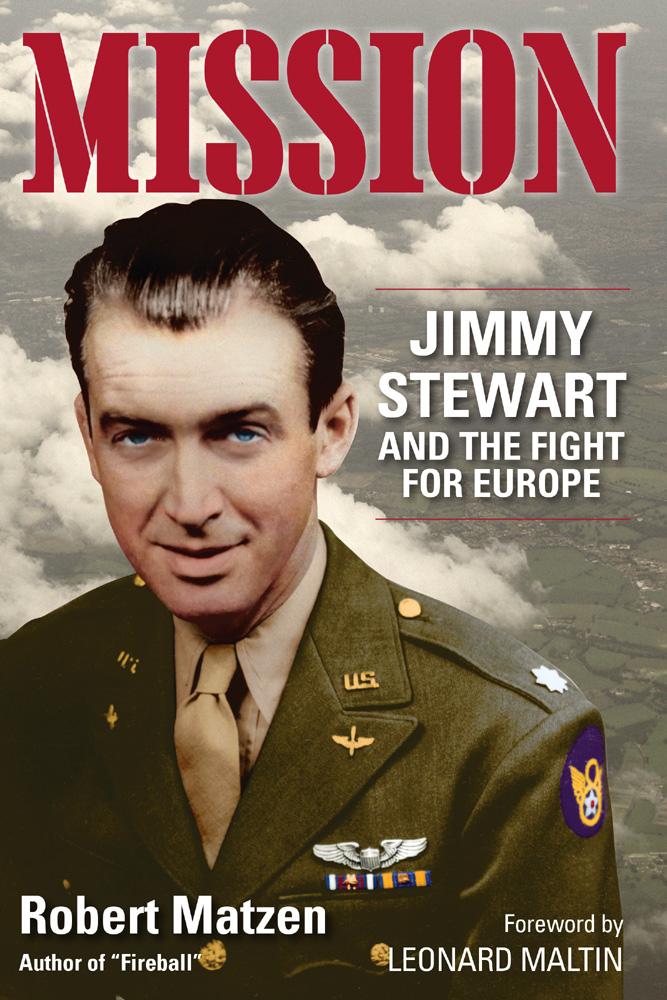
Mission: Jimmy Stewart and the Fight for Europe by Robert Matzen

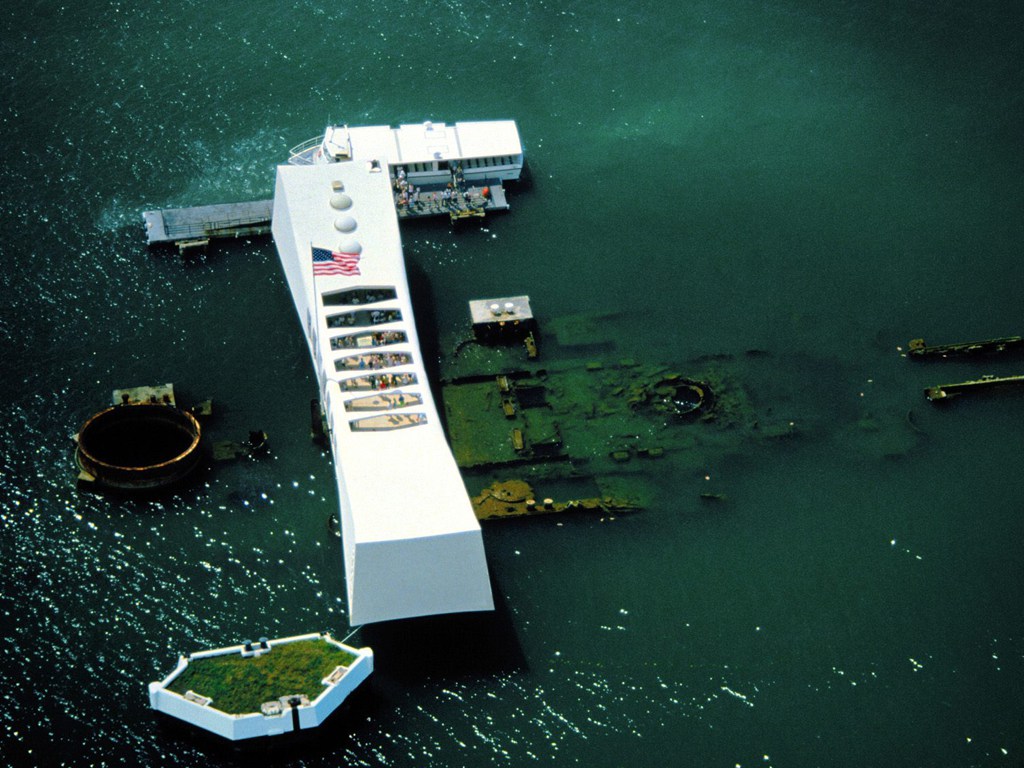
In 1962, a memorial was built over the sunken U.S.S. Arizona, where hundreds of American sailors and Marines remain entombed. Arizona crewmen who survived the battle of Pearl Harbor are given the option by the National Park Service of being interred there after death.

Long Live the King

Sometimes there’s nothing you can do but laugh. In the past two months I’ve been interviewed dozens of times about the themes of Mission: Jimmy Stewart and the Fight for Europe, my GoodKnight Books release. It’s a story with so many angles that the media practically has a smorgasbord. But my experience of a couple days ago was one I didn’t see coming and an angle I wasn’t comfortable talking about at all.

A certain talk show host at a radio station in a major Midwestern city asked me for a 7- to 10-minute interview. It was on the schedule for 10 days. Sometimes the station calls me and sometimes I call the station. Usually, I speak first with a producer during a commercial break who patches me in so I hear the intro, and then go live. Well, this time it was me doing the calling, and there wasn’t any conversation with a producer. I automatically went into a queue where I heard the commercial break and then the talk show host, a woman, started her segment with a folksy chat about the holidays, and I thought she was segueing nicely into a mention of It’s a Wonderful Life and then here I’d come after she completed a standard welcome of Jimmy Stewart biographer Robert Matzen.

She was going on about the baking of holiday cookies, and I wondered how she was going to bring it back to Mission, but OK I’m sitting there listening waiting for the plane to circle around to my direction. Then she started talking about the “Cookie King,” Robert Merten who has written a book about holiday cookies and in a split second I realized: Wait a minute. Robert Matzen, Robert Merten. World War II book, cookie book.

Mission: Jimmy Stewart and the Fight for Europe by Robert Matzen

A book not about cookies.

It’s a horrible thing when you realize, This plane isn’t landing. This plane is about to crash. She launched into an adoring, full-fledged introduction to Cookie King Robert Merten and the deeper she got into it, and the closer I got to going live, the faster my brain operated as I tried to think of what to do. I imagined the conversation that was about to take place, the one where I hesitated and stumbled my way through an explanation of how, yeah, I like cookies just fine but I’m not the king of them and in fact my blood isn’t blue but rather, it’s as red as the next guy’s, and I’ve written this book called Mission about death in the heavens over Germany. It would be a conversation blinded on both sides by egg on faces, and there would be earwitnesses all over a major Midwestern city.

The flop-sweat started to flow as she brought the intro into what she imagined was a smooth landing with a warm, “Joining me today in a rare radio appearance is the Cookie King himself, Robert Mert—

*CLICK*

Yes, people, I strapped on my ’chute and jumped before the plane crashed in flames. I left the host to die in the cockpit and I besmirched Robert Merten’s reputation but at that moment the Cookie King was on his own and I was out of the doomed ship in one piece. I lived to fight another day.

The post-mortem with Sarah my top-notch publicist left us both baffled (and her furious on my behalf), and I don’t feel too bad because somebody at that station wasn’t paying very close attention: How do you confuse an author who’s written a book about cookies with an author who’s written a book about World War II? I mean, I can sort of imagine how this crash happened, but only sort of, and the startling lack of preparation on their end mitigates any guilt I felt about bailing out with bare seconds until impact.

For the record, the Cookie King’s book is entitled, logically enough, The Cookie King, and sports a royal crest on its cover. The subtitle is, “Delicious, sweet and savory cookies from a lifetime journey of cookie baking” and my sweet tooth thinks it must be a steal at $34.95.

So there you have it, just another day in the life of an author who is soldiering on in a major publicity campaign. And Robert Merten, the next time you realize that somebody has booked you to talk about Jimmy Stewart as a combat pilot in World War II, please bail at the last moment and leave the host to crash in flames. At that point we’ll be even.

The Mission

I stood in high Pennsylvania winds last Sunday morning on what is ground zero to the core story of Mission: Jimmy Stewart and the Fight for Europe. At my back was Gettysburg’s infamous Wheatfield, scene of some of the bloodiest fighting of the second day’s battle. A half mile at my front rose Little Round Top. And staring me in the face was a granite monument to the 11th Pennsylvania Reserves, the regiment commanded by Col. Samuel M. Jackson. In murderous fighting on July 2, 1863, the 11th Pennsylvania—part of Fisher’s Brigade of the Fifth Corps—was part of a charge down the slope of Little Round Top that checked Longstreet’s ambitious maneuver to hit the federal left flank. Afterward, a Union commanding general rode up to Jackson hat in hand and exclaimed, “Colonel Jackson, you have saved the day. Your regiment is worth its weight in gold; its weight in gold, sir!”

Thanks to men like Col. Sam Jackson, the Union was preserved.

Mission: Jimmy Stewart and the Fight for Europe by Robert Matzen

The monument of the 11th Pennsylvania Reserves, with Little Round Top in the background. This ground was carpeted with the dead and dying on July 2, 1863, but Sam Jackson remained upright. It was here that union Brig. Gen. Samuel Crawford praised Jackson for saving the day.

Why is this ground zero to Mission? Sam Jackson was Jimmy Stewart’s grandfather, his mother’s father. Jackson’s regiment had been positioned at the foot of Little Round Top and received orders to hold against the Confederate advance at all cost. This his regiment did, and advanced probably no more than 1,500 yards that day, but hard-fought and bloody real estate it was. Standing amidst the monuments to so many regiments intermingled there and representing both Union and Confederate units, this hallowed acreage, I was hit by what Jackson had done, and how much it influenced James Maitland Stewart, the laid-back star of stage and screen.

Except Stewart wasn’t laid back at all. Stewart was high-strung and possessed a compulsion to serve—his Mission of the book title—that was born of his two grandfathers, Sam Jackson and James Maitland Stewart, Jim’s father’s father and a sergeant in the Army Signal Corps. Sergeant Stewart had fought his way through many Civil War battles, the last being Appomattox, where he then witnessed the surrender of Lee to Grant that ended the war. The estimable Jackson had died just before Jim was born in 1908, but old J.M. lived into the 1930s and Jim learned about service and sacrifice from this man above all others, one who had lived through America’s bloodiest war.

Mission: Jimmy Stewart and the Fight for Europe by Robert Matzen

The Pennsylvania Memorial at Gettysburg, where S.M. Jackson gets top billing.

This past Sunday, November 20, I lectured at the Gettysburg Heritage Center, which includes an ambitious multi-media museum designed to entertain and educate even today’s short-attention-span learners. When I described Jackson’s advance and his connection to Jim to a packed Heritage Center house, there was a collective gasp. People just don’t realize what a giant shadow Jim’s grandfathers cast on his life. In effect, Jim was poured into a military mold and had no choice but to end up a soldier. It’s the reason he gleefully reported for induction after being drafted nine months before Pearl Harbor. With this action he turned his back on Hollywood luxury, a thriving avocation as a sexual athlete, and an Academy Award career with a giant, goofy grin and pulled an army private’s uniform onto his six-foot-four, 139-pound frame. After he was fingerprinted and sworn in before a throng of reporters and cameraman, Jim refused to talk to or work with the press for the next five years so he could concentrate on being the best soldier he could be. It’s unprecedented what he did and the way he did it.

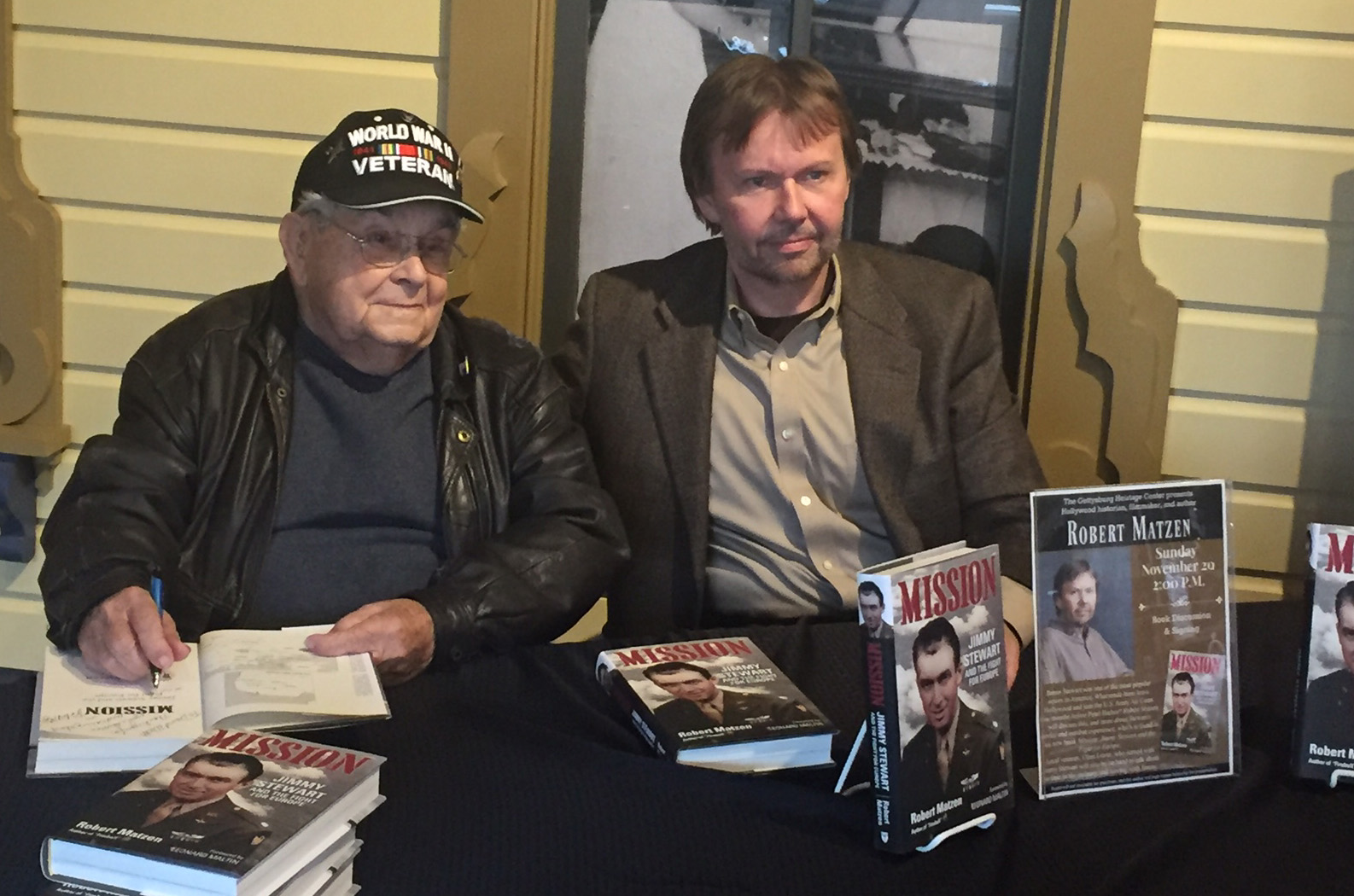
Speaking of soldiers, I shared the microphone last Sunday with Clem Leone, 92-year-old veteran of the air war over Europe. Clem knew and flew with Stewart as described in Mission, and was shot down over Gotha, Germany, on February 24, 1944. I’ve never experienced anything quite like this stretch of two hours, sharing the stage and then sitting and signing books with my own hero who had lived history. It’s one of many things I’m thankful for this Thanksgiving 2016.

Mission: Jimmy Stewart and the Fight for Europe by Robert Matzen

With Clem Leone at the Gettysburg Heritage Center event. Amidst an outpouring of love for Clem, who is a local celebrity, 97 books sold in 90 minutes.

Inside the Reptile

There is an affectionate term for the planes that helped win the fight against Hitler: warbirds. Mary and I saw all the warbirds of World War II in our recent visit to the National Museum of the United States Air Force at Wright-Patterson Air Force Base in Ohio, where Mission: Jimmy Stewart and the Fight for Europe was launched the evening of October 27.

This Veterans Day it’s easy to think about the boys who stormed Normandy’s beaches 72 years and 5 months ago because they’ve been memorialized in the neat and tidy The Longest Day and in the stunningly realistic Saving Private Ryan, and as one who sees and hears and feels and smells and tastes history, I don’t know how they did what they did that day. You know how you blanch when facing headwinds and slanting rain and the natural sense is to squint from it and recoil and run for cover? Well imagine the raindrops are eight-ounce parcels of lead coming at you like slanting rain. We’re all waterproof so the rain can’t really hurt us, although we act as if it could. None of us are bulletproof and for thousands of those guys that day, the rainstorm ended in instant death or worse.

Where do the warbirds fit in this story? Well, I didn’t know before writing Mission exactly how the war had played out up to the point that the LSTs hit the beaches of France. I knew there was an air war and a ground war in Europe, but it didn’t sink in that the air war came first and made the ground war possible, which means that for Americans over a two-year period, the front lines in the war for Europe were manned by flyers of the U.S. Army Air Forces. They climbed into their warbirds every morning not knowing if they’d ever walk the earth again. They’d give a thumbs-up and take off not into a glorious sunrise but into pea soup because, after all, this was England and the English weather is usually dreary.

And the warbirds themselves? Yikes. Sure, you had your sleek and nasty fighter planes, your Warhawks and Thunderbolts and Mustangs, and the kids who climbed into them fought like the glamorous swashbucklers they were. Theirs was the grave responsibility of guarding and defending the most unglamorous of warbirds, the heavy bombers. And that is the core story of Mission.

Mission: Jimmy Stewart and the Fight for Europe by Robert Matzen

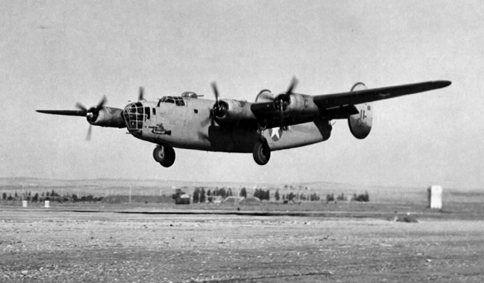
The B-24 Liberator, mocked as “the packing crate the B-17 came in,” but beloved by the men who flew inside.

Two heavy bombers flew for America in WWII, the B-17 Flying Fortress and the B-24 Liberator. The relative beauty of the 17 and its lethal firepower made it the media darling of the war. Think Memphis Belle. The 24 was described as “the packing crate the B-17 came in.” It was boxy; it was decidedly unglamorous. Imagine this as a verbal portrait of your airplane: “On the ground it looks like a slab-sided prehistoric monster wading through swamps.”

But the boys assigned to the B-24 Liberators loved their airplanes. They cared for each as if it were a hotrod, as if the thing wasn’t a flying death trap. The Liberators Jim Stewart flew exclusively in the war had real problems, like controls that required muscle at all times and leaks in the fuel lines that would, all of a sudden, cause them to blow up in the air, usually on ascent when loaded with gas and bombs. Ka-BOOM! Ten men obliterated over friendly skies because of spark meeting fuel leak: pilot, copilot, bombardier, navigator, radio operator, engineer, waist gunners, ball turret gunner, tail gunner, all gone. This happened to Lt. Earle Metcalf and crew of Stewart’s squadron one morning during a relatively “easy” mission to bomb German rocket emplacements near the coast of France. There one moment and vanished the next, with no trace ever found.

Mission: Jimmy Stewart and the Fight for Europe by Robert Matzen

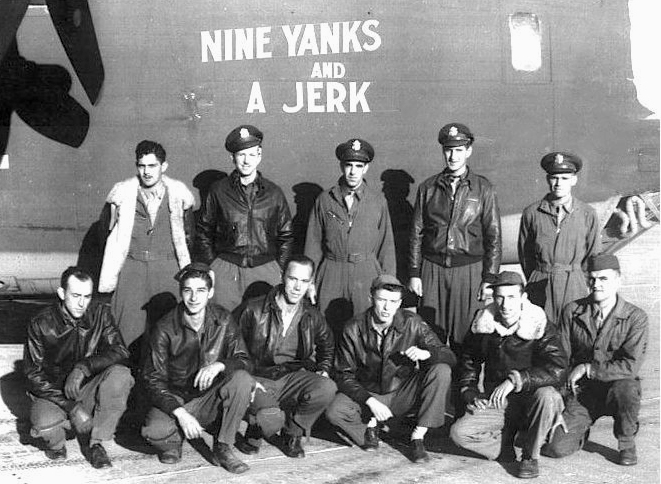
This Veterans Day I am saluting the flyers of the Eighth Air Force, with a special shout-out to this crew: (kneeling, L to R) engineer Don Dewey, gunner Stan Treusch, gunner Bill Timmons, radioman Phil Bronstein, gunner Earl Doggett; (standing) engineer Jim Crawford, navigator Paul Fischer, copilot John Lercari, pilot Earle Metcalf, and bombardier Ernie Hutton. Of the men in this photo, only ground crew chief Eugene Peterson, kneeling at far right, lived past Feb. 2, 1944 when the Lib they were in, Billie Babe, blew up without warning in English airspace. These men were under Jim Stewart’s command in the 703rd Squadron of the 445th Bomb Group, and their deaths hit him hard.

On each mission to Germany, missions sent up every possible day, hundreds of planes would take off from a cluster of bases each five miles from the next in eastern England into that pea soup I described earlier featuring low cloud cover. If the pilot didn’t fly precisely in that cloud cover, as in, fly straight for 47 seconds after takeoff while climbing to 5,000 feet at an air speed of 150 and then on the 48th second turn right to a precise compass heading, ka-BOOM! Two bombers both flying blind would collide—loaded with gas and bombs—and not 10 but 20 men would be erased from the roster. That happened more than once on missions Jim commanded. He would hear the deafening explosion close by, muscle the controls as the shock wave hit his plane, and know that a score of fine flyers alive five seconds ago were now dead. Young men he had just seen and eaten breakfast with.

Dear readers, we haven’t even left friendly airspace yet! This was the easy part before hitting an enemy coastline that featured hundreds of anti-aircraft batteries aimed at Forts and Libs lumbering straight and level across the sky as if targets in a carnival shooting gallery. Each plane held 10 males somewhere between 19 and 26, except for Jim, the old man of 35. They were kids, so very young, so very brave, so very skilled, who died by the hundreds and thousands for the two years leading up to D-Day in an ongoing effort to smash Hitler’s ability to manufacture weapons of war. Not until they had succeeded in the task of fighting and fighting and fighting on endless brutal missions to knock out enough of the German air fleet did D-Day even become possible.

I spend a great deal of time in Mission driving home the point that, yes, Jim was a hero, but the band of brothers he flew with every day were people who lived and breathed. Each represented the best the United States had to offer. On the morning of a mission they rode out to their slab-sided reptile of an airplane, a beast that might turn around and bite them at any moment. They struggled inside it while loaded down with flying gear. They held their breath through a lumbering takeoff, each focused on all the tasks essential to keeping that plane in the air for a flight to and from Germany. For many, too many, something would go wrong and they would fly on to glory.

I am writing about the men of the Eighth Air Force today, but I think of them every day. They inspire me to be an American worthy of their bravery and sacrifice.


To learn more about Mission: Jimmy Stewart and the Flight to Europe, visit the publisher’s website.

Calling All Ghosts

If you spend a lifetime around history, you can’t help but experience something paranormal along the way, even if you’re a pragmatist like me. I am not one to see ghosts. I will get an inkling of something once in a while, like the time I was on a ghost hunt with a friend and his group. As I walked down a hallway in an old house supposedly haunted, I felt someone touch the back of my neck with cold fingers…even though there was no one there. I can feel cold spots and get a sense of things being off, but I just don’t have whatever it is that allows a person to actually see ghosts. I’ve spent lots of time in haunted places begging for something to happen and it never did. When I went to England last year to explore the abandoned American air bases from World War II for my book, Mission: Jimmy Stewart and the Fight for Europe, I was told it was inevitable I’d see ghosts because so many men died in crashes at those spots—I saw nothing. At Tibenham, where Stewart was based with 4,000 other guys of the 445th Bomb Group, I was on very spooky ground and I felt the frantic energy of this now quiet and desolate spot, but saw no ghosts. Thirty years ago the old control tower was still standing and supposedly very haunted, but it had been long-ago torn down by the time I got there. Years and years before my visit to England, on the only occasion when I did see a ghost, I wasn’t thinking anything about ghosts at the critical moment, and it took years to figure out what had happened.

Mission: Jimmy Stewart and the Fight for Europe by Robert Matzen

Thirty-one years after last setting foot there, Jimmy Stewart returned to Tibenham in 1976 and here leans against the operations building with the control tower behind him. It even looks haunted. By the time I got here, these buildings were long gone, although if you know where to look, spooky old Army structures dot the Tibenham landscape and remain to be explored.

If you’ve read Errol Flynn Slept Here you know the story of the day I saw a ghost while visiting Flynn’s Mulholland Farm. I was so sure I was imagining things that I didn’t talk about the experience, and it was only 15 years later that I learned of Tracy Nelson’s close encounters with Flynn’s ghost in the house. Even then, that’s only two people seeing things, and when Mike Mazzone and I embarked on the writing of EFSH, we thought it would make an interesting one-column sidebar to talk about the legend of the Flynn ghost, as in ha ha ha isn’t this funny?

Then we started to interview inhabitants of the house, including the entire Hamblen family who lived there from 1959 to 1979. These are devout Christians, nationally known, who had a gospel radio show and were close friends of Billy Graham. Suzy Hamblen, matriarch of the Hamblen family and famous wife of Stuart Hamblen, was 100 when Mike and I spoke with her. Her story still gives me goosebumps: The night Flynn died in Vancouver, BC, she and Stuart were in the house he built, a quiet evening, and all of a sudden the pipes in the house started to moan and vibrate. It was as if the very bones of the place were rattling. At least a half-dozen members of this cold-sober family told us about seeing the ghost close up.

The last inhabitants of Mulholland Farm were Rick Nelson and his children, Tracy, Gunnar, and Matthew (the latter two were leaders of the 1980s rock group Nelson). I interviewed both guys and Gunnar told me of crazy experiences in his bedroom that shook him up and still bother him, like the ghost sitting on his bed at some points and slamming doors at others. Interestingly, Matthew didn’t experience these things—and they’re twins! The boys and their band practiced in Flynn’s bedroom, so you can imagine how racket like that would shake up an already restless spirit.

Mission: Jimmy Stewart and the Fight for Europe by Robert Matzen

Mulholland Farm from the vantage point where I saw the ghost. If you look at the set of three second-story windows on the right side of the photo, the ghost appeared in the window on the left. I would learn later that this was Errol Flynn’s bedroom.

Here is my story for the record one more time. I was alone at Mulholland Farm high in the Hollywood Hills in 1987, standing outside by the pool one hot afternoon trying to drink in this setting. Before me stood a rambling ranch house, once elegant and now neglected more than a year after the sudden death of Rick Nelson in a plane crash. As I stood there looking, a face appeared in a second-story window and peered out at me. A face and a not-quite-solid form–that of a man. The hairs on my neck stood up, and we stared at each other for a while, and then the face and form were gone. On that occasion the house was locked up tight so it’s not like a resident was checking me out. Not a living resident anyway. Since my rational mind told me I couldn’t have seen what I saw, I kept it to myself all those years until others came forward to say they too saw the face and form…at the top of the stairs, in a bathroom mirror, just everywhere in the house over the years. Was it the ghost of Errol Flynn? Well, I can only answer that by saying that in life, his was one of the more troubled souls on earth, so in death why would it be any different?

The place was torn down the next year, and I have always wondered what happens to a restless spirit when the home he’s so comfortable with, the space he himself designed, is removed. Is its energy left behind so that he keeps seeing the same floor and walls and ceilings? Or does he move into the new house built on the footprint of the old? Next time you run into Justin Timberlake, ask him and let me know, because it’s Timberlake who built his fortified compound at 7700 Mulholland Drive on the spot where once sat the home of the dearly departed Errol Flynn.

Learn more about Mission: Jimmy Stewart and the Fight for Europe and Errol Flynn Slept Here at the GoodKnight Books website. And I would love to hear about your close encounters with ghosts; I’m sure you will make me envious.

Mission: Jimmy Stewart and the Fight for Europe by Robert Matzen

A 1944 magazine article detailed Flynn’s mountaintop home. In the shot above he sits under the windows where I saw the ghost.

Icons

If this were 1966 instead of 2016, you could go down any street and ask passersby if they knew who Clark Gable was, and be met by incredulity or outright anger. “Of course I know who Gable is! (…you idiot!)” Back then we were still attached to Hollywood’s golden age because the movies played on local and network TV and the glamorous movie stars showed up in series and variety and game shows. They existed in the fabric of our culture. If this were 1966, in just two more years would come yet another major revival of Gone With the Wind, this time updated in 70mm, and moviegoers would get another shot of Gable, Vivien Leigh, and crew to keep them fresh in our minds.

But that was a long, long time ago now. The old stars have passed on and their motion pictures no longer play on the late show. Instead those feature films have been relegated to that great Indian reservation for old cinema, Turner Classic Movies, where they can roam in free black-and-white isolation and not offend the youngsters. Here’s a great explanation of why classic film is not likely to endure in popular culture much longer.

Most of you come here to read my babble because you love classic Hollywood. And because you do know so much about it and have seen hundreds or thousands of vintage Hollywood movies and read dozens of books, you might not be aware how dramatically popular culture has changed around you. It’s no longer a slam dunk that some stranger will know even the name Clark Gable since his most famous picture hasn’t played network television in, what, a generation? Forget getting a glint of recognition about Ronald Colman or Norma Shearer. Joan Crawford is known only as the eyebrow lady who hated wire hangers—if she’s known at all. Astaire and Rogers; what’s that, a law firm? You get my point.

But there are a few old stars who still ring the bell all these decades later. One is John Wayne, subject of a definitive biography by Scott Eyman a couple of years ago that became a runaway hit and New York Times bestseller. The Duke is an American icon whether or not you’ve ever sat through one of his pictures. Marilyn Monroe and Audrey Hepburn are unquestionably still bigtime. And then there’s Jimmy Stewart.

Mission: Jimmy Stewart and the Fight for Europe by Robert Matzen

Duke and Jim together in one of their best pictures, The Man Who Shot Liberty Valance.

One thing that led to Stewart’s longevity is that after World War II, he reinvented himself and started looking for edgier roles. For a solid decade he made pictures you wouldn’t expect to find him in, usually with strong box office results. In other words, he didn’t play it safe and go out to pasture (move to television). He looked down his nose at television, skillfully played the system, and kept showing up on theater marquees well into the 1960s.

That’s not to say business acumen makes JS relevant in 2016. He died in 1997, about a generation ago. He stopped making public appearances long before that, and so for practical purposes he slipped from the “newsfeed” at the end of the 1980s. His last starring role in a feature film was way back in 1971. And oh by the way that picture bombed. Sure he left behind some wonderful films—Vivacious Lady, Mr. Smith Goes to Washington, The Philadelphia Story, Winchester ’73, Harvey, and Vertigo come to mind off the top of my head. He made his share of clunkers too, but my point is, if you’re under 40 and not a fan of old Hollywood, you belong to a vast majority that doesn’t know these pictures. Nor do you likely have any urge to see them. It’s very much a generational thing.

Mission: Jimmy Stewart and the Fight for Europe by Robert Matzen

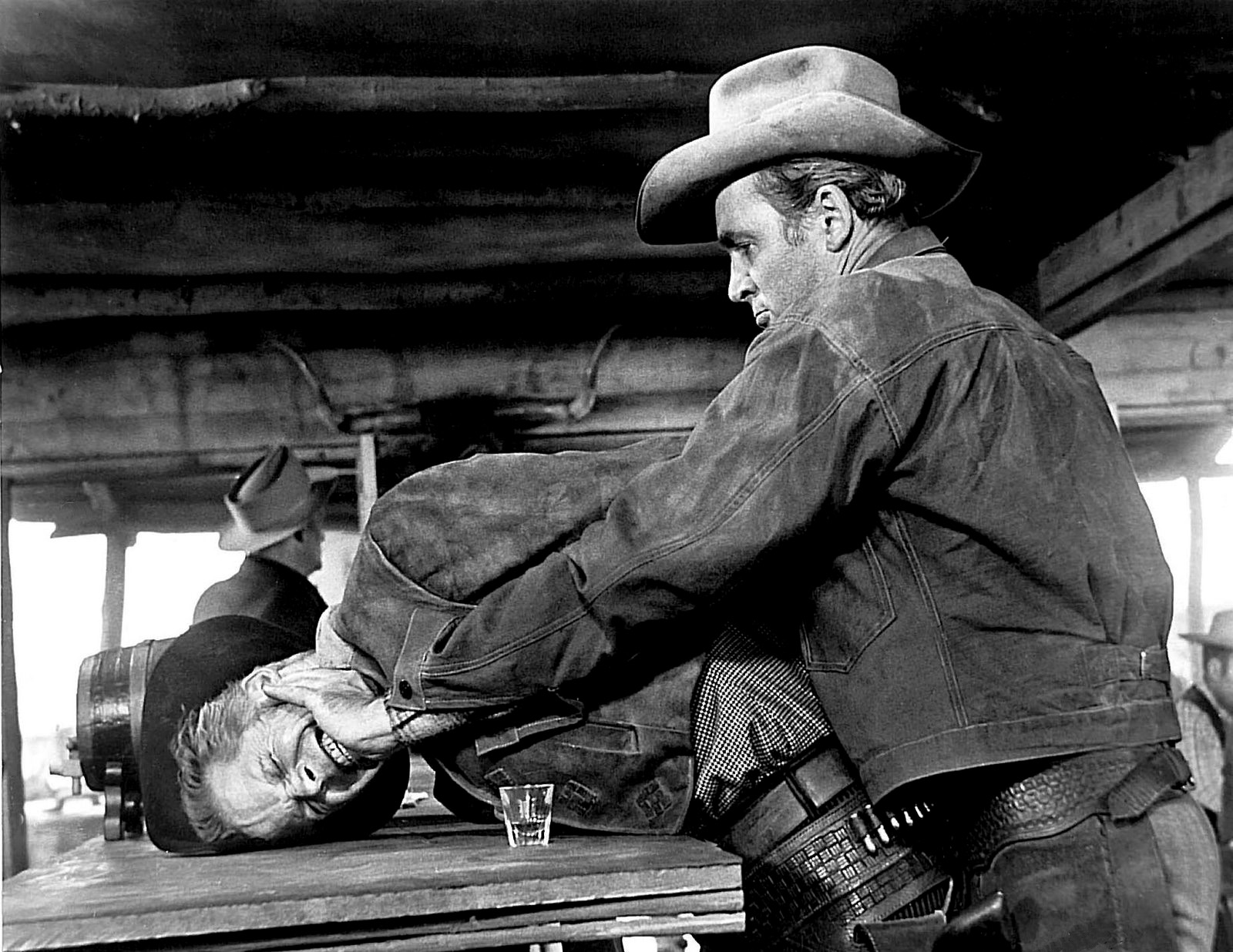
Jim in one of those pictures you wouldn’t expect, grinding Dan Duryea’s face into the bar in Winchester ’73.

But Stewart has something no other leading man has, and he’s not about to lose it. Stewart starred in It’s a Wonderful Life.
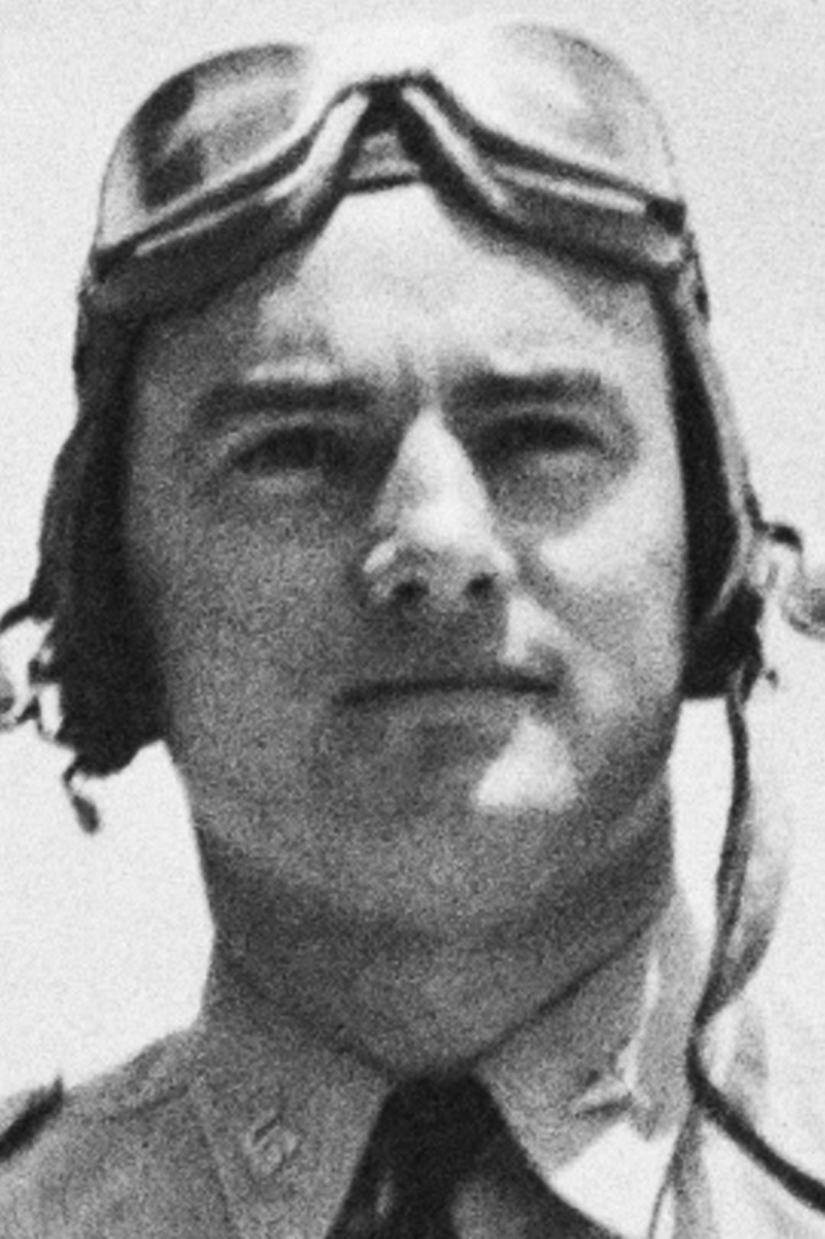
I could ask the person on the street, “Who’s Jimmy Stewart?”—even ask it of a 20-something—and I’ll get a smile and an enthusiastic, “I love Jimmy Stewart!” and that’s because of It’s a Wonderful Life, a picture I’m beginning to believe has become the most beloved in American popular culture. Parents pass it along to children who grow up and pass it along to children, and it keeps resonating because the concepts are universal. Do the right thing. Have honor. Don’t give up. Value your friends. Value your life.

I’ve lost track of how many times I’ve read customer reviews of Fireball that said, “I didn’t know anything about Carole Lombard before I read this book,” and for good reason. Carole Lombard died almost 75 years ago! Why should the modern reader know about Carole Lombard?

Stewart is a different animal. Everybody thinks they know Jimmy Stewart because they know George Bailey. Know him very well, in fact, and figure Jim is George, but guess what? Jim isn’t George. Jim isn’t even Jimmy. Jim is a complex, almost impenetrable character, and for me the hook was Jim came home from war and made It’s a Wonderful Life. From the moment the dynamics of this formula hit me, horrors of war, beloved actor, beloved film, I started writing and didn’t look back for fear somebody else was out there banging out the same story in Peoria or Sioux Falls.
Luckily, nobody was, and in a short six days you can tell me if you really knew Jim and if you still love him, because in six days Mission: Jimmy Stewart and the Fight for Europe (GoodKnight Books) has its official release. In fact, why not plan to join me at the National Museum of the United States Air Force at Wright-Patterson Air Force Base in Dayton, Ohio for the launch event next Thursday, October 27 at 6:30 p.m.?

A Question of Character(s)

Mission: Jimmy Stewart and the Fight for Europe by Robert MatzenI have a new book coming out in two weeks, Mission: Jimmy Stewart and the Fight for Europe, published by GoodKnight Books. I wrote it because Stewart in World War II represents one of the last great untold stories of Hollywood. Jim never talked about what he did in the war, and so there was a vacuum of information about it. I also wrote Mission because I love a challenge, and his commitment to remain mum meant there were no quotes from him about his experiences in combat, so I was starting with nothing, but had to end up with everything or the concept wouldn’t be valid.

In a nutshell, what I knew going in was that James Stewart flew heavy bombers over Germany as a member of the U.S. Army Eighth Air Force. I discovered in my research over the next 18 months that this was no tin soldier. Stewart was smack-dab in the middle of WWII, the most horrific nightmare in human history, and writing about something of that magnitude posed not one but a series of cascading challenges. How much can I assume the reader knows going in? How much do I have to set the stage? I can’t provide the whole history of the Great War and Hindenburg and Hitler and the rise of the Nazi Party but they’re all relevant to why the United States (and Jim Stewart) went to war, just as is the global Great Depression, the oppression of the Jews, and Germany’s aggressions against Poland and other countries. The reader also needs to have a basic understanding of the United States military before and during the war. In other words, Mission is supposed to be about Jimmy Stewart but it called for a whole lot of context.

Mission: Jimmy Stewart and the Fight for Europe by Robert Matzen

Nineteen-year-old T. Sgt. Clem Leone graduates gunnery school and will soon meet up with Capt. J.M. Stewart.

I grant you that my biographical model is unorthodox: I always try to craft interesting stories rather than just tell you, the reader, “Jim did this, then Jim did that,” I decided to present readers with the German side through three supporting characters, Dolfo Galland, the ace German fighter pilot; Selma Lesser, the German Jew hiding in Berlin; and Gertrud Siepmann, the daughter of a German naval engineer. To let you see the American side I didn’t just feature Jim; I also told the story of Clem Leone, a young B-24 radioman from Baltimore. They’re all real people who lived during the war (I interviewed two of the three extensively), and through their eyes I was able to access a great deal of critical background in relatively few words.

So what happened was, I wrote the manuscript for Mission and gave it to some smarter people than me to review—two were experts on the Eighth Air Force and three were experts on classic Hollywood. All were expecting a straight bio of our boy Jimmy and what they got was a cast of characters led by Jim and supported by these others.

I had braced myself for a strong reaction to my unorthodox model and Whoa, Nellie, did I get it! To me, these other sets of eyes and experiences deepened our understanding of Stewart, his world, and what he faced. Two of the Hollywood experts had major objections, and passionate ones at that. They advised that these other characters had to GO because they got in the way and would put readers off who were expecting a book on Jimmy Stewart, although one of the two offered a solution: If I felt I must keep these characters, the best place for them was in an appendix at the back of the book where they’d be safely out of the way.

Mission: Jimmy Stewart and the Fight for Europe by Robert Matzen

Gertrud Siepmann and her sister Anne in Eppstein, Germany during the war. Today Gertrud goes by the name Trudy McVicker and lives near Chicago.

Well, what a pickle, because I have tremendous respect for all my reviewers, and they cared enough to level with me that I had a big problem on my hands. The trouble was, I had constructed my story in a particular way and to lose the other characters meant ripping the frame out and starting over.

My editor supported my concept because Fireball, my telling of the Carole Lombard story, had been a big success and was just as unorthodox a biography. It was my call, and what a tough one to make.

My solution was to drop Selma the German Jew, and cut back the narrative of the other supporting characters to lean, hard-hitting snapshots of these lives lived in parallel to, and then intersecting with, Jim’s. I didn’t want to lose Selma; I had discovered her diary-style letter to family, 22 pages of single-spaced German text written just after the end of the war, and I had had the letter translated with care. What a story it tells—all the brutality of the Nazi regime and the death and suffering of the war wrapped up in one woman who lost everything, with the coup de grace a bombing mission by Jim and the boys over Berlin that destroys even her place of hiding. I will detail her story in a future column because Selma Lesser’s is a voice that must live on.

I’m glad I kept my other characters; when Publishers Weekly reviewed Mission a couple of weeks ago they singled out Clem and Gertrud, and I felt such relief that these people were seen as assets to the narrative about Stewart.

I’ll have a lot more to say about Mission in coming weeks, so stay tuned. In the meantime, please visit the GoodKnight Books website to learn more. (Imagine what a great Christmas gift Mission‘ll make.)

The Time I Was a Legend

In the ninth grade I cut my fingertip off in shop class. It’s the ring finger of my left hand, and I was planing a piece of wood on a machine called a joiner and the plastic guard was off it for some reason and I was holding the wood carelessly. Mr. Russell the shop teacher watched my fingertip fly up in the air and I’m sure imagined his career flying beside it. Such a sound it made, the blade hitting my flesh, that whenever I hear a similar sound today all these years later a chill runs from the base of my spine down my legs. I just heard a version of that sound out the open window as someone in the neighborhood fed tree branches into a wood chipper.

Blood was everywhere. Mr. Russell kept his cool and wrapped my hand up so the principal could drive me to the doctor’s office. Now, I come from a small town and we had two doctors, both alcoholics. I remember the doctor I went to that day had an old portrait of himself as a navy officer in his office, so he must have been in his 50s, although at the time I thought he was ANCIENT. Or did he just look ancient because of the booze?

Anyway, as the principal parked along the street in front of the doctor’s office I watched my mother run into view and straight inside. She wasn’t exactly a graceful woman and definitely not an athlete but she had still managed to sprint about three-quarters of a mile and beat us there even though the principal was hurrying and only had to drive three blocks. In other words, Mom cared.

When the doctor removed Mr. Russell’s wrapping, my finger was sticking up at a perfect sightline between my eyes and Mom’s, and I watched her face turn chalk white at what a high-speed circular saw can do to human flesh. It looked like ground sirloin, except purple.

My fingertip looked like this, but purple.

My fingertip looked like this, but purple.

The doctor said there was nothing to sew so he didn’t sew it. He wrapped it in gauze and then cotton bandage and sent me home. Even then at—what was I, fourteen?—I thought to myself, shouldn’t you lubricate that, because things are going to congeal and it’ll be difficult to get the bandages off down the road?

I believe seven days ensued. In that time I became a high school legend as the ninth grader who cut off his finger in shop class. My school was a junior high, a decrepit old set of buildings long since torn down, while grades ten to twelve were jailed in a shiny new school out in the country. Aside from being a mediocre baseball player on championship teams, I had never achieved notoriety of any sort until now, unless you count the time I (along with at least 100 others) colored a picture of a clown flawlessly and won two free tickets to the circus, or the time I won a drawing in the fifth grade and got to take home the week-old jack-o-lantern at Halloween.

Now? Now I hit the bigtime as the ninth grader who lost a hand in shop class. None of the upper classes laid eyes on me, but when one loses an arm, you can imagine what the poor bastard must look like in all those bandages lying in a hospital room hooked up to IVs and monitors. That was the progression, as I found out later, with my condition worsening until a week had passed and I was hanging on by a thread in ICU.

The day came for me to go back to the alcoholic ex-navy man for a follow-up, and here I am just a kid kind of shaking my head thinking… Salve? Ointment? Something was supposed to go between my flesh and those bandages.

He started unwrapping and, son of a gun, the bandages were stuck. He said, no problem, let’s soak it. I can still remember the kidney-shaped metal dish that my hand, bandages attached, soaked in. He came back after a while and gave a tug. “YEEEEOWW!” I think I’m quoting myself accurately. I think it was, “YEEEEOWW!”

My doctor sort of looked like this while sober.

My doctor sort of looked like this while sober.

No problem, let’s soak it some more. We repeated the process. Same result. Finally he said, “Here, lie back,” as he must have said to many a wounded navy man back in the South Pacific, and I did as ordered and he said—I kid you not, he said, “This might hurt.”

I reached out with my right hand and found the metal stirrups that are used when ladies are examined. Just as I did, he gave it all he had and yanked the bandage off.

I don’t remember the next moment or two because the lights went out, but for years afterward my big sister Janet would ask me to tell the story of the time the doctor removed the bandages from my finger, and she would laugh and laugh.

What happened was that he knew he was going to have to pull hard, and I guess he was trying to make it go quick for me, but with the bandage when it separated from my hand went all the ground meat, plus what was left of my fingernail, and the cuticle, which was ripped clean up to the first joint. What a scar it made, and for ten, fifteen years the slightest bump would put me through the roof.

I was reminded of this incident while cutting my nails and facing again the result of that morning in shop class. The end of my finger grew back after a fashion, although there’s no fingerprint and the nail, which did grow back against all odds, is about half the size of its right-hand mate. The coolest thing in retrospect is that if you look closely, you can see where the cuticle was ripped in a blazing trail in the direction of his yank. I was actually pretty lucky when you think about the alternative, like my brother-in-law who was a meat cutter in adolescence and apparently not a very accurate one by what’s missing today.

I know what you’re thinking, what a lawsuit this must have made because of the missing guard on the table saw, but that wasn’t the cut of my father’s jib. Dad chalked it up to inherent Matzen clumsiness and we moved on, and the grateful school district rewarded me in the only way it really could, with an A in shop class.

The Killer

From the beginning, crazy things have surrounded the project that became Fireball. In October 2012 when I climbed the killer mountain to the site of the crash of TWA Flight 3, which had occurred more than 70 years earlier, I wasn’t prepared for the experience of the people who had died there whispering to me. I had climbed 4,000 feet pretty much straight up to see the spot where Carole Lombard met her fate and to examine the wreckage of the plane still on the mountainside. The last thing I expected was for the others to make their presence known; don’t get me wrong, I don’t mean to say that I heard voices, but I felt the people around me, including in my ears, and when I held a human bone in my hand that day I wasn’t creeped out, because I understood what it was: communication.

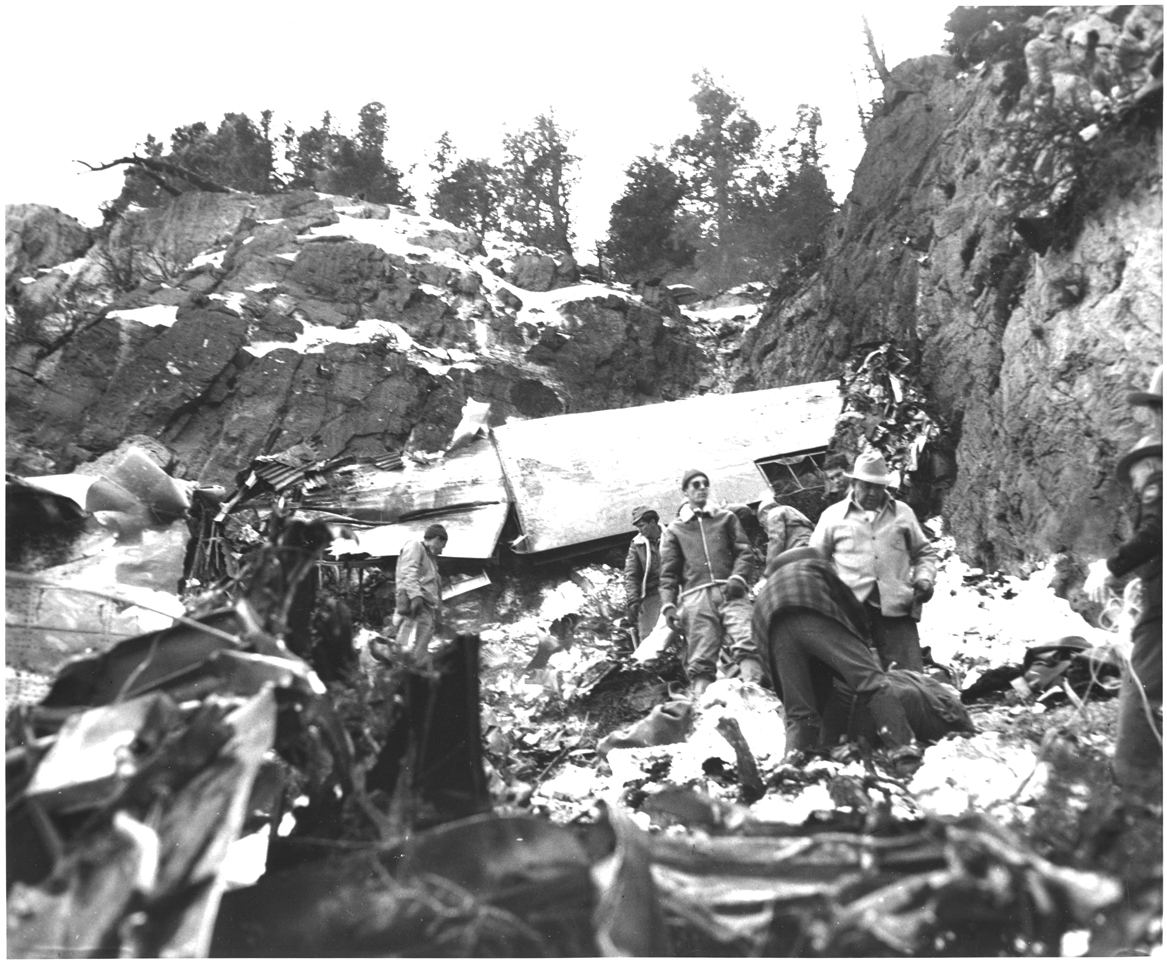
I don’t know if I inadvertently trod on 2nd Lt. Kenneth Donahue that autumn day four years ago because I don’t know exactly where they found him. Come to think of it, was it Donahue who took the time to hover around me? Who knows, but found he was, in April 2014, by people exploring the site as once I had explored it. There were twenty-two souls aboard Flight 3 when she hit that Nevada cliff at 180 miles per hour after dark on January 16, 1942—a flight crew of three, four civilians, and fifteen Army personnel. Three of those fifteen couldn’t be identified because of the horrific nature of the crash, and Donahue was one of them. When remains were found at the site last year, the coroner’s office sent out a team for recovery, and the starting point for DNA testing was that list of three lost men, which was obtained by reading Fireball. This being the coldest of cases, finding family members and securing DNA samples took more than a year, but finally a positive match confirmed that this was Second Lieutenant Donahue, a native of Stoughton, Massachusetts, and copilot of heavy bombers in the Army Ferrying Command.

Fireball: Carole Lombard and the Mystery of Flight 3 by Robert Matzen

One of the 15 Army flyboys that perished aboard TWA Flight 3 was 2nd Lt. Kenneth Donahue, a co-pilot in the Army Ferrying Command.

Here’s the crazy part. The trade paperback edition of Fireball is about to go to press in time for the 75th anniversary of the crash, and I just barely have minutes to get Donahue’s story in there. It reminds me very much of dear Mary Johnson Savoie, the “human computer” who flew across the country with Carole Lombard and became a survivor of Flight 3 when she was forced off the plane in Albuquerque—so Kenneth Donahue and his mates could climb aboard. Through an improbable series of circumstances set in motion by my pal Tom Wilson, Mary popped up at age 92 in a retirement facility in Lake Charles, Louisiana, and I interviewed her at length and rushed her story into Fireball just before it went to press. Mary lived long enough for me to sit and read her every passage recounting her story, and then passed on two months later. Her story was meant to be told, and now Kenneth’s story is meant to be told and will be told in the expanded trade paper version of Fireball.

As Lieutenant Donahue’s niece Maureen Green told me last evening, “Kenneth hung out until the right person and the right technology came along and he could make it home. I think that’s how things work.” The right person was Clark County Coroner’s investigator Felicia Borla and a team of experts, whose part of the story was reported in Biddeford’s Journal Tribune. The right technology was DNA testing that confirmed a match from a simple cheek swab. Confirmation set into motion events that took the small casket containing Donahue’s remains from McCarran International Airport in Las Vegas to Hartsfield-Jackson in Atlanta, where Delta arranged an honor guard that transferred the lieutenant from one plane to another. Then he flew to Logan in Boston where another honor guard saw the casket safely into a hearse for one last commute to Biddeford, Maine.

No one alive today in the Donahue family remembers Kenneth, but his niece Maureen has always felt a special connection. Maureen’s mother Rita was Kenneth’s younger sister and Maureen heard stories of Kenneth’s life and death, and grew up with a portrait of the young serviceman in her home. Rita passed on in 1999, but the connection between Maureen and Kenneth remained strong, so strong that when the Clark County Coroner called in February 2015, she said, “I knew it was him.”

Fireball: Carole Lombard and the Mystery of Flight 3 by Robert Matzen

Thirty-six hours after the crash of Flight 3, body recovery has begun.

Fireball: Carole Lombard and the Mystery of Flight 3 by Robert Matzen

The same place in 2012, still guarding its secrets.

As recounted in Fireball, in 1942 most of the crash victims were positively identified, but the coroner had parts of some bodies and these were cremated and divided into three urns for shipment home to the families of the Army fliers who couldn’t be identified. That’s what was buried in Biddeford’s St. Mary’s Cemetery in 1942, and Maureen’s mother used to talk about what a tough moment it was when they played “Taps” at the graveside.

Well, on August 12, Kenneth came home to a formal military graveside service that Maureen and her older sister Peggy found emotional. Then, a soldier in formal dress blues stood under a tree and began to play “Taps.” It was quite a moment for Maureen, who felt the connection to Kenneth, and to her mother and that story of a lone bugler in 1942. “I got it right then,” she said. “I understood.”

Twilight

On this past rare Friday night alone I sought out the equivalent of cinematic comfort food: Errol Flynn’s Adventures of Don Juan. I wanted something I could completely relax to and enjoy after a tough week, and yet something that if I fell asleep, no big deal, I knew what was going to happen anyway.

Did you ever notice that when you watch a movie over and over, the same things happen? I mean, every single time. You can count on Mr. Takagi saying the wrong thing and Hans Gruber shooting him. You can count on Johnny to get fired from that place but come back for one last revenge dance. Hiller and Levinson survive reentry to earth against the odds every single time. It’s uncanny!

Errol & Olivia by Robert Matzen

Viveca Lindfors and a wistful Errol Flynn in one of their dynamic scenes in Adventures of Don Juan.

However, the thing I realized Friday evening is, as the years go by, the movies don’t change but my awareness about them does. Don Juan is presented in this picture as a diffident lover. We get the sense he has had a great number of adventures with women, but he’s bored and no longer into the challenge—and these are genuine babes that are falling all over him. What the Bros. Warner were doing, I’m sure, was making sure that Errol Flynn of all people wasn’t seen as taking advantage of the women. They were systematically taking advantage of him, and he was letting them. He was a very reluctant don juan. Then all of a sudden he falls in love and not just with anybody but with the queen of Spain. Yikes, the chemistry of Errol Flynn and Viveca Lindfors in this picture. Because he is Don Juan, he has a whopping arsenal of lines to lay on this woman he has genuinely fallen in love with, but she’s a sharp cookie and easily parries the obvious ones. In their early scenes together, it’s clear he’s trying to manipulate her, but pretty soon the tables are turned and he’s in over his head. When he lays his cards on the table, she of course thinks he’s just naughty boy Don Juan putting on the moves. The love scenes in Adventures of Don Juan are so intimate and so lyrical that I cry—that’s another given in repeated viewings of this picture.

Not too long ago I watched The Private Life of Don Juan with Douglas Fairbanks, a Korda picture made in 1934 with Fairbanks way past his prime and displaying that tenor voice that killed him in talkies (I have a tenor voice and it killed me in talkies too). I did not cry at this version. But the thing is, the Fairbanks Don Juan is a middle-aged guy (50 as cameras rolled) also going by the numbers, so obviously middle aged in fact that the ladies don’t fall for his attempts to be Don Juan. There’s some pretty good shtick in The Private Life of Don Juan, some recurring gags, as he always looks into a woman’s eyes and reveals, “You baffle me. Once again I’m just a frightened child. I could kill you for being so attractive.”

Errol & Olivia by Robert Matzen

In both pictures, Juan’s sidekick is wry and cynical Leporello—Melville Cooper in the Fairbanks version, Alan Hale in the Flynn. The plot for Fairbanks seems trivial—an imposter Don Juan is killed and the real one uses the death as a way to take some time off—because the Flynn version is a deadly serious story about very nasty men attempting to seize control of the Spanish crown. I can tell you that 38-year-old Flynn took his Don Juan more seriously than did Fairbanks, seeing it as a comeback picture that could hoist him back up to the kind of popularity he had enjoyed with The Adventures of Robin Hood a decade earlier. In fact, Flynn’s well-documented self-destruction six weeks after production was, I believe, America’s heartthrob buckling under the pressure to make a big comeback picture. Far from walking through the role, as some have alleged, he’s trying very, very hard, and for the most part he pulls it off. But owing to changing tastes among the public, his smash picture just didn’t come to pass.

Errol & Olivia by Robert Matzen

Lloyd Bridges, Jose Ferrer, Beau Bridges, Cornel Wilde, and Alan Hale, Jr. on one last great adventure.

I made it a trilogy of stories about heroes in their twilight years by watching Olivia de Havilland’s last picture, The Fifth Musketeer, which had the working title Behind the Iron Mask when it went into production in Austria in 1976 on the heels of the popular Richard Lester Three and Four Musketeers. It was based on Dumas’ final “d’Artagnan romance,” Man in the Iron Mask, about the dissolution of the musketeers, who ended up feuding to the grave. When I first saw The Fifth Musketeer in 1979 I wasn’t impressed, but this time around the casting really got me. Cornel Wilde was the perfect d’Artagnan; in fact he had played d’Artagnan’s son in the 1952 Howard Hughes picture, Sons of the Musketeers. People, Cornel Wilde was born to play d’Artagnan. And Alan Hale, Jr. (yes, the Skipper from Gilligan’s Island) had played the son of Porthos in the same picture, Sons of the Musketeers, which was mysteriously and stupidly retitled At Sword’s Point. What?! Hale’s father the original Alan had played Porthos in the 1939 version of The Man in the Iron Mask. Well, Hale the younger was back as Porthos in The Fifth Musketeer, with Jose Ferrer, one-time Cyrano de Bergerac, as Athos. Phenomenal casting! Lloyd Bridges made an OK Aramis but his lack of ties to previous costume pictures and his main claim to fame as skin diver Mike Nelson in Sea Hunt made him feel out of place for me. I’ll tell you—Cornel Wilde and Jose Ferrer were 64 at the time, and Bridges 63, and they strut about and handle the action sequences like men half their ages. Wilde had been a fencing champion and Ferrer had practiced his use of the blade through hundreds of Broadway performances as Cyrano. It’s just too bad that a number of things worked against their sincere attempts to pull this version off, like a miscast Beau Bridges as Philippe and Louis, like a terrible musical score, like a great deal of period-incorrect costuming, and like the use of plastic swords that I’m sure cut down on injuries but also any sense that deadly things were happening. Olivia shows up for two scenes and a handful of lines of dialogue dressed in a nun’s habit both times. It wasn’t much of a part and there wasn’t much she could do with it but bellow as directed by the script. Don’t get me wrong—hers is the role that reveals the Big Secret of the plot, but as the last theatrical role for a talent like hers, it was an anti-climax. Behind the Iron Mask got a European release in 1977 but barely made U.S. theaters in a terrible 1979 distribution deal under its alternate title, and died a quick, miserable death.

It’s nearing autumn in Pennsylvania, with the crickets, tree frogs, and locusts singing their sad songs, and watching these great stars in pictures about aging and the passing of legendary characters—for many of them their swan-song as actors in features—I mourned that their time had come and gone. Look! There’s Errol Flynn giving it his best! Over there, Cornel Wilde lunging and parrying! And Doug Sr. so charmingly self-deprecating in his final feature! All long gone now, but such treats they left us for a lonely Friday night.

Mission: Jimmy Stewart and the Fight for Europe by Robert Matzen